

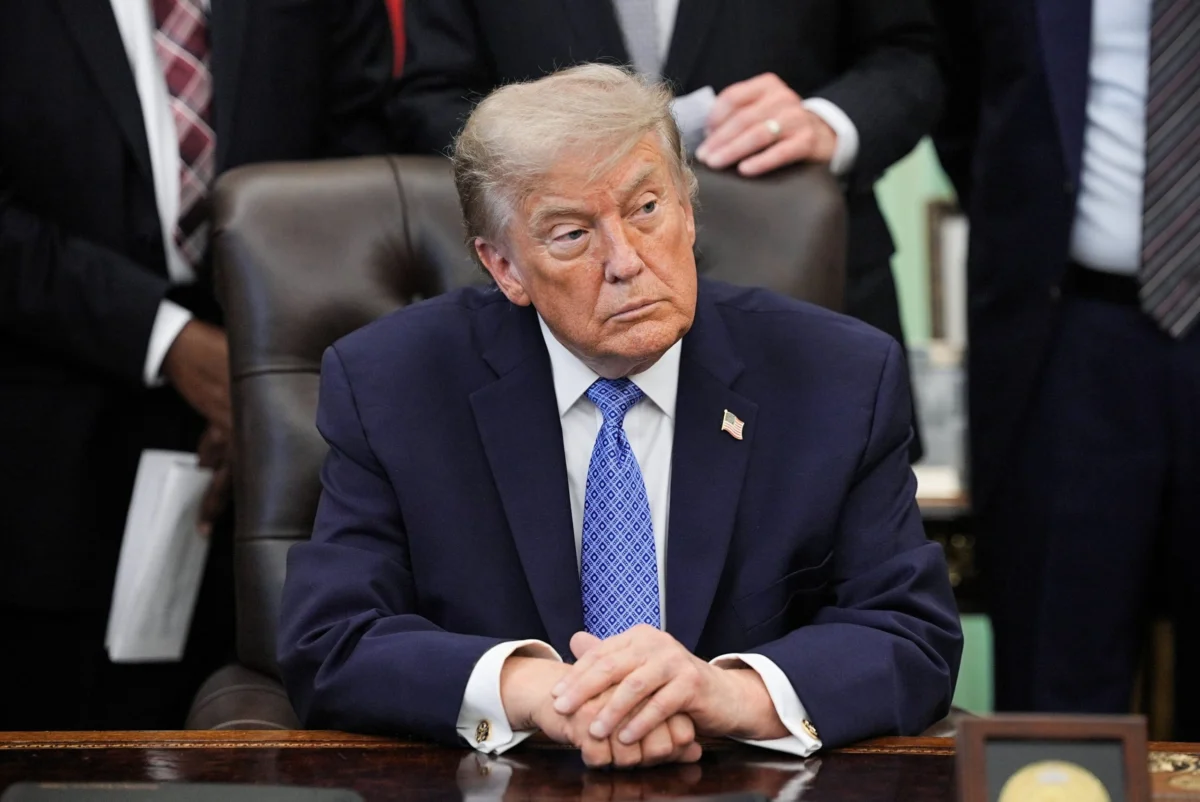
President Donald Trump announced Friday his refusal to sign a landmark housing bill, the 21st Century ROAD to Housing Act, which had sailed through Congress with overwhelming bipartisan support. Despite his withholding of signature, the legislation was poised to automatically become law at 12:01 a.m. ET Saturday, underscoring a rare constitutional mechanism and highlighting a deep political rift between the executive branch and parts of the legislative body. Trump explicitly stated his inaction was a direct protest against the Senate’s failure to advance his controversial election security initiative, the SAVE America Act.
The president’s decision, communicated via a post on his Truth Social platform, did not constitute a veto, a crucial distinction under constitutional law. Article I, Section 7 of the U.S. Constitution stipulates that if the President does not return a bill to Congress within 10 days (excluding Sundays) of receiving it, it "shall be a Law, in like Manner as if he had signed it," unless Congress by their adjournment prevents its return, in which case it does not become law (a "pocket veto"). With Congress still in session, the housing bill’s passage into law was assured regardless of presidential endorsement. The White House, when pressed by reporters on the possibility of a veto, simply directed inquiries back to the president’s Truth Social declaration.
The "21st Century ROAD to Housing Act": A Bipartisan Effort to Address Soaring Costs
The "21st Century ROAD to Housing Act" (formally H.R. 6644) represents one of the most significant bipartisan legislative achievements in recent memory aimed at tackling the nation’s escalating housing affordability crisis. The bill was designed with two primary objectives: to lower costs for prospective homebuyers and to curb the increasingly dominant influence of institutional investors in the residential real estate market. Its passage reflected a broad consensus across the political spectrum that the current housing landscape is untenable for many American families.
In the House of Representatives, the bill garnered a resounding 358-32 vote in favor, demonstrating a rare alignment of Democrats and Republicans. The Senate echoed this sentiment, approving the measure by an equally impressive 85-5 margin. These voting figures are critically important, as they far exceed the two-thirds supermajority required in both chambers to override a presidential veto. Had President Trump opted for a direct veto, it would have been swiftly overridden, rendering his action largely symbolic in terms of the bill’s ultimate fate. This context highlights that his choice to withhold a signature was a tactical protest rather than an attempt to prevent the bill from becoming law.
The urgency behind the housing bill is underscored by recent economic data. Just one day prior to Trump’s announcement, the National Association of Realtors (NAR) reported that home prices in the preceding month had reached the highest level on record. The median price of an existing home sold in June was reported at an astonishing $440,600, marking a 1.8% increase from the previous year. This continuous upward trajectory in housing costs has placed immense financial strain on millions of Americans, making homeownership an increasingly distant dream for many and driving up rental prices across the country. The bill aimed to alleviate some of this pressure by, among other things, limiting the bulk purchasing of single-family homes by large investment firms, a practice that critics argue inflates prices and reduces inventory for individual buyers.
The "SAVE America Act": A Contentious Election Security Push
President Trump’s decision to leverage the housing bill as a protest vehicle stems from his deep frustration over the stalled "SAVE America Act," a piece of legislation he has championed as a critical measure for election integrity. This proposed bill seeks to introduce stringent new requirements for voting in U.S. elections, primarily mandating photo identification for all voters casting a ballot and requiring proof of citizenship for voter registration. The stated aim of the SAVE America Act is to reduce the possibility of non-citizens participating in federal elections.
However, the necessity and impact of the SAVE America Act have been subjects of intense debate. While it is indeed illegal for non-citizens to vote in federal elections, extensive research by non-partisan organizations and academic institutions has consistently shown that instances of non-citizens casting ballots are extraordinarily rare and statistically insignificant in the context of overall election results. Critics of the bill argue that such measures disproportionately disenfranchise eligible voters, particularly minorities, the elderly, and low-income individuals who may face greater hurdles in obtaining the required documentation. They contend that the bill is a solution in search of a problem, designed more to energize a specific political base than to address a widespread threat to election integrity.
Trump’s advocacy for the SAVE America Act has become a central pillar of his political agenda, particularly ahead of the upcoming midterm elections. He has repeatedly pressured his fellow Republicans in Congress to prioritize its passage, viewing it as essential for restoring public confidence in the electoral system. His frustration with the Senate’s inability to pass the bill led to his prior cancellation of a scheduled signing ceremony for the housing bill in June, signaling his intent to use other legislative processes as bargaining chips.
Chronology of a Political Gambit
The events leading to Friday’s announcement unfolded over several weeks, revealing a calculated political strategy by the former president:
- Early June: The 21st Century ROAD to Housing Act passes both chambers of Congress with overwhelming bipartisan majorities, signaling strong legislative momentum and broad public support.
- June 24th: President Trump abruptly cancels a scheduled signing ceremony for the housing bill. At the time, sources close to the administration indicated this was due to his growing discontent with the Senate’s inaction on the SAVE America Act, though no formal statement was issued. This initial cancellation served as a warning shot.
- July 9th: The National Association of Realtors releases its report detailing record-high home prices, intensifying public and political focus on the housing crisis and the urgency of the housing bill.
- July 10th (Friday): President Trump issues a defiant post on Truth Social, declaring: "I will not sign the Housing Bill, which has been fully approved by Congress and sent to the White House, in PROTEST over the fact that the United States Senate is not capable of passing THE SAVE AMERICA ACT." He further lambasted the Senate’s inaction, calling it "CRAZY" and a "serious threat to any politician who votes against it!" He also made unsubstantiated claims about the SAVE America Act’s broad public support, contradicting recent polls that showed voter uncertainty or outright opposition to some of its provisions.
In his Friday post, Trump escalated his demands, explicitly calling on Senate Republicans to eliminate the legislative filibuster rules to facilitate the passage of the SAVE America Act and other GOP priorities. The filibuster, a procedural tool, typically requires 60 votes to advance most legislation in the 100-member Senate, rather than a simple 51-vote majority. Senate Republican leaders have historically defended the filibuster, viewing it as a crucial mechanism for protecting the minority party’s voice and fostering compromise. Senate Majority Leader John Thune (R-S.D.) publicly stated last month that there is insufficient support within the GOP caucus to both eliminate the filibuster and push through the SAVE America Act, even with the Republican party holding a 53-47 majority. A handful of GOP lawmakers have openly expressed reservations or opposition to the election bill, further complicating its path.
Official Responses and Broader Implications
Democrats were quick to seize upon Trump’s protest, portraying it as further evidence of his indifference to the everyday financial struggles of American families. Senate Minority Leader Chuck Schumer (D-N.Y.) took to X (formerly Twitter), stating, "Millions of Americans are being crushed by housing costs. Donald Trump called their crisis ‘a big yawn’ – then refused to sign the most significant bipartisan housing bill in decades." Schumer’s reference to "a big yawn" harked back to previous comments attributed to the president regarding the severity of the housing crisis. He concluded, "His priorities couldn’t be clearer: higher costs for families and more power for himself." Similarly, Rep. Jason Crow (D-Colo.) posted, "The rising cost of mortgages and rent are hitting Americans hard. Yet Trump refuses to act."
Housing advocacy groups, while relieved the bill would still become law, expressed disappointment in the President’s approach. "The housing crisis demands urgent action, not political theater," stated a representative from the National Housing Coalition. "While we celebrate the 21st Century ROAD to Housing Act becoming law, the President’s tactic of withholding his signature sends a troubling message about prioritizing partisan battles over the tangible needs of the American people." Economists largely concurred with the need for the bill, noting that while it wouldn’t be a silver bullet, it represented a step in the right direction to address market imbalances exacerbated by institutional investment and supply shortages.
The broader implications of Trump’s action are multifaceted.
- Constitutional Precedent and Presidential Power: While not a veto, the act of deliberately allowing a bill to become law without signature as a form of protest is a relatively rare presidential maneuver. It highlights the constitutional framework where Congress can legislate effectively even without presidential endorsement, particularly for measures with strong bipartisan backing. This mechanism is distinct from a "pocket veto," which can only occur when Congress adjourns, preventing the President from returning the bill. In this case, with Congress in session, the bill automatically becomes law.
- Political Strategy and Leverage: Trump’s tactic serves as a stark demonstration of his willingness to use any available leverage to advance his political agenda. By making a popular bipartisan bill a hostage to his demands for the SAVE America Act, he aimed to exert maximum pressure on Senate Republicans. This strategy could set a precedent for future legislative battles, potentially complicating the passage of future bipartisan initiatives if they become entangled in unrelated political disputes.
- Midterm Election Dynamics: The incident injects fresh fuel into the narratives shaping the upcoming midterm elections. Democrats will undoubtedly amplify Trump’s perceived indifference to housing costs, aligning with their broader messaging on affordability. Republicans, meanwhile, face the delicate task of balancing their support for Trump’s election integrity efforts with the practical realities of governing and addressing pressing economic concerns like housing. The internal GOP struggle over the filibuster and the SAVE America Act further complicates their electoral strategy.
- The Filibuster Debate: Trump’s renewed call to eliminate the filibuster reignites a perennial debate within the Senate. While many Republicans defend the filibuster as a guardrail against bare-majority tyranny, a growing faction, often aligned with Trump, sees it as an impediment to enacting conservative priorities. The standoff over the SAVE America Act, therefore, is not just about election law but also about the fundamental rules governing the Senate’s legislative process.
- Public Perception and Trust: The episode may also influence public perception of political efficacy. Voters grappling with high housing costs may view the political maneuvering as an unnecessary distraction, potentially eroding trust in the ability of elected officials to prioritize their needs above partisan squabbles. Conversely, those deeply concerned about election integrity may see Trump’s actions as a courageous stand.
In conclusion, while the 21st Century ROAD to Housing Act is now officially law, President Trump’s refusal to sign it has cast a long shadow over its enactment. His protest, rooted in the contentious debate surrounding the SAVE America Act and the Senate’s filibuster rules, underscores the deep ideological and procedural divisions plaguing Washington. As the nation heads into a crucial midterm election cycle, this political maneuvering highlights the ongoing struggle for legislative control and the strategic use of presidential power, even in inaction, to shape the national agenda.
