

In the late 1990s, the city of Markham, Ontario, stood at a critical crossroads common to many North American municipalities: the era of unchecked suburban sprawl was clashing with the emerging realities of climate change and the urgent need for more efficient urban planning. As the city expanded, its leadership recognized that continuing with status quo development—characterized by individual heating and cooling systems for every building—would lead to long-term energy inefficiencies and a lack of flexibility in the face of a shifting energy landscape. In 1999, Markham’s city councillors made a visionary decision to invest in a district energy system for its burgeoning downtown core. This move shifted the paradigm from building-specific infrastructure to a shared, centralized energy network designed to scale in tandem with the city’s growth.
Today, nearly a quarter-century since that initial investment, the results of Markham’s pivot are physically embedded in the city’s geography. Thousands of meters of insulated pipes are buried beneath the streets, carrying hot and chilled water from central energy plants to a massive network of connected buildings. This system now services more than 14 million square feet of commercial and residential development. What began as a strategic gamble has evolved into a cornerstone of the city’s infrastructure, delivering a faster transition to clean energy, improving long-term reliability, and providing a level of resilience that individual building systems cannot match.
The Centralized Advantage: Future-Proofing Urban Infrastructure
The core philosophy behind district energy is the separation of energy production from energy consumption. In a traditional urban setup, every office tower or condominium must maintain its own boilers, chillers, and cooling towers. This not only consumes significant physical space within each building but also locks those buildings into specific technologies for the lifespan of the equipment, which can be 20 to 30 years.
District energy systems, such as the one operated by Markham District Energy (MDE), consolidate this equipment into centralized plants. This centralization allows for much higher efficiency and, perhaps more importantly, the ability to upgrade technology at scale. Peter Ronson, the Chief Operating Officer of Markham District Energy, notes that centralized plants allow the city to adopt new, greener technologies long before an individual building owner might be willing or able to do so. When the central plant upgrades to a more efficient heat pump or integrates a renewable energy source, every building connected to the network benefits instantly without needing to undergo its own expensive retrofit. This "plug-and-play" capability ensures that the entire downtown core can transition toward a lower carbon footprint in a synchronized manner.
Canada’s Standing in the Global Energy Landscape
While Markham’s success is a beacon for domestic urban planning, Canada as a whole has historically lagged behind other regions in the adoption of shared community energy. In Europe, particularly in Scandinavian countries like Denmark and Sweden, district energy is the standard rather than the exception. In cities like Copenhagen, nearly 98% of buildings are connected to a district heating network, a factor that has been instrumental in the city’s goal to become carbon neutral. Similar trends are seen in the Middle East and parts of Asia, where district cooling is a vital component of urban resilience in hot climates.
However, the tide is beginning to turn in Canada as more municipalities recognize the economic and environmental imperatives. Beyond Markham, other Canadian cities are demonstrating the viability of this model. For instance, Yellowknife in the Northwest Territories has implemented a district energy system that leverages local biomass, a move that is projected to save the city up to $160,000 annually in energy costs while significantly reducing its reliance on imported heating oil. These projects illustrate that district energy is not merely a solution for large metropolitan centers but is also a scalable tool for smaller communities looking to achieve energy independence and cost stability.
Overcoming the Financial Hurdles of District Energy
The primary barrier to the widespread adoption of district energy is not technological, but financial. These systems are capital-intensive, requiring massive upfront investment for central plants and the underground distribution network before the first building is even connected. This "front-loaded" cost structure can be a deterrent for municipal governments with limited budgets and for private developers focused on short-term returns.
This is where the Federation of Canadian Municipalities (FCM) and its Green Municipal Fund (GMF) play a transformative role. The GMF serves as a de-risking mechanism, providing the patient capital—in the form of grants and low-interest loans—necessary to get first-phase systems off the ground. In the case of Markham, the GMF has been a consistent partner for over two decades, providing more than $17 million in funding. This early-stage support allowed Markham to prove the viability of the system, which in turn attracted significantly larger tranches of private and institutional capital.
The financial trajectory of Markham’s system is a testament to its "bankability." Since its inception, the utility has attracted more than $270 million in additional capital from sources including the Canada Infrastructure Bank (CIB) and the Canadian Imperial Bank of Commerce (CIBC). By providing the initial feasibility studies and business case data, the GMF ensures that by the time a project is ready for large-scale investment, the risks are clearly allocated and the return potential is evidenced by hard data.

Resilience in the Face of Climate Volatility
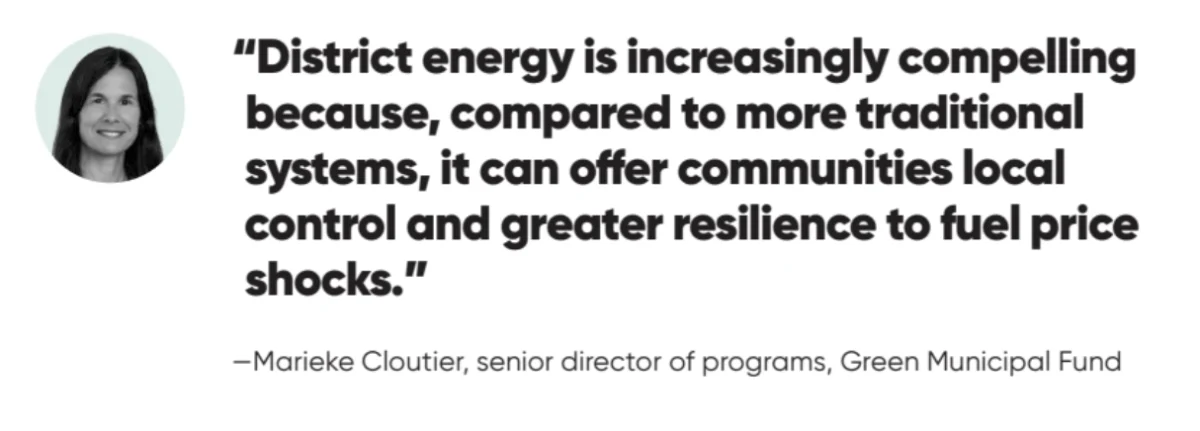
As climate change increases the frequency and severity of extreme weather events, the concept of "resilience" has moved to the forefront of municipal planning. Traditional electrical grids and individual building systems are often vulnerable to energy shocks, fuel price volatility, and physical damage from storms.
District energy systems offer a robust alternative. Because these networks can draw from multiple energy sources—including natural gas, electricity, biomass, and even waste heat—they are inherently more flexible. If one fuel source is disrupted, the central plant can often pivot to another. Furthermore, the equipment used in centralized plants is typically of a higher industrial grade than what is found in individual buildings, and it is maintained by professional stationary engineers around the clock.
Gerard MacDonald, a principal at Reshape Infrastructure Strategies, points out that district energy systems around the world have proven their worth during disasters ranging from ice storms to hurricanes. By reducing the overall demand on the electrical grid—especially during peak cooling or heating periods—district energy also helps prevent the kind of grid overloads that lead to blackouts. In an era of increasing uncertainty, this centralized reliability is a significant asset for any city’s economic and social stability.
Innovative Frontiers: Harvesting Heat from the Sewers
Markham’s commitment to innovation continues as it expands its network. The city currently operates two distinct systems with four energy plants and is in the process of commissioning a fifth. This new facility represents the next frontier of urban energy: wastewater energy recovery.
The new plant will utilize a heat exchanger and industrial-grade heat pumps to extract thermal energy from a large sanitary sewer that runs adjacent to the facility. This "sewer heat" is a consistent, renewable resource that would otherwise be wasted. By capturing this warmth and pumping it back into the district energy loop, Markham will further reduce its carbon footprint and improve the overall efficiency of its heating network. This project serves as a practical example of the "circular economy," where urban waste products are repurposed to meet the city’s essential needs.
The Public Interest and the Bottom Line
Ultimately, the shift toward district energy is a matter of public interest. While the environmental benefits of decarbonization are clear, the economic benefits for the end-user are equally compelling. District energy systems provide long-term price stability, protecting residents and businesses from the volatile fluctuations of global fuel markets.
"It’s in the public interest to go the route of district energy because it’s lower cost, it can be low-carbon, and it’s not going to break the utility rate," says Gerard MacDonald. For investors, the appeal lies in the "forever" nature of the infrastructure. Once a building is connected to a district energy system, it becomes part of a permanent utility network, providing stable, long-term revenue streams that mirror traditional utilities but with a much higher growth ceiling in densifying urban areas.
A Blueprint for the Rest of Canada
The story of Markham’s 25-year evolution from a sprawling suburb to a leader in thermal energy networks provides a blueprint for other Canadian municipalities. As the federal government pushes toward its 2050 net-zero targets, the decarbonization of the building sector—which accounts for roughly 13% of Canada’s greenhouse gas emissions—is a top priority.
The success of the Green Municipal Fund in de-risking these projects suggests that the model is ready for national expansion. With approximately $2.4 billion in programs funded by the Government of Canada, the GMF is positioned to help more cities navigate the complex transition from feasibility studies to large-scale infrastructure deployment.
As cities like Markham continue to push the boundaries of what is possible—from sewer heat recovery to massive private-sector partnerships—the narrative around urban energy is changing. It is no longer just about how we heat or cool a single room, but how we power entire communities in a way that is sustainable, affordable, and resilient enough to withstand the challenges of the 21st century. The pipes beneath Markham are more than just conduits for water; they are the arteries of a modern, future-proof city.
