

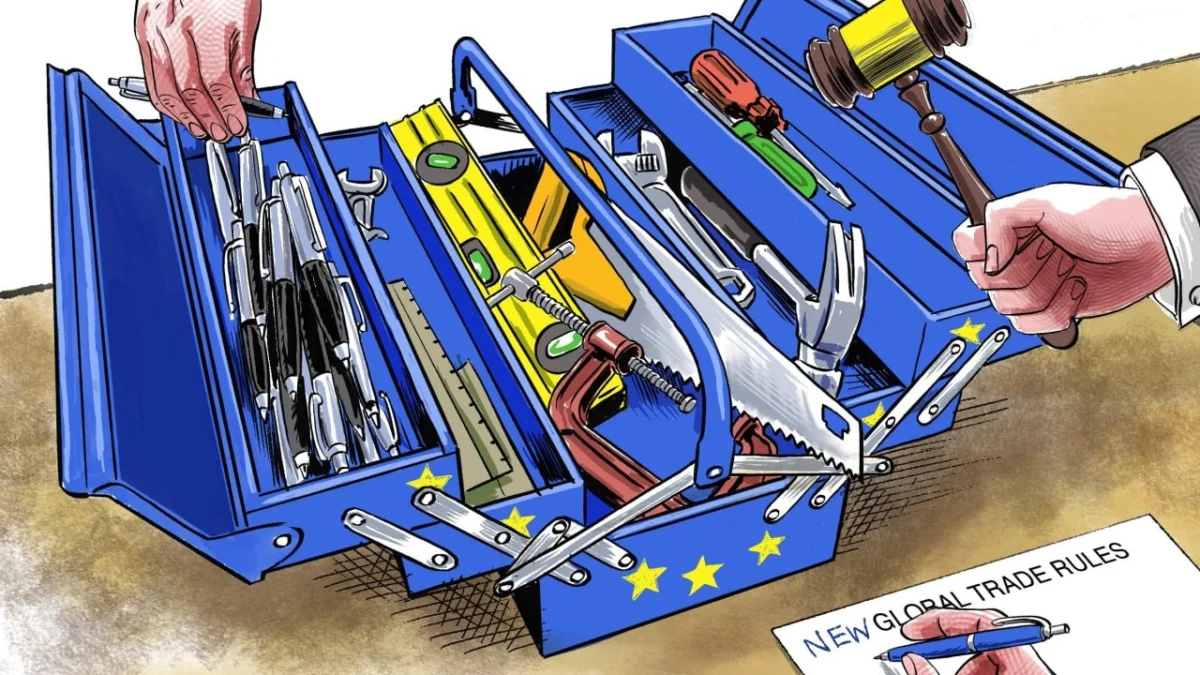
At the conclusion of the most recent Brussels summit, the heads of state and government from all 27 European Union member states issued a collective mandate to the European Commission, urging a significant expansion and fortification of the bloc’s trade defense mechanisms. This strategic pivot is aimed directly at addressing what the European Council describes as "global macroeconomic imbalances," a term that diplomatic and economic analysts widely interpret as a reference to China’s burgeoning industrial overcapacity. The move signals a watershed moment in European trade policy, marking a transition from a historically open-market stance toward a more assertive, protectionist framework designed to shield domestic industries from a flood of low-cost imports.
The measures currently under deliberation within the halls of the Berlaymont building include innovative mechanisms for sector-wide tariffs and stringent administrative restrictions. These tools are being tailored to protect critical sectors such as the chemical industry and the green technology sector—encompassing electric vehicles (EVs), solar panels, and wind turbines—which the EU views as vital to its future economic sovereignty and the success of the European Green Deal. For decades, European leaders were among the most vocal critics of unilateral trade actions, particularly the United States’ use of Section 301 tariffs. However, the current geopolitical climate has seen Brussels considering instruments that increasingly mirror the very American policies they once disparaged.
The Evolution of Trade Philosophy: From Multilateralism to Defense
The shift in the European Union’s approach reflects a broader global retreat from the neoliberal consensus that dominated the late 20th and early 21st centuries. For over thirty years, the United States and Europe were the primary architects of a global trading system anchored in multilateral rules, the principle of comparative advantage, and the integration of global supply chains. During this era, Western capitals consistently pressured Beijing to liberalize its domestic markets, reduce tariff barriers, facilitate foreign direct investment, and adhere to international intellectual property standards.
The underlying theory was that by integrating China into the World Trade Organization (WTO) in 2001, the global economy would benefit from a more efficient distribution of labor and resources. However, as industrial competition has intensified, the narrative has shifted. Today, European governments are increasingly preoccupied with the specter of deindustrialization. The vulnerabilities of global supply chains, exposed first by the COVID-19 pandemic and later by the energy crisis following the invasion of Ukraine, have sparked a re-evaluation of technological dependence.
In Washington, the response has been characterized by aggressive tariffs and massive industrial subsidies under the Inflation Reduction Act (IRA). In Brussels, this has translated into the "de-risking" strategy championed by European Commission President Ursula von der Leyen. Protectionism, once a fringe economic theory in the West, has returned to the mainstream as a tool for managing the political consequences of economic dislocation and ensuring national security.
The Overcapacity Debate: Competitive Edge or Market Distortion?
At the heart of the current friction is the debate over "overcapacity." The European Union and the United States argue that China’s state-led economic model has resulted in production levels that far exceed domestic demand, leading to a "dumping" of excess goods on global markets at prices that Western firms cannot match.
Conversely, Chinese officials and some economic analysts argue that "overcapacity" is a misnomer used to mask Western protectionism. From Beijing’s perspective, the growth of China’s manufacturing sector is the result of decades of strategic investment, infrastructure development, and the creation of massive industrial clusters. They contend that Chinese products in the "Three New" industries—electric vehicles, lithium-ion batteries, and solar products—are competitive not because of unfair subsidies, but due to scale, market discipline, and manufacturing expertise.
China maintains that it has followed the very roadmap laid out by its trading partners: it opened its economy, integrated into global supply chains, deregulated various sectors, and strengthened intellectual property protections to meet international standards. The current friction, Beijing argues, is a reaction to China’s success in moving up the value chain, transitioning from a producer of low-end textiles to a leader in high-tech green energy solutions.
Chronology of Escalating Tensions (2001–2024)
The trajectory of EU-China trade relations has moved from cooperation to systemic rivalry over the last two decades:
- 2001: China joins the World Trade Organization (WTO), beginning a period of rapid export-led growth.
- 2016: The EU declines to grant China "Market Economy Status," a designation that would have made it harder to impose anti-dumping duties.
- 2019: The EU officially labels China a "systemic rival" and an "economic competitor" in a strategic outlook paper.
- 2020: The EU and China reach an "agreement in principle" on the Comprehensive Agreement on Investment (CAI), intended to level the playing field.
- 2021: The CAI is frozen by the European Parliament following a series of tit-for-tat sanctions related to human rights concerns in Xinjiang.
- 2023: Ursula von der Leyen delivers a landmark speech on "de-risking," and the EU launches an anti-subsidy investigation into Chinese electric vehicles.
- 2024: The Brussels Summit sees all 27 leaders call for an expansion of the trade defense toolbox, citing macroeconomic imbalances and overcapacity.
Supporting Data: The Scale of the Imbalance
The urgency in Brussels is driven by stark economic data. The EU’s trade deficit with China has expanded significantly over the past decade, reaching a record peak of nearly €400 billion in 2022 before slightly moderating.
In the automotive sector, the stakes are particularly high. European carmakers, who once dominated the Chinese market through joint ventures, now face a dual threat: losing market share in China and facing stiff competition at home. According to industry data, Chinese EV brands’ share of the European market rose from less than 1% in 2019 to nearly 8% in 2023, with projections suggesting it could reach 15% by 2025 if current trends continue.
The solar industry serves as a cautionary tale for European policymakers. In the early 2010s, Europe was a leader in solar cell manufacturing. However, a surge in low-cost Chinese production saw European manufacturers collapse. Today, China accounts for over 80% of the global manufacturing capacity for all solar panel manufacturing stages. Brussels is determined to prevent a similar outcome in the wind and EV sectors.
Official Responses and Divergent Views
The call for a tougher trade stance has met with a variety of responses across the continent and beyond.
The European Commission: President Ursula von der Leyen has been the primary driver of this shift. Following the summit, Commission officials emphasized that the EU prefers a rules-based system but will not hesitate to act if "fairness" is compromised. "The world cannot absorb China’s surplus production," von der Leyen stated recently. "Europe will be firm in defending its industries and its workers."
Beijing’s Reaction: The Chinese Ministry of Commerce has repeatedly criticized the EU’s moves as "typical protectionism." A spokesperson for the ministry stated that the EU’s investigations into Chinese EVs and wind turbines lack "factual basis" and violate WTO rules. Beijing warns that these measures will disrupt global supply chains and slow down the global transition to green energy.
Member State Dynamics: While the 27 leaders were unanimous in their call to the Commission, internal divisions remain regarding the intensity of the response. France has been a vocal proponent of aggressive trade defense, seeking to protect its domestic auto industry. In contrast, Germany, with its heavy industrial investments in China and reliance on Chinese consumers for its luxury car brands, has been more cautious, fearing retaliatory measures that could cripple its export-oriented economy.
Analysis of Implications: A High-Stakes Balancing Act
The expansion of the EU’s trade defense toolbox carries significant implications for the global economy and the fight against climate change.
First, there is the risk of a trade war. If the EU imposes broad tariffs on Chinese chemicals or green technology, Beijing is likely to retaliate. Potential targets for Chinese counter-measures include European agricultural products (such as French wine or cognac), luxury goods, and high-end machinery. Such a cycle of escalation could stifle economic growth at a time when the global recovery remains fragile.
Second, the EU faces a "green dilemma." The bloc has set ambitious targets to become carbon-neutral by 2050. Achieving these goals requires a massive and rapid deployment of solar panels, wind turbines, and EVs. Chinese manufacturers currently provide the most cost-effective path to meeting these targets. By imposing tariffs and driving up the price of these technologies, the EU may protect its industrial base but simultaneously slow down its energy transition and increase costs for European consumers.
Finally, the move signals the end of the "Golden Era" of EU-China relations. The relationship is now defined by "de-risking"—a strategy of reducing dependencies on China for critical minerals and technologies while maintaining trade in non-sensitive sectors. However, defining what is "sensitive" in an era of "dual-use" technology is becoming increasingly difficult.
As the European Commission begins the technical work of expanding the trade defense toolbox, the global community will be watching closely. The decisions made in Brussels over the coming months will not only shape the future of European industry but will also determine the rules of engagement for international trade in the 21st century. The challenge for the EU will be to find a path that ensures economic security and industrial survival without retreating into a fortress-like isolationism that could undermine the very global stability it seeks to preserve.
