

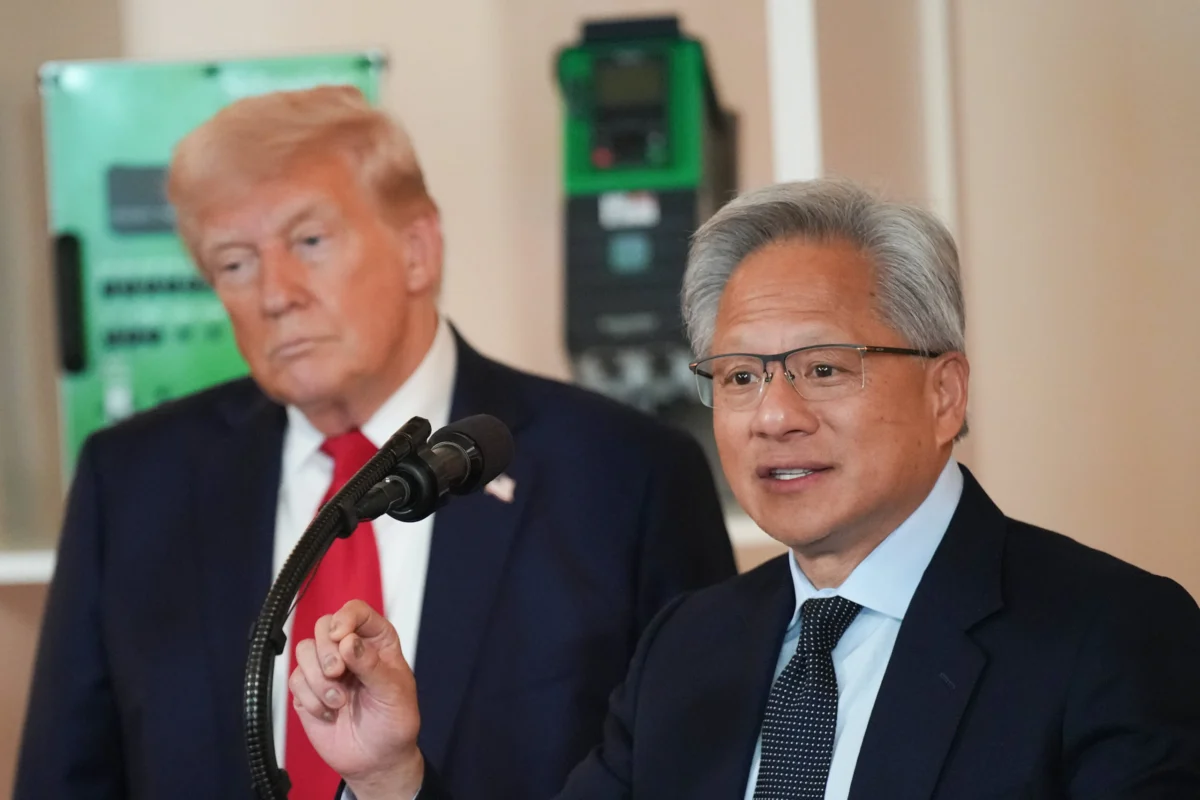
BEIJING – Nvidia CEO Jensen Huang, a figurehead of the global artificial intelligence revolution, is notably absent from the high-stakes U.S. presidential delegation accompanying Donald Trump to China this week, an omission that underscores the escalating technological and geopolitical tensions between the two economic superpowers. Despite Huang’s prior expressions of honor at the prospect of representing the United States on such a mission, his exclusion from the closely watched visit, which includes prominent U.S. executives like Apple’s Tim Cook, Tesla’s Elon Musk, and Qualcomm’s Cristiano Amon, signals a stark reality: Nvidia’s significant sales in China, once a cornerstone of its data center revenue, are unlikely to see a swift recovery amidst tightening U.S. export controls.
The U.S. President’s visit to Beijing, marking the first by a sitting U.S. president in nearly a decade, is anticipated to focus on a myriad of complex issues ranging from trade imbalances and geopolitical stability to regional security concerns and the future of technological dominance. While the delegation includes leaders from sectors poised for potential breakthroughs, such as Boeing’s Kelly Ortberg, who is reportedly close to securing a major Chinese order after years of strained relations, the absence of a titan like Huang from Nvidia speaks volumes about the intractable nature of the semiconductor dispute.
The Strategic Significance of Huang’s Exclusion
Jensen Huang’s absence is not merely a logistical detail; it is a profound symbolic indicator of the entrenched difficulties faced by Nvidia in its second-largest market. China previously accounted for at least one-fifth of Nvidia’s lucrative data center revenue, a segment that has been the primary driver of the company’s meteoric rise due to the insatiable demand for its high-performance graphics processing units (GPUs) essential for AI model training. The company’s most advanced chips, including the A100 and H100 series, have been subject to stringent U.S. export controls since late 2022, designed to impede China’s progress in advanced AI and supercomputing capabilities.
Nvidia has consistently navigated these restrictions by developing modified, less powerful versions of its chips, such as the A800 and H800, specifically tailored to comply with U.S. Commerce Department regulations. However, even these compliant versions faced further tightening, with new controls in October 2023 requiring export licenses for a broader range of semiconductors. In February 2026, the company confirmed that U.S.-government-approved versions of its chips, including newer products like the H20, L20, and L2, had yet to be cleared for sale into the Chinese market. This regulatory quagmire has left Nvidia in a precarious position, struggling to serve a vital customer base while adhering to an increasingly restrictive U.S. policy framework.
A History of Engagement Amidst Rising Tensions
Despite the current impasse, Jensen Huang has maintained a proactive stance in engaging with the Chinese market. Over the past 18 months, Huang has made multiple visits to China, including a highly publicized trip last summer where he reportedly engaged with local employees and partners, underscoring Nvidia’s commitment to sustaining its presence and relationships in the region. These visits, often characterized by a "charm offensive," highlighted Nvidia’s efforts to balance compliance with Washington’s dictates and its commercial interests in Beijing. The goal was to signal long-term commitment and explore avenues for legal, compliant sales, even as the regulatory landscape grew more challenging.
However, the current presidential delegation appears to be a different kind of diplomatic and commercial endeavor, one where the U.S. administration selectively curates attendees to align with its strategic objectives. The inclusion of executives from companies like Qualcomm, which supplies chips for smartphones and other consumer electronics, and Boeing, which deals in large-scale commercial aircraft, suggests a focus on sectors where U.S. companies either have clear regulatory pathways or where significant, tangible trade deals can be announced to demonstrate progress during the summit. For Nvidia, with its core products at the heart of the U.S.-China tech rivalry, such clear pathways currently do not exist.
The Broader Context of U.S.-China Tech Decoupling
The expert consensus reinforces the grim outlook for Nvidia’s immediate prospects in China. Hao Hong, chief investment officer at Lotus Asset Management, articulated this perspective on CNBC’s "The China Connection," stating that there would be "very little" for Nvidia to gain in terms of deliverables if Huang were part of Trump’s delegation. Hong emphasized the unlikelihood of the Trump administration approving the sale of more advanced Nvidia chips to China, predicting an intensification of technology "decoupling" between the two nations.

"I think China realized that the tech rivalry between the two countries will be one of the key determinant factors going forward to determine the relative competitive position in the global geopolitics between the two countries," Hong remarked, capturing the strategic depth of the current standoff. This sentiment reflects Beijing’s accelerating efforts towards technological self-sufficiency, particularly in semiconductors, spurred by the U.S. restrictions. Companies like Huawei, with its Ascend series, and other domestic players are heavily investing in developing indigenous AI chips to reduce reliance on foreign technology, a trend that poses a long-term threat to Nvidia’s market share even if restrictions were to ease.
A Chronology of Escalating Controls
The current situation is the culmination of a series of actions taken by the U.S. government to restrict China’s access to advanced semiconductor technology.
- October 2022: The U.S. Commerce Department announces sweeping export controls, including restrictions on the sale of advanced AI chips (like Nvidia’s A100 and H100) and chip manufacturing equipment to China, citing national security concerns. Nvidia subsequently introduces modified chips (A800, H800) designed to fall below the performance thresholds defined by the regulations.
- Summer 2023: Jensen Huang undertakes a high-profile visit to China, engaging with local businesses and government officials, signaling Nvidia’s intent to remain a key player in the market despite restrictions.
- October 2023: The U.S. Commerce Department revises and expands its export controls, further tightening the performance thresholds for AI chips and requiring licenses for a broader range of semiconductor exports to China. This move effectively closes loopholes and impacts Nvidia’s A800 and H800 chips.
- Early 2024: Nvidia announces new "compliant" chips for the Chinese market, including the H20, L20, and L2, designed to meet the revised export control specifications. These chips offer significantly reduced performance compared to their unrestricted counterparts.
- February 2026: Nvidia publicly states that its new U.S.-government-approved versions of chips for China have yet to be allowed into the market, indicating ongoing regulatory hurdles and delays.
- May 2026: Jensen Huang confirms his availability and willingness to join the presidential delegation if invited, but is ultimately not included in the list of executives for the Beijing summit.
Economic Ramifications and Market Dynamics
The financial impact on Nvidia, while not crippling given its global dominance and soaring demand elsewhere, is significant. China’s market for AI infrastructure remains immense, driven by rapid advancements in large language models and other AI applications. Losing a substantial portion of this market forces Nvidia to reallocate resources and focus more heavily on other regions, potentially increasing competition in those markets.
Furthermore, the restrictions have spurred the growth of domestic Chinese AI chip manufacturers. While these firms currently lag behind Nvidia in terms of performance and ecosystem maturity, the sustained pressure from U.S. sanctions provides a strong impetus for indigenous innovation. Companies like Huawei’s HiSilicon, Alibaba’s T-Head, and Biren Technology are aggressively developing their own AI accelerators, aiming to capture the domestic market. This dynamic not only impacts Nvidia’s sales but also contributes to the long-term strategic goal of tech sovereignty for China, potentially creating a bifurcated global AI chip market.
For the broader U.S. tech sector, the situation with Nvidia serves as a cautionary tale. While some companies, like Qualcomm and Apple, continue to thrive in China through different product categories or less sensitive technologies, the precedent set by AI chip restrictions highlights the vulnerability of U.S. firms heavily invested in technologies deemed critical for national security by either government. The ongoing trade negotiations and the summit’s outcomes will be closely watched for any indications of future policy directions that could further impact other sectors.
Statements and the Path Forward
Jensen Huang’s prior statements to CNBC’s Jim Cramer last week reflected a pragmatic acceptance of the political realities: "We should let the president announce whatever he decides to announce… If invited, it would be a privilege, it would be a great honor to represent the United States." This measured response underscores Nvidia’s position of compliance and deference to U.S. policy, even as it navigates complex commercial waters.
The White House, in confirming the list of executives, has not offered specific commentary on Huang’s absence, instead focusing on the overall objectives of the delegation and the breadth of industries represented. The selection of executives from sectors like aviation (Boeing) and consumer electronics (Apple, Tesla) suggests a focus on areas where the U.S. administration sees potential for immediate trade concessions or symbolic gestures of cooperation, rather than engaging directly with the most contentious aspects of the tech rivalry.
As President Trump prepares to arrive in Beijing late on Wednesday local time for two days of meetings with President Xi Jinping, the focus will be on the concrete outcomes of the summit. While breakthroughs on tariffs, rare earths, or even the geopolitical situation in Iran might be discussed, any significant easing of advanced technology export controls, particularly concerning AI chips, seems highly improbable. The absence of Jensen Huang is not just a footnote; it is a clear signal that the technological "iron curtain" between the U.S. and China, at least in the realm of cutting-edge AI, continues to descend, with profound implications for global commerce, innovation, and strategic competition.
