

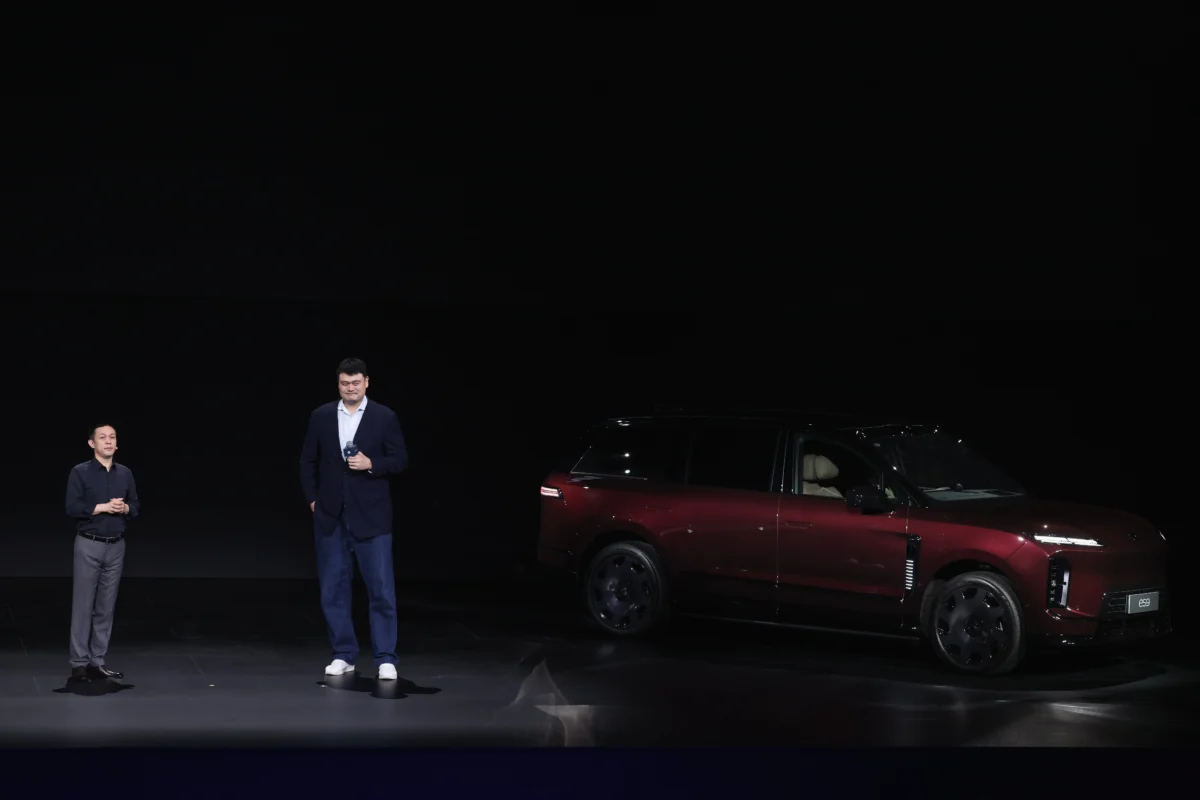
Chinese electric vehicle (EV) manufacturer Nio officially unveiled its ES9 SUV on May 27, 2026, marking a significant move to elevate its premium market standing. The launch was accompanied by the announcement that former NBA superstar Yao Ming would serve as a brand representative, lending considerable star power to Nio’s latest offering, which CEO William Li Bin proudly presented as China’s largest SUV. This strategic unveiling, which saw Nio’s Hong Kong-listed shares surge by as much as 10.45% and its U.S.-listed stock close 9.32% higher overnight, extending gains for 2026, comes as the company navigates a profoundly competitive and rapidly evolving domestic automotive landscape.
The ES9, with a starting price of 390,000 yuan ($57,470) under Nio’s innovative battery subscription model, aims to redefine luxury and utility in the burgeoning SUV segment. This model, which separates the vehicle’s upfront cost from ongoing monthly battery payments, offers consumers flexibility and potentially lower initial investment, a critical strategy in a market increasingly sensitive to pricing. Deliveries of the ES9 commenced on Thursday, signaling Nio’s intent to quickly capitalize on market momentum generated by the launch event in Beijing.
Navigating the "Involution" of China’s EV Market
Nio’s latest gambit unfolds against the backdrop of an intense price war, often termed "involution," that has gripped China’s electric car market. This phenomenon describes a state of internal competition where increased effort and investment lead to diminishing returns, characterized by a relentless drive to lower prices and offer more features, often at the expense of profit margins. Despite repeated efforts by Beijing to curb what it perceives as excessive competition and stabilize pricing, the sector continues to witness a "race to the bottom." This fiercely contested environment is driven by several factors, including an initial surge of government subsidies that spurred a multitude of EV startups, overcapacity in manufacturing, and aggressive pricing strategies by new entrants and established players alike. The resulting market saturation has led to significant pressure on profit margins across the industry, forcing companies to constantly innovate while simultaneously cutting costs. Beijing’s attempts to guide the industry towards more sustainable growth, including consolidation and quality emphasis, have yet to fully mitigate the intense price wars, as evidenced by the continued decline in new energy vehicle (NEV) sales growth.
Sales of NEVs in China dropped by 17% in the first four months of the year, according to data from the China Passenger Car Association. This decline underscores the challenge facing manufacturers in a market where the rapid expansion years are largely perceived to be in the past, with a significant portion of potential car buyers having already made their purchases. As articulated by Nio CEO William Li, the market has matured beyond its fastest growth phase. Li emphasized that with technological features becoming increasingly standardized across various EV models, brand differentiation and a focus on "targeted premiumization" will be paramount for survival. This philosophy underpins the ES9’s positioning, aiming to attract discerning buyers who value advanced features, luxury, and a strong brand identity beyond mere price points, thereby seeking to escape the direct impact of the price war.
The ES9: A Deep Dive into Premium Features and Strategic Positioning
The Nio ES9 stands as a testament to the company’s commitment to luxury, technology, and an elevated passenger experience. CEO Li showcased an impressive array of features during the Beijing launch event, designed to appeal to a sophisticated clientele seeking both utility and indulgence. The SUV boasts advanced driver-assist systems capable of interpreting and responding to road signs with heightened precision, enhancing both safety and convenience through features like adaptive cruise control, lane-keeping assistance, and intelligent parking. Inside, passengers are treated to amenities typically found in high-end private jets, such as spacious passenger seats equipped with elegant wood-colored tables that unfold seamlessly from the seatbacks, providing a convenient surface for work or leisure. A unique and culturally resonant addition is the in-car water boiler, allowing occupants to brew tea or coffee on the go, highlighting Nio’s meticulous attention to comfort and personalized luxury for its domestic market.
Beyond these comforts, Nio has heavily invested in "smart safety" systems for the ES9. These proactive technologies are engineered to detect potential hazards in real-time and minimize impact in dangerous scenarios, leveraging a suite of sensors, cameras, and AI-powered algorithms. To underscore its commitment to safety and build consumer trust in a market where vehicle safety standards are increasingly scrutinized, Nio orchestrated a live crash test during the launch event, which was notably livestreamed by China’s state broadcaster CCTV. This public demonstration aimed to transparently showcase the ES9’s structural integrity, advanced airbag systems, and overall protective capabilities, providing tangible proof of its safety credentials.
The ES9’s pricing strategy, leveraging Nio’s established battery-as-a-service (BaaS) model, is a calculated move to offer financial flexibility and reduce the initial purchase barrier for a premium vehicle. The BaaS model allows customers to buy the vehicle without the battery pack, instead subscribing to battery services, which can include convenient battery swapping at Nio Power Swap Stations, battery upgrades as technology evolves, and a significantly lower upfront vehicle cost. This model has been a cornerstone of Nio’s strategy, addressing common EV concerns like range anxiety and battery degradation while making its vehicles more accessible to a broader premium segment.
A Shifting Competitive Landscape: From ET9 to ES9 Adaptation
Nio’s journey in the premium segment has been dynamic and responsive to market shifts. When the company launched its flagship ET9 sedan in late 2023, it was positioned aggressively at the very top of the market, with prices starting at 800,000 yuan. This move aimed to challenge ultra-luxury segments. However, the market quickly transformed with unforeseen speed and intensity. Before ET9 deliveries even began in the first quarter of 2025, consumer electronics giant Xiaomi made a significant splash with its inaugural electric car, priced drastically lower at 215,900 yuan. This aggressive entry from a tech behemoth, known for its disruption across various consumer product categories, underscored the volatility and intense competitive pressures in the Chinese EV market, forcing established players like Nio to rapidly re-evaluate their strategies and pricing. The ES9’s comparatively lower starting price, even with the BaaS model, reflects this crucial adaptation to evolving market realities and the need to offer compelling value within the premium segment.
The broader market dynamics reveal both formidable challenges and strategic opportunities for Nio. While Nio delivered 83,465 cars in the first quarter of 2026, nearly doubling its figures from a year prior, this represented a 33% drop from the fourth quarter of 2025. This fluctuation highlights the seasonal and competitive pressures on sales volumes that affect even established brands. Importantly, these delivery figures include vehicles from Nio’s lower-priced sub-brands, Onvo and Firefly, which the company introduced in the last two years. These brands are crucial to Nio’s multi-pronged strategy to address different market segments and remain competitive across a broader spectrum of China’s sluggish consumer market, diversifying its revenue streams and market penetration beyond the ultra-premium niche.
Endorsements and Brand Building: The Yao Ming Factor and Industry Backing
The selection of Yao Ming as a brand representative for the ES9 is a masterstroke in Nio’s brand-building efforts. Yao Ming, a towering figure standing at 7 feet 6 inches, is not only an international basketball legend but also a beloved national icon in China. He brings immense credibility, widespread recognition, and a powerful sense of aspirational achievement to the Nio brand. His image, synonymous with excellence, perseverance, and global success, aligns perfectly with the premium, powerful, and technologically advanced attributes Nio seeks to project for the ES9. Such high-profile endorsements are critical in the crowded Chinese market, where consumer trust, brand affinity, and purchasing decisions are heavily influenced by celebrity appeal and perceived quality. The choice of Yao Ming is particularly astute for Nio, a brand that positions itself at the intersection of technology and lifestyle; his appeal transcends demographics, making the ES9 resonate with a broad, affluent consumer base.
Beyond celebrity endorsement, Nio also leveraged the support of industry titans to bolster confidence in its product. Robin Zeng, the influential CEO of CATL (Contemporary Amperex Technology Co. Limited), the world’s largest EV battery manufacturer and a critical supplier to Nio, appeared in a marketing video. In the video, Zeng affirmed that approximately 2,000 of his employees had purchased Nio vehicles. This internal validation from a key technological partner adds another robust layer of credibility and confidence in Nio’s product quality, technological prowess, and overall reliability, sending a strong signal to potential buyers and investors alike.
Intensifying Competition from Global and Local Players
The premium segment, where Nio strategically positions the ES9, is not immune to intense competition; in fact, it is becoming increasingly crowded. Tesla’s Model Y, for instance, maintained its position as the top-selling SUV in China by deliveries last month, according to industry data site China AutoHome, demonstrating the enduring appeal, strong brand loyalty, and significant market penetration of Elon Musk’s automaker. Tesla’s recent achievement of regulatory approval from Beijing to launch its Full Self-Driving (FSD) capabilities in China, after years of anticipation, further intensifies the competition in the advanced driver-assist systems space, a key selling point for Nio and other premium EV brands. This development means Nio will face a direct technological challenge from a formidable competitor known for its software prowess.
Traditional foreign automakers are also aggressively revamping their strategies to compete more effectively in China’s premium EV market, often at more competitive price points and with localized offerings. Audi, for example, commenced presales for its E7X electric SUV on May 8, with prices starting at 289,800 yuan. The E7X, set for official launch on Friday morning, is the second model under the German automaker’s new China-focused brand, developed in close collaboration with Shanghai’s SAIC. This new brand notably replaces Audi’s traditional four-rings logo with the "AUDI" letters, signifying a tailored approach specifically designed for the discerning Chinese consumer, emphasizing localization and cultural relevance. Such moves by established global luxury brands indicate a broader trend of deep localization and strategic price adjustments to maintain and grow market share in the fiercely competitive Chinese EV arena.
Chinese automakers like BYD continue to dominate various segments with their diverse offerings, from entry-level EVs to premium sub-brands like Denza and Yangwang, further contributing to the market’s dynamism and competitive intensity. Nio’s ES8, an earlier SUV model, still managed to rank 10th in April deliveries across both electric and traditional gasoline-powered cars, indicating a degree of sustained brand loyalty and market acceptance for Nio’s existing lineup, even amidst the introduction of newer models.
Strategic Pivot: Recalibrating Focus to the Domestic Market
A significant strategic announcement by CEO William Li during the ES9 launch event was Nio’s decision to shift its primary focus back to the Chinese market, a pivotal reorientation decided last year. This marks a departure from its earlier, more aggressive ambitions for overseas expansion, particularly in key European markets. Nio had previously concentrated much of its international efforts on markets like Germany and Norway, establishing its innovative battery swapping stations and comprehensive service infrastructure, aiming to replicate its successful domestic model abroad.
Li cited a confluence of geopolitical tensions and economic realities as key drivers for this strategic pivot. Rising EU tariffs on Chinese-made EVs, stemming from concerns over state subsidies and fair competition, coupled with the ongoing geopolitical instability and supply chain disruptions exacerbated by conflicts like the Russia-Ukraine war, have created an increasingly challenging, unpredictable, and costly international operating environment. Furthermore, Li highlighted the significantly higher cost of investing in and maintaining battery services infrastructure overseas compared to China, where Nio has a robust, mature, and rapidly expanding network of battery swap stations that offers significant economies of scale. Expanding this energy infrastructure abroad proved to be a disproportionately capital-intensive endeavor with slower returns.
To underscore the immense, often underestimated, potential of the domestic market and to validate this strategic shift, Li drew a compelling comparison: the far-western Chinese region of Xinjiang alone represents a market twice the size of Norway’s. This vivid illustration emphasizes the vast, untapped, and less geopolitically fraught opportunities within China itself, reinforcing Nio’s renewed commitment to solidify its home turf before embarking on further costly and risky international ventures. This domestic focus will likely involve deepening its presence in various regional markets across China, tailoring products and services to local preferences, and leveraging its established infrastructure network to maximize efficiency and market penetration.
Financial Implications and Future Outlook
The positive reaction from investors, reflected in Nio’s stock performance following the ES9 launch, signals a cautious optimism regarding the company’s refreshed strategy and new product. The ES9, strategically positioned as a premium flagship, has the potential to boost Nio’s average selling price (ASP) and improve profit margins, which are critical for the company’s long-term financial health in a highly price-sensitive market. The successful integration of celebrity endorsement and a strong emphasis on safety and luxury features could significantly enhance brand perception and drive sustained sales, contributing to stronger revenue streams.
However, Nio still faces substantial challenges that demand continuous strategic agility. The sustained "involution" means that even premium segments are subject to intense pricing pressures, albeit in a more nuanced form focusing on value-for-money. The need to balance cutting-edge innovation, unparalleled luxury, and competitive pricing will remain a tightrope walk for Nio. The success of its lower-priced sub-brands, Onvo and Firefly, will also be crucial in achieving overall sales volume and expanding market share, as they cater to a broader demographic and act as entry points into the Nio ecosystem.
Nio’s strategic pivot to prioritize the Chinese market is a pragmatic and calculated response to both global economic realities and the immense domestic opportunities. While it may temper international growth ambitions in the short term, it allows Nio to consolidate its resources, refine its competitive edge in its home market, and potentially achieve greater financial stability and sustainable profitability. The company’s ability to innovate continuously, adapt to evolving consumer demands, and effectively manage the fierce competition from both domestic champions and revamped foreign brands will determine its trajectory in the coming years. The ES9, backed by the gravitas of Yao Ming and Nio’s demonstrated technological prowess, represents a significant step in this ongoing evolution, signaling Nio’s determination to lead in China’s premium EV segment.
