

The mortgage banking landscape is undergoing a fundamental recalibration as industry leaders confront a reality where high interest rates are no longer a temporary hurdle but a long-term fixture of the economic environment. At the recent HousingWire Mortgage Banking Summit held in Dallas, a series of live surveys and executive panels revealed a stark consensus: the era of easy refinancing and low-interest-rate stimulus is over, and the industry must now prepare for a "higher-for-longer" scenario that could stretch well into 2027. When the summit began, Freddie Mac had already reported a 30-year fixed-rate average of 7.28%, the highest weekly average in nearly three years. This upward trajectory has fundamentally altered the strategic planning of the nation’s largest lenders, shifting the focus from waiting for Federal Reserve intervention to aggressive internal restructuring.
The Dallas Consensus: No Relief on the Horizon
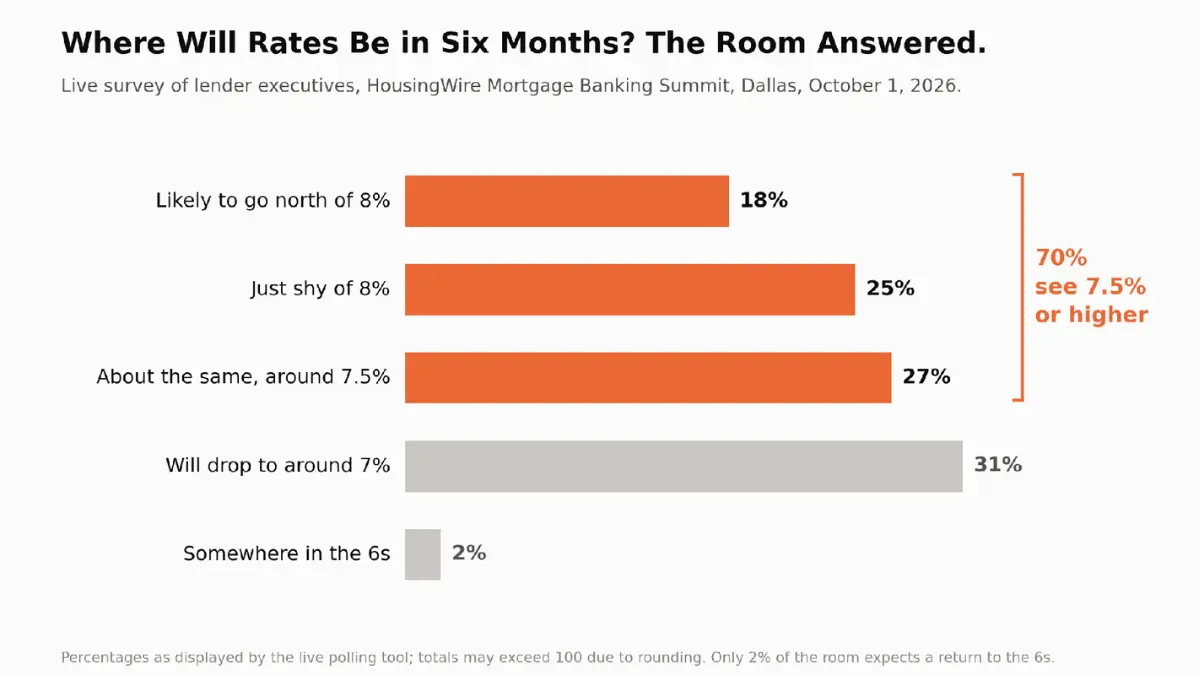
The mood in Dallas was characterized by a pragmatic, if somber, acceptance of current macroeconomic pressures. During a live survey conducted on October 1, mortgage executives were asked for their projections on where interest rates would stand six months from now. The results were telling of a deep-seated pessimism regarding near-term relief. Approximately 27% of respondents believe rates will remain stable at around 7.5%, while 25% anticipate a climb toward the 8% mark. Most significantly, 18% of the room projected rates exceeding 8% by early 2027.
Collectively, seven out of ten mortgage executives now expect the 30-year fixed rate to remain at or above 7.5% for the foreseeable future. Only a marginal 2% of attendees—statistically a rounding error—expressed hope for a return to the 6% range. This shift in sentiment suggests that the "pivot" many had hoped for from the Federal Open Market Committee (FOMC) is no longer viewed as a viable business strategy. Instead, executives are drafting 2027 budgets based on the assumption that the cost of capital will remain a significant barrier to entry for many homebuyers.
The Mortgage Bankers Association (MBA) supports this cautious outlook, projecting relatively flat origination volumes of $2.12 trillion for 2026 and $2.10 trillion for 2027. To put these figures in perspective, the industry is looking at roughly 5.5 million loan closings per year—a figure lower than the transaction volume seen in 2009 during the nadir of the Great Recession. With single-family housing permits running 25% below levels seen in the late 1990s and builder confidence trending downward, the supply-side constraints are compounding the issues created by high borrowing costs.
Historical Context: A Generation Since the Last 8% Market
To find a historical parallel to the current environment, analysts point back to 1997, the last full year when the 30-year fixed rate averaged between 7.5% and 8%. However, the structural differences between 1997 and 2026 highlight the severity of the current contraction. In 1997, the industry originated approximately $860 billion in loans. While that dollar amount is lower than today’s projections, the average loan size was only $115,000, meaning those dollars represented roughly 7.5 million closed loans.
By contrast, the $2.1 trillion projected for 2026 will cover only 5.5 million loans due to the massive appreciation in home values over the last three decades. When adjusted for the growth in the number of U.S. households—which has increased by one-third since 1997—the transaction rate has plummeted from 74 closings per 1,000 households to just 41. This represents a nearly 45% decline in market activity per household, a staggering metric that underscores why many independent mortgage banks (IMBs) are struggling to maintain profitability.

Furthermore, the "refinance valve" that historically rescued the industry during purchase-market slumps has been effectively sealed. In the late 1990s, many homeowners held mortgages with coupons in the 8% to 10% range, making even a slight dip in rates an incentive to refinance. Today, roughly 70% of outstanding mortgages carry rates below 5%. This "lock-in effect" means that only those who purchased homes between 2023 and 2026 have any incentive to refinance if rates drop slightly, and even that pool is being aggressively targeted by AI-powered digital lenders and servicers who use data-mining to capture payoffs before traditional retail loan officers can even identify the opportunity.
The Great Migration: Loan Officers Seek New Models
As the market contracts, a significant shift is occurring in how loan officers (LOs) choose to affiliate. Data from the Nationwide Multistate Licensing System (NMLS) shows a clear migration pattern away from traditional employment models at banks and IMBs toward broker and wholesale channels. Over the past nine months, the broker and wholesale channel was the only segment of the industry to report net positive production growth, gaining more than $8 billion. Conversely, IMBs lost nearly $2 billion in production to this migration, and traditional banks saw a decline of over $5 billion.
This trend is not merely a search for better rates; it is a move toward more flexible manufacturing platforms. Large-scale wholesalers, such as United Wholesale Mortgage (UWM) and Rocket Pro TPO, provide the technological infrastructure and "manufacturing floor" that smaller, independent companies can no longer afford to build or maintain. Loan officers are increasingly opting for non-delegated and broker platforms where they can operate with lower overhead, passing those savings on to consumers in the form of more competitive pricing.
Interestingly, the executive suite appears somewhat blind to this quiet exodus. When surveyed about competitive threats, 40% of mortgage executives pointed to consumer-direct and digital platforms as their primary concern, while only 8% cited the broker channel. This suggests that while many are focused on the "loud" threat of digital marketing and advertising budgets, the actual production is leaking out through the "back door" of the wholesale warehouse.
The 78 Percent Mandate: Cost Reduction Without Compensation Cuts
The most lopsided result of the summit survey involved organizational strategy. A staggering 78% of executives agreed that their primary goal is to reduce operating costs to offer better pricing. However, a significant contradiction emerged: while cost reduction is the mandate, 0% of executives expressed a willingness to reduce loan officer compensation, which typically accounts for 62% to 65% of direct production costs.
This leaves management with only one lever to pull: the operational stack below the loan officer. To remain competitive, lenders are looking to reduce the cost per closed loan from the current average of $11,900 toward a target of $8,000. This $3,900 gap represents the "efficiency frontier" where the next round of industry winners will be determined.
To achieve these savings, the industry is turning toward artificial intelligence and straight-through processing. The goal is to move toward an "exception-based" staffing model, where human intervention is only required when the technology encounters a non-standard file. AI is now capable of reading complex files, clearing automated conditions, balancing disclosures, and performing real-time quality control across entire loan populations.

Technology and the Path to Efficiency
The implementation of technology is shifting from a luxury to a survival mechanism. Two primary "doors" have emerged for lenders in this high-rate environment. The first door is dramatic, technology-led cost reduction. This involves rebuilding the operating model around platforms that offer measurable operating leverage—the ability to handle more volume without a proportional increase in headcount.
On the sales and marketing front, outbound voice AI platforms are beginning to automate the early stages of the funnel, including prequalification and client acquisition. This reduces the cost of sales, an area that traditional headcount reductions rarely touch. On the fulfillment side, platforms like Copperlane.AI and Snapdocs are streamlining the process from application to closing. Digital closing and eNote infrastructure not only provide a better consumer experience but also deliver "cleaner" loans to investors, which can lead to better delivery pricing.
Industry analysts estimate that between 50 and 70 basis points of savings per loan are available through tools already in production. On an average loan balance, this equates to roughly $1,900 to $2,700 in savings. For many IMBs, this is the difference between a profitable quarter and a net loss.
Strategic Combinations and the Future of Consolidation
For companies that lack the capital to invest in a complete technological overhaul, the "second door" is a strategic combination or merger. Consolidation is no longer a prediction; it is an arithmetic certainty. A market producing only 5.5 million units cannot sustain the current number of independent operators, especially when there is a $6,350 cost-per-loan gap between the top-quintile and bottom-quintile lenders.
The current environment favors the strong absorbing the weak. While only 4% of executives in Dallas stated they plan to sell their companies, market pressures may force the hand of the remaining 96%. Industry experts suggest that the difference between a successful merger and a forced liquidation will be the timing of the decision. Companies that seek partners from a position of strength in 2026 will command a premium, while those that wait until their capital is exhausted in 2027 will find themselves with fewer, and less attractive, options.
The ultimate test for any lender in the coming 24 months will be "strategic optionality"—the ability to choose a path forward before the market dictates one. This requires passing four critical tests: achieving scale through execution rather than just size, building durable and permissioned customer relationships, establishing a defensible product or distribution niche, and transforming technology from an expense into a lever for operating margin.
As the HousingWire Mortgage Banking Summit concluded, the takeaway for the Dallas attendees was clear: the decisions made in the next two quarters will define the trajectory of the next two years. With no rescue coming from the Federal Reserve or a sudden surge in housing inventory, the mortgage industry must find its own way through the most challenging economic cycle in a generation. The "rate clock" continues to tick, and for many, the time to reorganize is running short.
