

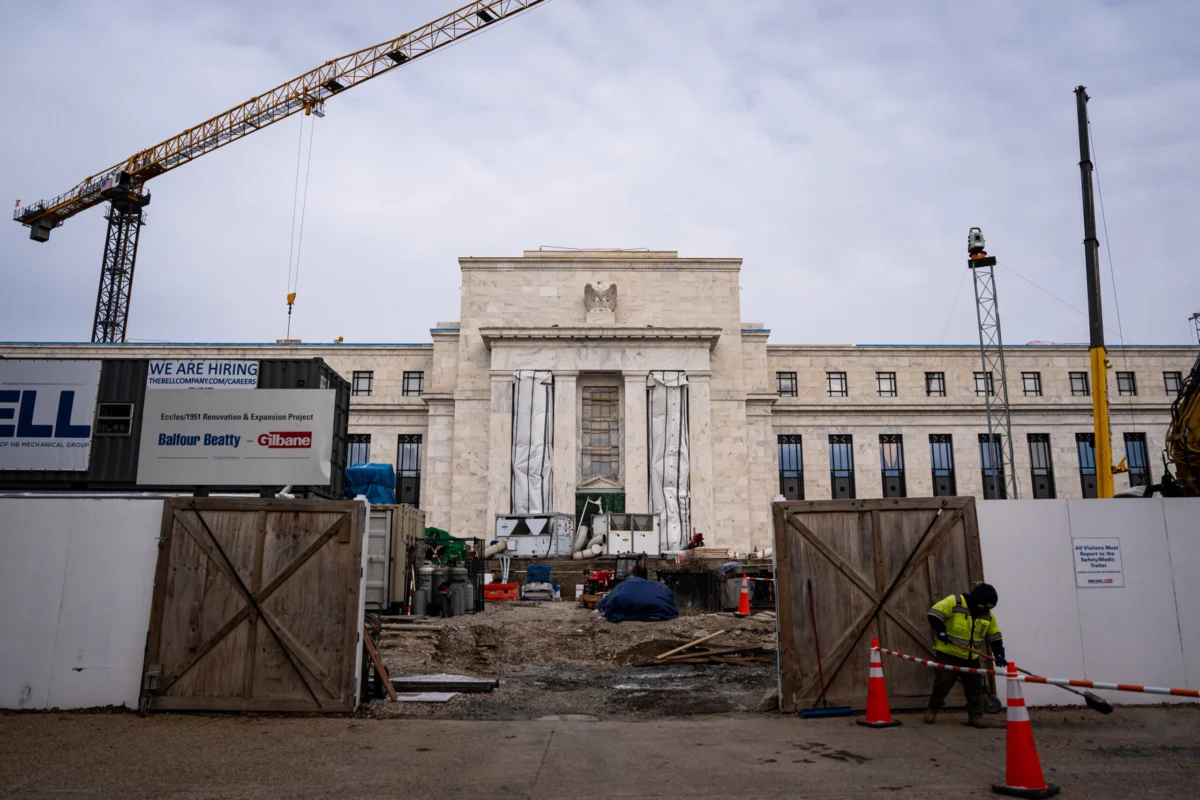
Construction on the Marriner S. Eccles Federal Reserve building in Washington, DC, US, on Monday, Dec. 15, 2025. Al Drago | Bloomberg | Getty Images
In a significant shift reflecting growing investor concern over persistent price pressures, financial markets are now pricing in the possibility of an interest rate hike by the Federal Reserve, a stark departure from earlier expectations of monetary easing. This sentiment has materialized for the first time in the current economic cycle, driven by a series of surprisingly elevated inflation readings that have rattled policymakers and investors alike.
The Fed funds futures market, a key barometer of market expectations for monetary policy, indicates a growing probability of an increase in the benchmark interest rate as soon as December. The data, meticulously tracked by CME Group’s FedWatch tool, reveals a substantial increase in certainty regarding a rate hike into the early part of 2027. As of the latest readings, the probability of a rate increase in December stands at nearly 51%. This likelihood escalates to approximately 60% for a move in January, and a robust 71% by March. This sophisticated tool derives its insights from the prices of 30-day federal funds futures contracts, offering a granular view of market sentiment.
This market recalibration follows a week marked by alarming inflation data across the consumer and wholesale price spectrums. Both reported multiyear highs, signaling a potentially entrenched inflationary environment that demands a reevaluation of the Federal Reserve’s monetary stance. The surge in import and export prices further compounds these concerns, echoing levels not witnessed since the last major inflation spike. That period necessitated aggressive rate hikes from the Fed, beginning with an unprecedented series of four consecutive three-quarter percentage point increases in 2022.
The timing of this market shift is particularly noteworthy given the recent leadership transition at the helm of the Federal Reserve. Kevin Warsh officially took over as the new Chair of the Federal Reserve as of Friday. Warsh has previously expressed a view that the central bank possesses the capacity to lower interest rates even within the prevailing economic conditions. This perspective, however, appears to be at odds with the current market trajectory, which is now leaning towards a tightening of monetary policy.
The internal deliberations within the Federal Reserve also highlight a growing divergence of opinion. At the most recent Federal Open Market Committee (FOMC) meeting, three members dissented from the decision to maintain benchmark rates at their current levels. Their objection was reportedly rooted in the committee’s language, which hinted that the next policy move would likely be a rate cut. This dissent underscores a palpable tension within the Fed regarding the appropriate path forward in the face of rising inflation.
Further bolstering the narrative of rising inflation, economists participating in the Survey of Professional Forecasters have projected that second-quarter inflation will reach a peak of 6%. This figure represents a significant upward revision from previous estimates and underscores the broad consensus among economic experts about the inflationary pressures facing the economy. This latest projection was released on Friday, adding further weight to the market’s concerns.
The Shifting Sands of Monetary Policy Expectations
The market’s sudden pivot towards anticipating a rate hike is a dramatic turn of events. For a considerable period, the prevailing narrative among investors and many economists was that the Federal Reserve, having engineered a series of rate hikes to combat post-pandemic inflation, was poised to begin a cycle of interest rate reductions. This expectation was built on the premise that inflation would continue its downward trajectory and that the economy might begin to show signs of slowing, necessitating a more accommodative monetary policy.
However, the recent inflation reports have fundamentally challenged this outlook. The Consumer Price Index (CPI), a key measure of inflation, has shown a persistent upward trend, defying predictions of a steady decline. Similarly, the Producer Price Index (PPI), which tracks inflation at the wholesale level, has also exhibited a concerning acceleration. These data points suggest that inflationary pressures are not merely transitory but are becoming embedded in the economy, impacting a wider range of goods and services.
The implications of these sustained inflation readings are profound. For consumers, it translates into higher prices for everyday necessities, eroding purchasing power and potentially dampening consumer spending, a critical engine of economic growth. For businesses, it means increased input costs, which can squeeze profit margins and lead to higher prices for their products and services, creating a potential wage-price spiral.
A Timeline of Inflationary Surprises and Market Reactions
The shift in market sentiment has not occurred overnight but has been a gradual, albeit accelerating, process.
- Early 2026: For much of the early part of the year, market participants largely anticipated the Federal Reserve to begin cutting interest rates. The Fed’s own communications, while cautious, had hinted at a potential pivot towards easing once inflation showed sustained signs of returning to the 2% target.
- Mid-Spring 2026: A series of economic indicators began to paint a less optimistic picture. Inflationary readings, both in the CPI and PPI, started to exceed forecasts, signaling a potential recalibration was needed.
- Late Spring 2026 (Current Period): The release of significantly higher-than-expected inflation data for April 2026 proved to be a watershed moment. Import and export price data further solidified concerns. This led to a rapid repricing of Fed funds futures, with the probability of a rate hike in December moving from negligible to nearly 51% in a matter of days. The FedWatch tool began to reflect a growing consensus for tightening.
- Anticipation of Future Data: Market participants are now keenly awaiting upcoming economic data, particularly employment figures and further inflation reports, to gauge whether this inflationary trend is a fleeting anomaly or a more persistent phenomenon.
Supporting Data: A Deeper Dive into Inflationary Pressures
The recent inflation data provides concrete evidence of the economic challenges. While specific figures for April 2026 are not detailed in the provided text, the reference to "multiyear highs" and levels "not seen since the last inflation spike" allows for an informed discussion of the magnitude of the problem.
For context, during the inflation surge of 2021-2022, the CPI reached peak annual increases of over 9%, and the PPI saw even higher spikes. The current situation, with multiyear highs, suggests inflation is likely in the high single digits or even approaching double digits on an annualized basis for certain components.
- Consumer Price Index (CPI): When the CPI rises significantly, it means consumers are paying more for a basket of goods and services, including food, energy, housing, and transportation. This erodes disposable income and can lead to reduced consumer confidence and spending.
- Producer Price Index (PPI): A rising PPI indicates that businesses are facing higher costs for raw materials, intermediate goods, and services. These costs are often passed on to consumers in the form of higher prices, contributing to the CPI increase.
- Import and Export Prices: Increases in import prices can directly translate to higher costs for domestically produced goods that rely on imported components. Similarly, rising export prices can make U.S. goods less competitive in international markets.
The fact that these indicators are at levels not seen since the aggressive rate-hiking cycle of 2022 is particularly concerning. It suggests that the underlying drivers of inflation may be similar to those experienced previously, potentially requiring a similarly forceful response from the central bank.
Official Responses and Divergent Views
The Federal Reserve, as an institution, has remained committed to its dual mandate of maximum employment and price stability. However, the recent economic data and market reactions have brought into sharp focus the differing perspectives within the Federal Reserve itself.
Kevin Warsh’s ascent to the Chairmanship introduces a new dynamic. His stated belief that the Fed can lower rates in the current environment suggests a potential inclination towards maintaining a more accommodative stance, or at least a skepticism towards immediate tightening. This contrasts with the market’s current pricing of a hike.
The dissent from three FOMC members is a critical indicator of this internal debate. Their objection to language hinting at a future rate cut signifies a belief that the inflationary risks are substantial enough to warrant a more hawkish outlook. They may be concerned that signaling a potential cut could embolden inflationary expectations and make it harder for the Fed to achieve its price stability goals.
These divergent views create uncertainty about the Fed’s future policy path. While the market is currently betting on a hike, the Chair’s perspective and the dissenters’ concerns suggest that a unanimous decision to tighten may not be straightforward. The Fed’s communication strategy will be crucial in navigating this complex environment and managing market expectations.
Broader Impact and Implications
The prospect of a Federal Reserve rate hike, especially after a period where cuts were anticipated, carries significant implications for the broader economy:
- Borrowing Costs: An interest rate hike would lead to higher borrowing costs for consumers and businesses. Mortgages, auto loans, credit card rates, and business loans would likely become more expensive, potentially slowing down economic activity.
- Investment Decisions: Higher interest rates can make fixed-income investments, such as bonds, more attractive relative to equities. This could lead to a reallocation of capital and potentially impact stock market valuations.
- Currency Strength: A Fed rate hike could strengthen the U.S. dollar, making imports cheaper but exports more expensive. This can have implications for international trade balances.
- Risk of Recession: While a rate hike is intended to curb inflation, an overly aggressive tightening of monetary policy could increase the risk of tipping the economy into a recession. Policymakers will be walking a tightrope, attempting to disinflate the economy without causing a significant downturn.
- Market Volatility: The uncertainty surrounding the Fed’s next move and the potential for a policy shift can lead to increased market volatility as investors adjust their portfolios and expectations.
The coming months will be critical for the Federal Reserve and the U.S. economy. The market’s current bet on a rate hike underscores the urgency of the inflation situation. However, the path forward will depend on a complex interplay of incoming economic data, the Federal Reserve’s assessment of those data, and the evolving perspectives of its policymakers. The challenge for Chair Warsh and the FOMC will be to navigate these headwinds effectively, aiming to restore price stability without jeopardizing economic growth. The Marriner S. Eccles Federal Reserve building, a symbol of monetary policy, will be at the center of these crucial decisions.
