

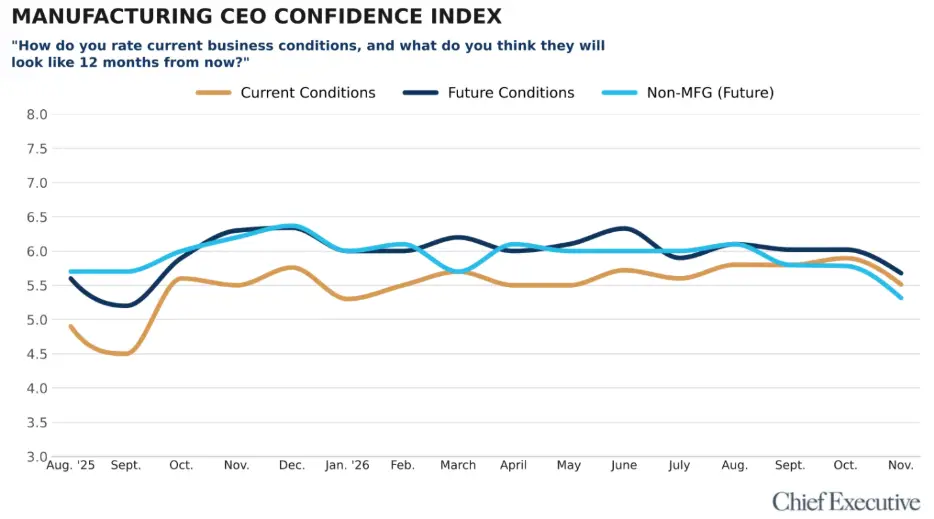
Manufacturing chief executives exhibited increased caution in November, with their outlook for the coming year plummeting to its lowest point of 2026. This dip in confidence was largely attributed to sentiments expressed before the results of the midterm elections were known. Interestingly, manufacturers who responded to the survey after the election outcomes were disseminated displayed a nearly identical level of optimism to that recorded in October, suggesting a significant moderating effect of the election results on their forward-looking perceptions.
The latest CEO Confidence Index, conducted by Chief Executive from November 3rd to 5th among 435 U.S. chief executive officers, reveals that manufacturers rated current business conditions at an average of 5.5 out of 10, where 1 signifies poor conditions and 10 represents excellent conditions. This represents a 7 percent decline from the 5.9 rating in October and marks the sector’s weakest performance since May of 2026. The 12-month forecast also saw a 6 percent decrease, falling to 5.7 from 6.0, a figure that falls below the average of 6.1 observed throughout 2026.
In contrast, non-manufacturing CEOs reported a more substantial downturn, with both current conditions and the year-ahead outlook dropping by 8 percent. Their ratings settled at 5.3, down from 5.8 in October. This sustained a trend where manufacturing has held a slight edge in perceived business conditions for three consecutive months.
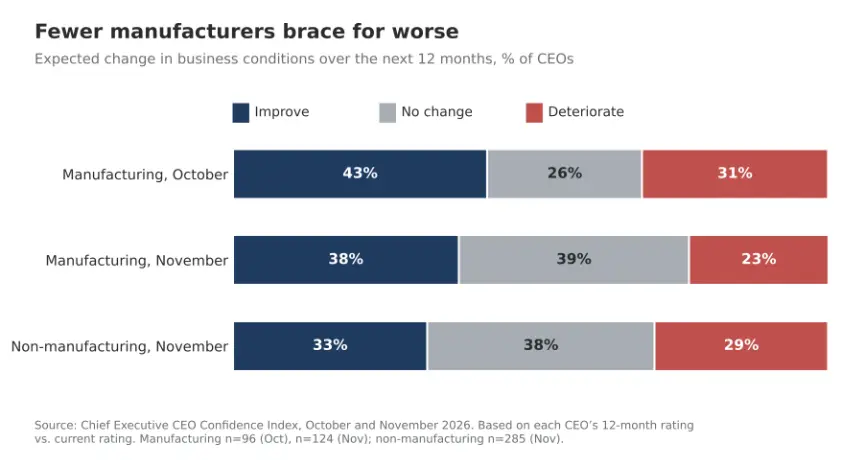
The composition of expectations among manufacturers shifted notably. Fewer CEOs anticipate an improvement in business conditions over the next twelve months, with 38 percent expressing this view, down from 43 percent in October. However, the proportion bracing for deterioration saw a sharper decline, falling to 23 percent from 31 percent. A significant portion of CEOs, 39 percent, now foresee conditions remaining unchanged, a notable increase from 26 percent in the previous month. Non-manufacturing leaders, however, exhibited a gloomier sentiment on both improvement and deterioration fronts.
Demand Dynamics and Sectoral Variations
Demand remains the primary engine driving the outlook for manufacturing CEOs. On the industrial side, this demand is concentrated within a select group of high-growth sectors, including data centers, power and utility projects, semiconductors, and aerospace and defense. Scott Wood, CEO of LISI Aerospace Fasteners North America, a manufacturer of specialized aerospace fasteners, reported a perfect score of 10 for current conditions, highlighting the robust activity in his segment. "Aerospace, defense, and space are all experiencing upward momentum," Wood stated.
While not the sole determinant, the midterm elections undeniably played a role in shaping executive sentiment. The CEO of a mid-sized industrial manufacturing firm attributed a more optimistic outlook to "automotive industry recovery and election results." Conversely, another executive predicted a slip in conditions, citing "continuing impact of tariffs" and "uncertainty the midterm results will create for the business climate."
The Midterm Election Effect
The influence of the midterm election results on CEO confidence mirrors broader trends observed across all industries, as previously analyzed. For manufacturers, the election outcomes appear to have provided a tangible boost to their forward-looking perspectives. CEOs who completed the survey on November 3rd, prior to the full revelation of election results, projected their 12-month outlook at 5.5. In stark contrast, those who responded after the results were known registered a higher forecast of 5.9. The perception of current conditions showed minimal variation between these two groups. Furthermore, among those surveyed after the election, 43 percent anticipated improved conditions, a significant increase from the 34 percent of earlier respondents, with no corresponding rise in the percentage expecting deterioration. This suggests a calming of political anxieties and a clearer path forward for business planning.
Economic Outlook and Recessionary Fears
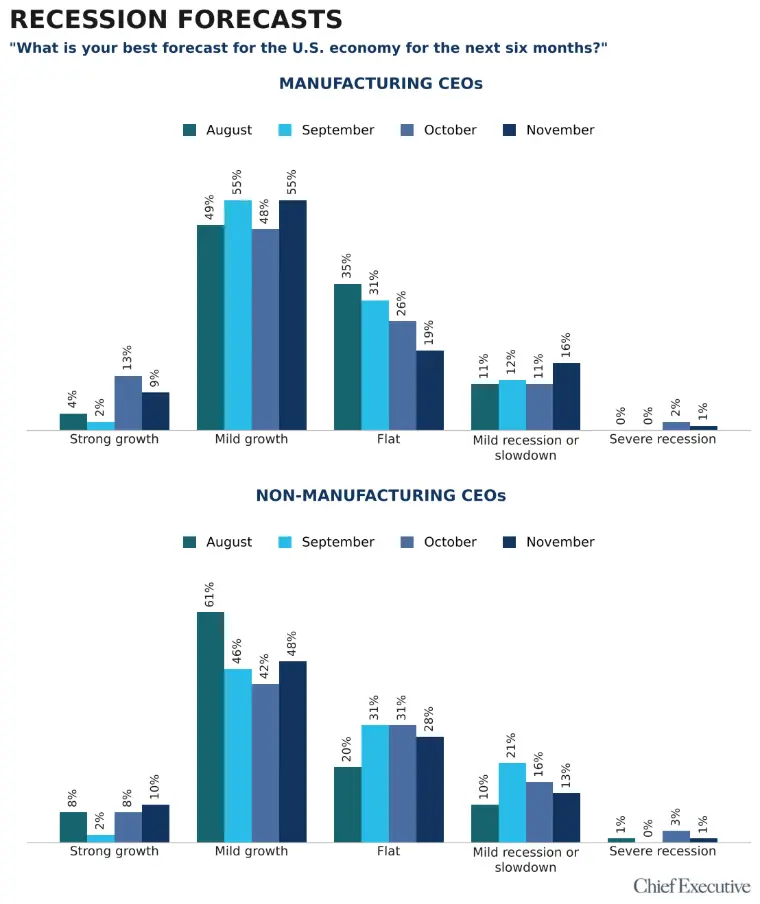
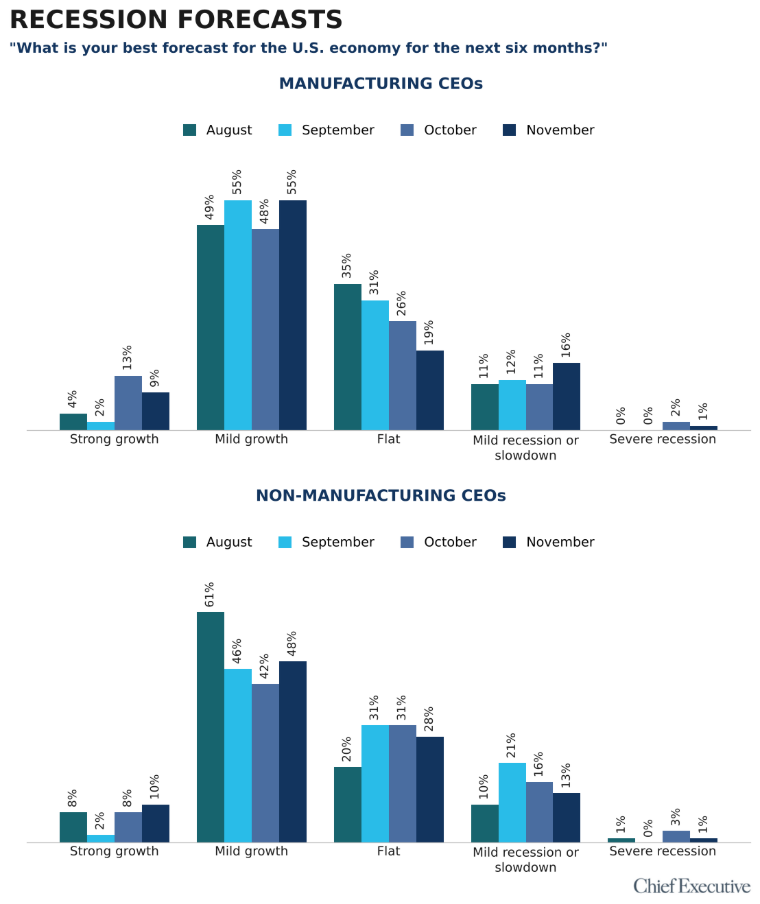
The broader economic outlook as perceived by manufacturers showed a polarization, with a greater proportion expecting either growth or a recession. Sixty-four percent of manufacturers forecast some form of economic growth in the next six months, an increase from 60 percent in October. Concurrently, the share anticipating flat economic conditions decreased to 19 percent from 26 percent. However, the percentage forecasting a recession rose to 17 percent, up from 14 percent in the prior month.
Non-manufacturers also showed a shift towards growth, with 58 percent anticipating it compared to 50 percent in October. Their recessionary forecasts, however, declined to 14 percent from 19 percent. This leaves manufacturers exhibiting a more bullish stance on growth compared to their non-manufacturing counterparts, while also being more inclined to predict a recession. The number of manufacturers on the fence regarding economic conditions is lower, with 19 percent expecting flatness, compared to 28 percent of non-manufacturers.
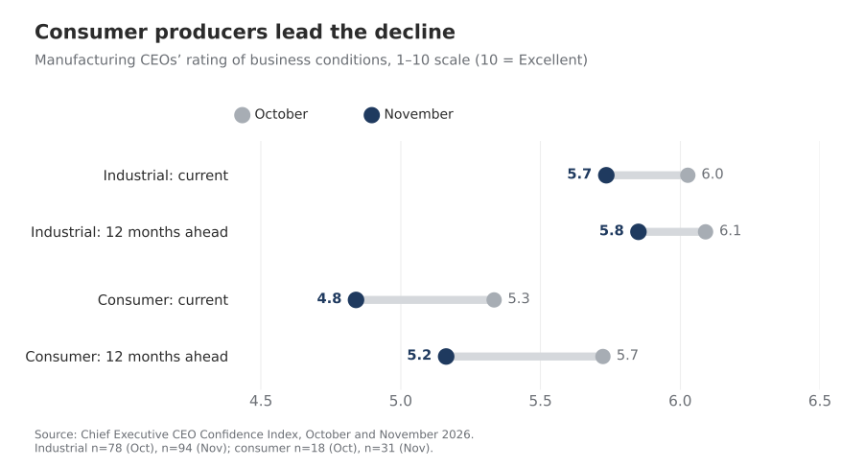
Consumer goods manufacturers emerged as the more pessimistic group within the manufacturing sector. A significant 29 percent of these executives forecast a recession, in contrast to 13 percent of industrial manufacturers. This divergence underscores the varied impacts of economic headwinds and consumer behavior shifts across different manufacturing sub-sectors.
Lingering Cost Pressures
Persistent cost pressures continue to act as a drag on the manufacturing sector. Across all survey respondents who elaborated on their outlook, approximately one in five cited inflation or rising input costs, ranging from steel to fuel, as a key concern. An additional one in ten pointed to the impact of increasing interest rates. Jim Nelson, CEO of Parr Instrument Company, a producer of laboratory pressure reactors and calorimeters, expressed a common sentiment: "Rising interest rates will slow the economy in 2027." This highlights the anticipation of a tighter monetary policy impacting investment and consumer spending in the near future.
Softer Outlook, Yet Resilient Plans
Despite the softening in their broader economic outlook, manufacturers’ forecasts for their own companies remained relatively robust, outperforming their views of the general business climate. A substantial 75 percent of manufacturers expect to conclude 2026 with higher revenues than in 2025, and 67 percent anticipate increased profits, a slight improvement from 71 percent and 62 percent, respectively, in October. Non-manufacturers lagged behind in both these measures, reporting 65 percent for revenue and 61 percent for profits.
Looking Ahead to 2027: Growth Projections
When projecting plans for 2027 compared to 2026, manufacturers displayed a consistent inclination towards expansion across several key metrics. A higher proportion of manufacturers anticipate increases in revenues, profits, and workforce size compared to non-manufacturers. Specifically, 77 percent of manufacturers expect higher revenues, versus 67 percent of non-manufacturers. For profits, 71 percent of manufacturers foresee an increase, compared to 64 percent of their non-manufacturing peers. Workforce expansion plans are projected by 64 percent of manufacturers, slightly ahead of the 61 percent of non-manufacturers.
Capital spending emerged as a notable area of divergence. A greater percentage of manufacturers plan to increase their capital expenditures, with this proportion rising by 13 percent from October. Conversely, the percentage of non-manufacturers intending to boost capex fell by 6 percent, settling at 50 percent. This suggests a strategic prioritization of investment in plant and equipment among manufacturers, potentially to enhance efficiency and capacity. Hiring expectations among manufacturers saw a slight dip of 4 percent, continuing a trend observed in the previous month where investment was increasingly channeled towards equipment rather than direct payroll expansion.
Escalating Cost Expectations for 2027
Cost expectations demonstrated the most significant movement. A commanding 82 percent of manufacturers now anticipate a rise in operating expenses in 2027, a substantial increase from the 65 percent who projected similar increases in October. Non-manufacturers also witnessed a climb in their cost expectations, with the figure rising to 78 percent from 68 percent. This collective anticipation of higher operating costs underscores the ongoing inflationary environment and the pressure it exerts on business margins.
For some industry leaders, navigating these uncertainties requires a blend of data analysis and intuitive decision-making. "Experience, judgment, and the willingness to trust your gut still matter," commented the CEO of a mid-sized, family-owned industrial manufacturer. "Sometimes leadership means making a decision before the numbers can fully justify it." This perspective highlights the human element in strategic planning, where seasoned judgment can complement quantitative forecasting in a dynamic economic landscape.
Background on the CEO Confidence Index
Since its inception in 2002, Chief Executive Group has consistently polled hundreds of U.S. chief executive officers across a diverse range of organizations, sizes, and industries to compile the CEO Confidence Index. This benchmark survey tracks executive confidence in both current and future business environments by aggregating CEOs’ observations on various economic and business components. The Index serves as a crucial indicator of the prevailing sentiment within the U.S. corporate leadership, offering insights into their strategic outlook and potential investment decisions. For additional data and historical analysis of the Index, readers are directed to the dedicated section on ChiefExecutive.net. The November 2026 survey, encompassing 435 U.S. CEOs, provides a snapshot of executive sentiment during a period of political transition and evolving economic indicators. The methodology, which involves direct polling of CEOs, ensures that the data reflects the perspectives of those at the helm of American businesses, offering a ground-level view of economic expectations.
