

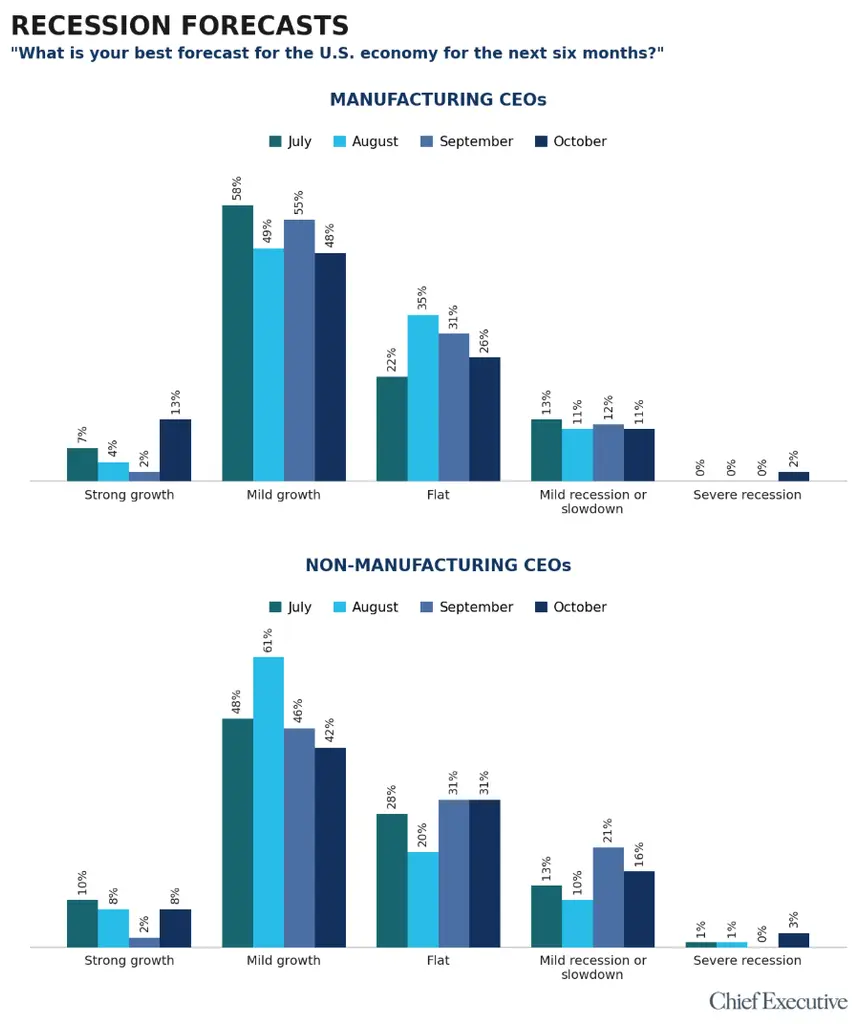
Manufacturing CEOs expressed a notable surge in optimism regarding current business conditions in October, achieving the highest rating of 2026. This positive sentiment, however, exists in stark contrast to a simultaneous reduction in hiring plans, elevated inflation forecasts, and the reemergence of severe recessionary predictions in their outlooks. This dichotomy suggests a complex and potentially precarious environment, where immediate performance is strong, but long-term anxieties are mounting. The underlying theme is a palpable sense of navigating uncertainty, as one CEO aptly described the prevailing mood: "Feels like walking on ice right now even though business continues to be good."
The latest Chief Executive CEO Confidence Index, surveyed from October 6-7 among 321 U.S. CEOs, reveals that manufacturing leaders rated current business conditions at 5.9 out of 10, on a scale where 1 signifies "Poor" and 10 denotes "Excellent." This figure represents an 11 percent increase from the year’s opening rating of 5.3 in January and comfortably surpasses the sector’s average of 5.6 for 2026. Even non-manufacturing CEOs reported an improvement, with their current conditions rating reaching 5.8.
However, this robust assessment of the present does not seamlessly translate into future expectations. The outlook for conditions one year ahead saw a slight dip. Manufacturers projected future conditions at 6.0, marginally below their average of 6.1 for the year, while non-manufacturers slipped to 5.8. This month’s survey data indicates a growing unease, with 31 percent of manufacturers anticipating worse conditions in 12 months, a notable increase from 24 percent in September. Conversely, the proportion expecting improvement declined to 43 percent from 47 percent. This divergence highlights a strategic recalibration, with businesses seemingly pushing their growth ambitions further into the future to manage the perceived gap between immediate success and anticipated headwinds.
Economic Outlook: A Divided Landscape
While manufacturers exhibit a more bullish stance on the broader economy compared to their non-manufacturing counterparts, this optimism is nuanced and accompanied by significant concerns. Sixty percent of manufacturing CEOs forecast some level of economic growth over the next six months, an uptick from 57 percent in September. The share predicting strong growth saw a substantial jump to 13 percent, from a mere 2 percent in the previous month. Intriguingly, 2 percent of manufacturers are now forecasting a severe recession, a scenario that had garnered no responses in either August or September.
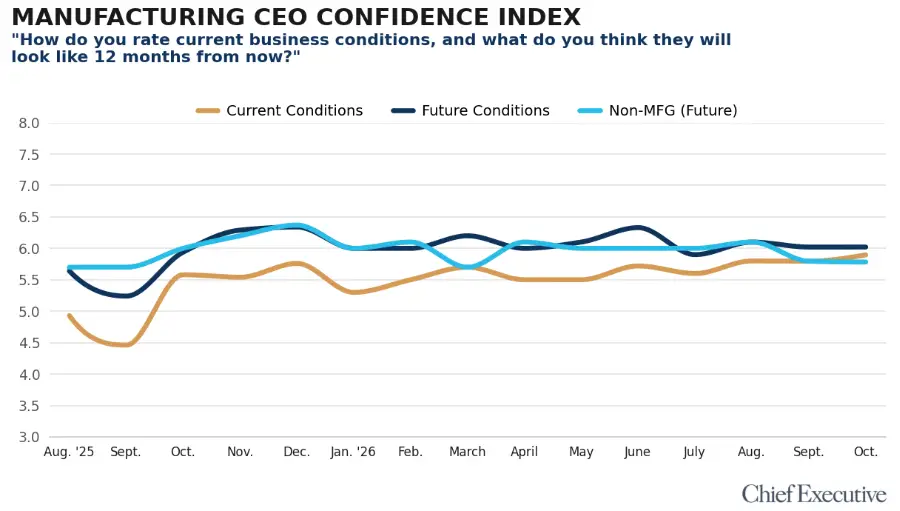
In contrast, non-manufacturers remain more conservative. Fifty percent of this group forecast growth, while a more significant 16 percent anticipate a mild recession or slowdown, compared to 11 percent of manufacturers. This suggests that while the manufacturing sector is sensing a near-term uplift, it is also more acutely aware of potential storm clouds gathering on the horizon.
Inflationary Pressures and Shifting Drivers
The specter of inflation continues to loom large, with cost expectations consistently rising. Manufacturers now anticipate headline Consumer Price Index (CPI) to average 3.9 percent over the next 12 months, an increase from 3.7 percent in September and 3.5 percent in August. This trend is likely exacerbated by external factors, as one CEO of a mid-size agricultural manufacturer noted, "Fuel prices are now having an impact," adding a critical perspective on fiscal policy: "Current fiscal policy is not working with tariffs."
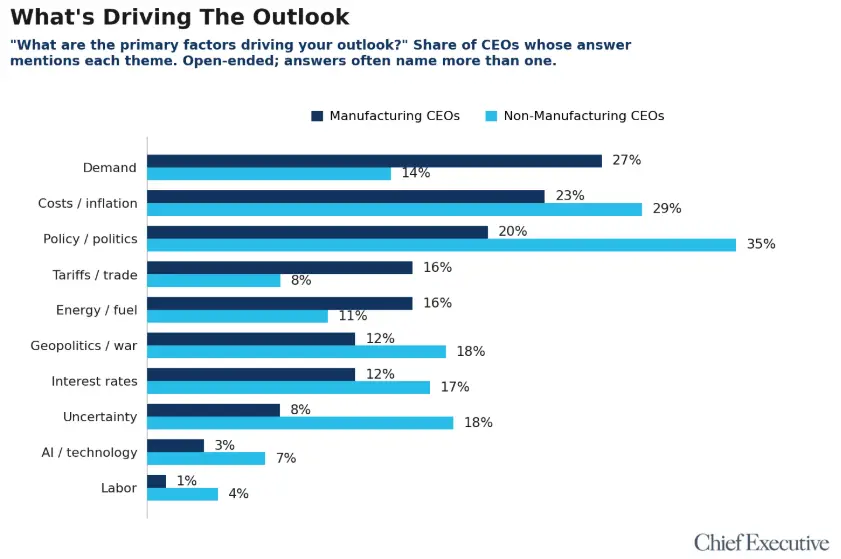
When probed about the primary drivers influencing their outlook, manufacturers and non-manufacturers point in different directions. Across all respondents, demand emerges as a leading factor for manufacturers, cited by 27 percent, significantly higher than the 14 percent reported by non-manufacturers. Tariffs also emerge as a more prominent concern for the manufacturing sector, mentioned twice as often (16 percent) compared to non-manufacturers (8 percent). Non-manufacturers, on the other hand, are considerably more likely to attribute their outlook to policy or political factors, with 35 percent citing these issues against 20 percent of manufacturers.
A deeper dive into the responses of CEOs expecting deteriorating conditions over the next 12 months reveals further distinctions. Manufacturers anticipating a downturn predominantly highlight tariffs (24 percent) and demand (21 percent) as key concerns. Non-manufacturers facing similar prospects are more likely to point to costs (38 percent) and politics (38 percent) as primary drivers. This indicates a divergence in the perceived threats to business stability between the two sectors.
A Softer Finish, A Bolder Target: The 2027 Ambition
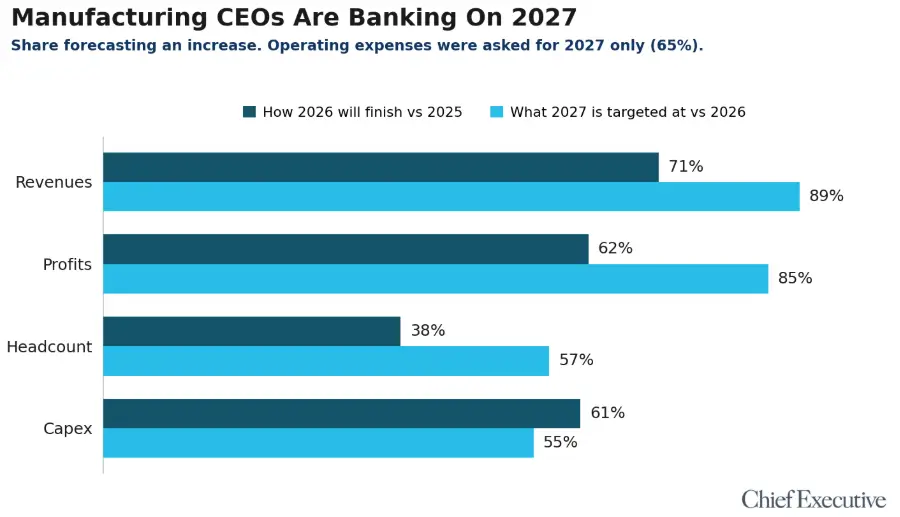
As the year 2026 draws to a close, manufacturers have adjusted three out of their four forecasts for the remainder of the year compared to 2025. Capital spending, however, stands as a notable exception, showing a sharp increase. The proportion of manufacturing CEOs forecasting increases in areas such as revenue, profits, and capital spending by the end of 2026 continues to outpace non-manufacturers across all four measures. This lead is most pronounced in capital spending, with 61 percent of manufacturers expecting an increase compared to 44 percent of their non-manufacturing counterparts.
A significant shift in strategy is evident: the proportion of manufacturing CEOs planning to increase their headcount has fallen by 22 percent since September, while capital spending projections have risen by 20 percent. This pattern strongly suggests a strategic pivot towards heavier investment in equipment and technology rather than an expansion of payrolls in the immediate future.
This current restraint, however, does not appear to extend to the following year. The October survey also included questions about CEOs’ targets for 2027. Manufacturers’ responses indicate far more ambitious projections for 2027 compared to their expectations for the remainder of 2026. A remarkable 89 percent project revenue growth, and 85 percent anticipate higher profits. Crucially, the proportion planning to increase their headcount climbs significantly to 57 percent for 2027. Bob Grote, CEO of Grote Company, an industrial food equipment manufacturer, encapsulates this forward-looking optimism: "The U.S. economy is resilient. 2027 will be excellent." This suggests a strategic deferral of growth initiatives, with a strong conviction that the long-term economic landscape will be more favorable.
AI’s Gradual Integration into the Organizational Structure
A new dimension explored in this month’s index is the impact of Artificial Intelligence (AI) on companies’ strategies concerning jobs, roles, and organizational structures. The findings indicate that manufacturers are adopting AI-driven organizational changes at a slower pace than non-manufacturers. Forty-two percent of manufacturing CEOs are either actively evaluating changes or already in the process of redesigning roles due to AI, compared to 53 percent of non-manufacturers. A substantial 27 percent of manufacturers report that AI use is not significant enough to warrant discussions about organizational changes or that it has no impact, a figure that is double the 14 percent reported by non-manufacturers.
Where AI is influencing changes within manufacturing firms, it is often framed as a solution to existing labor challenges rather than a direct cause for headcount reduction. Matt Guse, CEO of MRS Machining, a CNC machining manufacturer, explains, "For us, AI means automating more of our skilled work. We’ve struggled to find enough qualified people, which is limiting our growth. With greater automation, we could potentially double or even triple in size." This perspective suggests that AI is being viewed as an enabler of growth by augmenting the capabilities of the existing workforce and addressing skill shortages, rather than as a substitute for human labor. However, skepticism persists, with one CEO of a small industrial firm commenting, "AI is not affecting productivity as much as advertised." This indicates a measured and varied reception to AI’s transformative potential within the sector.
Background Context: A Shifting Economic Narrative
The October 2026 CEO Confidence Index survey unfolds against a backdrop of evolving economic indicators. Throughout 2026, the U.S. economy has demonstrated resilience, defying earlier predictions of a significant slowdown. However, persistent inflationary pressures, coupled with global geopolitical uncertainties, have created a complex operating environment. Supply chain disruptions, although somewhat abated from their peaks, continue to influence production costs and lead times for manufacturers.
The Federal Reserve’s monetary policy has been a central theme, with interest rate decisions closely watched for their impact on borrowing costs and overall economic activity. The divergence in sentiment between current conditions and future outlooks among manufacturers reflects this nuanced economic narrative, where immediate operational success is being experienced, but future uncertainties, particularly concerning inflation and potential economic contractions, are casting a shadow.
The inclusion of questions regarding AI’s impact reflects a broader societal and industrial trend. As AI technologies mature, businesses across all sectors are grappling with their integration and the consequent implications for workforce planning and organizational design. The manufacturing sector, with its emphasis on operational efficiency and skilled labor, is a key area where AI’s transformative potential is being closely examined.
Broader Implications and Future Trajectory
The data from the CEO Confidence Index paints a picture of a manufacturing sector navigating a delicate balance. The strong performance in current conditions provides a solid foundation, but the increased anticipation of a severe recession and heightened inflation forecasts signal a need for strategic foresight and risk mitigation. The shift towards increased capital expenditure over immediate hiring suggests a focus on enhancing productivity and efficiency, potentially to offset rising labor and material costs.
The ambitious targets set for 2027 offer a glimpse into the long-term strategic vision of manufacturing leaders. This optimistic outlook for the subsequent year implies a belief in the underlying strength of the U.S. economy and the sector’s capacity for sustained growth, albeit with a projected delay in realizing its full potential. The varied responses regarding AI adoption highlight the diverse pathways through which technology is being integrated into manufacturing operations, with a clear division between those seeing it as a catalyst for expansion and those expressing more reserved views on its immediate impact.
As manufacturers look towards the future, their ability to effectively manage inflationary pressures, adapt to evolving technological landscapes like AI, and navigate potential economic downturns will be critical determinants of their success. The "walking on ice" sentiment underscores the prevailing cautious optimism, where present strength is acknowledged, but the path ahead requires careful navigation and strategic agility. The coming months will be crucial in observing whether the robust current performance can withstand the anticipated future headwinds, and if the ambitious 2027 targets can be realized.
About the CEO Confidence Index
Since 2002, Chief Executive Group has been consistently polling hundreds of U.S. CEOs across organizations of all types and sizes to compile its CEO Confidence Index data. This index meticulously tracks confidence levels in both current and future business environments, drawing upon CEOs’ direct observations of various economic and business components. For more in-depth information about the Index and access to historical data, readers are encouraged to visit ChiefExecutive.net/category/CEO-Confidence-Index/.
