

The median CEO compensation package for manufacturing CEOs doesn’t fall far from that of the overall median. However, the components of their package differ greatly—even between types of manufacturing. This nuanced reality, highlighted by Chief Executive Group’s annual CEO and Senior Executive Compensation Report, reveals a complex tapestry of financial incentives, strategic benefits, and long-term equity plans that shape executive remuneration within the industrial and consumer goods sectors. While overall compensation figures may appear consistent, the underlying drivers and structures paint a distinct picture of how manufacturing leaders are rewarded, reflecting diverse ownership models, company philosophies, and competitive pressures.
Total Compensation Packages: A Close Match, Diverse Components
According to Chief Executive Group’s comprehensive report, the total compensation package for a median consumer manufacturing CEO reached $451,705 last year. For their counterparts in industrial manufacturing, the median package was slightly lower at $428,673. These figures hover closely around the median compensation for CEOs across all private companies, which stood at $438,203, demonstrating that manufacturing leadership compensation, in its entirety, is broadly in line with the broader private sector.
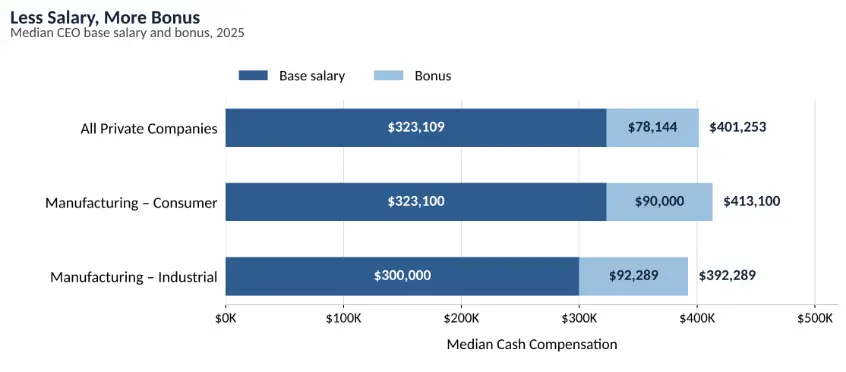
However, a deeper examination of the cash components—base salary and bonus—reveals more pronounced differences. Consumer manufacturing CEOs received a median cash compensation of $413,100, while industrial manufacturing CEOs earned $392,289. This contrasts with the all-company median cash compensation of $401,253. The slight disparities suggest that while overall package values are similar, the emphasis on different compensation elements can vary significantly between manufacturing sub-sectors.
The Salary-Bonus Dynamic: Performance-Driven Incentives
The most significant divergence in compensation structures lies in the split between base salary and bonus. For CEOs across all private companies surveyed, the median base salary was $323,109, with a median bonus of $78,144. In consumer manufacturing, the median base salary was almost identical at $323,100, but the median bonus was higher at $90,000. Industrial manufacturing, on the other hand, saw a lower median base salary of $300,000, yet offered the highest median bonus among the three categories at $92,289.
This emphasis on performance-based bonuses in manufacturing, particularly in the industrial sector, is a deliberate strategy. Jim Nelson, CEO of Parr Instruments, a 127-year-old industrial and chemical instruments manufacturer, articulates this philosophy clearly: "Our base salary is probably not as high as some companies because our [bonus structure] can be pretty lucrative."
Nelson explains that Parr Instruments employs a dual bonus system. The first is a company-wide bonus distributed to the entire employee base, ensuring that even hourly workers receive a share of the company’s success, with bonuses calculated even on overtime pay. The second bonus is directly tied to profitability. "We take a certain percentage of our operating profit, put it in a bonus pool, and for top executives, it can be more than your salary," Nelson states.
This structure is designed to align executive and employee interests with the company’s financial performance. "We try to weigh more of our compensation on that bonus structure because we want to be able to pay that in good years, but if it’s a bad year, then everybody, a rising tide floats all boats if we’re doing our job," Nelson elaborates.
Bob Grote, whose family has led an industrial food processing manufacturing company for 55 years, echoes this sentiment, noting that the workforce is keenly aware of the metrics that drive bonuses. "At the end of the day, we pay bonuses based on profit. So that’s what they really care about. When during a town hall meeting, that’s what they’re asking me. It’s like, so how are we on pace? Are we on pace for budget? Are we going to make money?" This direct link between company performance and individual rewards fosters a culture of accountability and shared success.
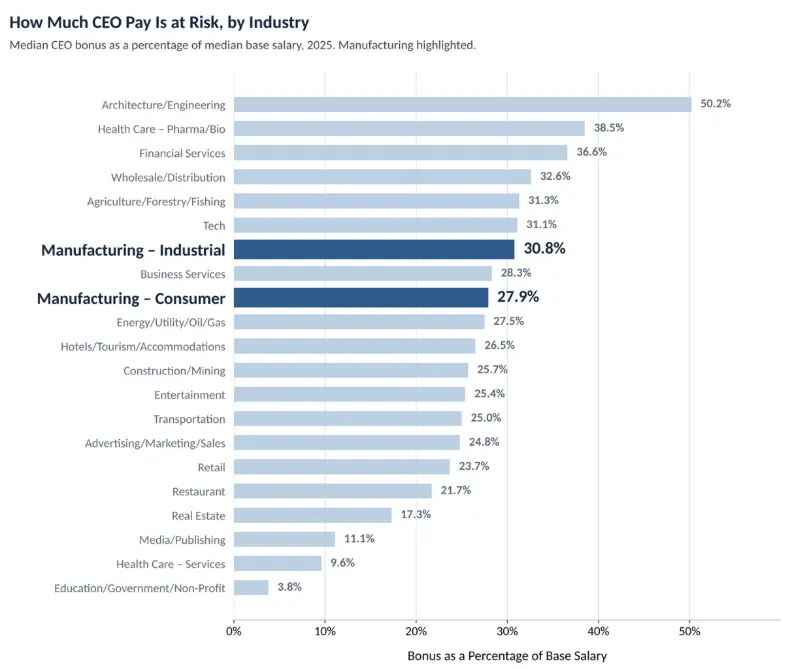
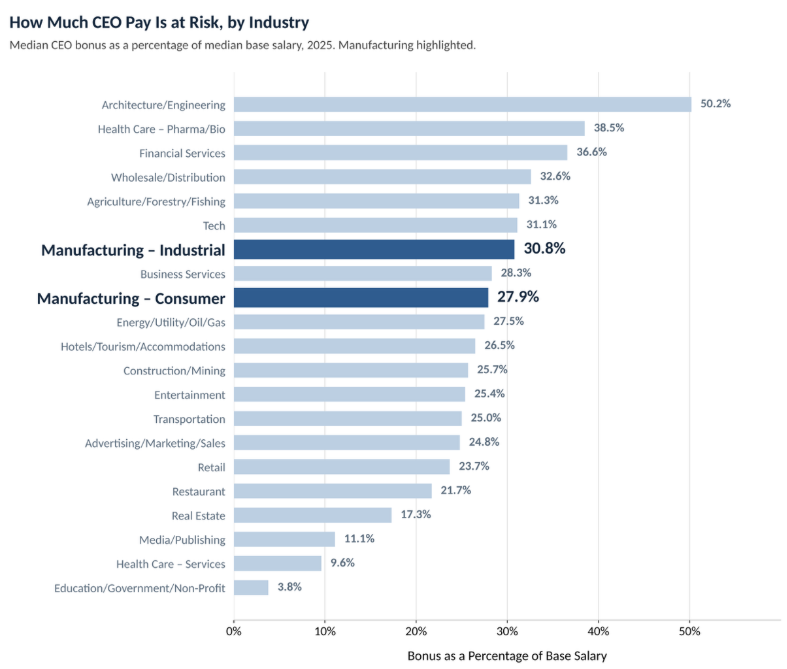
Across the 21 industries examined in the survey, manufacturing bonuses represent a substantial portion of base salary. Industrial manufacturing CEOs see bonuses accounting for 30.8% of their base salary, placing them seventh among all industries. Consumer manufacturing follows closely, with bonuses at 27.9% of base salary, ranking ninth. Both figures significantly surpass the median across all industries, underscoring the performance-driven nature of executive compensation in manufacturing.
Beyond Cash: The Realm of Benefits and Perks
While cash compensation is a significant component, the landscape of benefits and perks offers another layer of differentiation. Many manufacturing CEOs adopt a "no-frills" approach, prioritizing core compensation and performance incentives over extensive perquisites. "Our philosophy has been pretty no frills," Nelson of Parr Instruments states. "We don’t pay for cell phones, we don’t pay for cars." This aligns with the emphasis on profitability-driven bonuses, where the primary reward mechanism is directly tied to the company’s bottom line.
Pete Ensch, CEO of Sani-Matic, a private equity-backed Wisconsin manufacturer, shares a similar perspective. "We don’t have a ton of perks." While sales staff may receive car allowances and frequent travelers get some support, the overall offering is modest. "Equity-backed companies don’t really have a lot of that. They like to have everything kind of captured in kind of classic buckets."
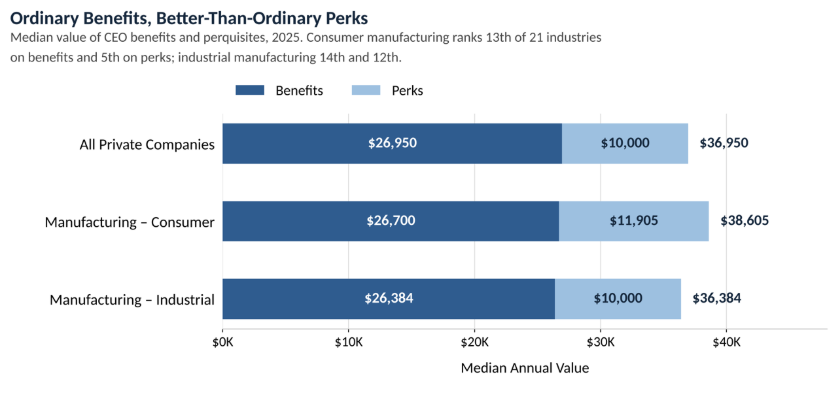
In terms of median benefits value for CEOs, manufacturing sectors are slightly below the overall market average. The median for all private companies was $26,950. Consumer manufacturing CEOs received median benefits valued at $26,700, and industrial manufacturing CEOs at $26,384. These figures place them 13th and 14th among 21 industries, below sectors like financial services, entertainment, and agriculture, but still above the median for tech companies.
However, when it comes to perks, consumer manufacturing is near the top of the market, and industrial manufacturing aligns with the median. This suggests that while core benefits might be standard, companies can differ in their approach to non-cash incentives based on ownership structure and overall compensation philosophy.
Divergent Philosophies in Non-Cash Compensation
Al Murphy, CEO of Mother Murphy’s, a prominent flavor manufacturer in the South, exemplifies a more generous approach to benefits and perks. His company covers 90% of employee healthcare costs, maintains a nurse on staff, provides access to financial advisors and enrollment counselors, and subsidizes continuing education, including executive physicals at the renowned Cooper Clinic, which he notes are valued at approximately $7,000 per person. "If you don’t have good health, what are you going to do? You don’t have really anything," Murphy explains, highlighting his philosophy of investing in employee well-being.
This proactive approach to health is a rarity. Only 17.3% of private-company CEOs receive an annual physical as a benefit, a perk now standard for Murphy’s executives. To ensure employees understand the full value of their compensation, Murphy’s company issues one-page statements detailing the total rewards package, including benefits and profit sharing, often pushing the perceived total compensation well above the base salary.
The perception of manufacturing as "no-frills" holds true for industrial manufacturing and is an overstatement for consumer manufacturing. It’s crucial to note what constitutes standard benefits. Nationally, 95.7% of CEOs receive health insurance, 85% life insurance, and 82.2% a defined contribution plan, forming the bulk of reported benefits. More discretionary perks, such as company cars or allowances, are offered to 42% of CEOs, with parking (28.2%), gym memberships (15.8%), and club memberships (12.8%) being less common. Personal technology, however, is nearly universal, with 86.1% of CEOs receiving it.
Parr Instruments’ Nelson highlights an unusual benefit for a company of its size and age: a defined benefit or pension plan, a rarity in today’s corporate landscape, with only 13.1% of private-company CEOs having one. The company also offers a generous 7.75% match on 401(k) contributions for employees who contribute at least 4%.
The Strategic Role of Equity in Executive Compensation
Long-term incentive (LTI) plans, particularly those involving equity, play a significant role in executive compensation, with their prevalence influenced by ownership structure and company size. Formal LTI plans are present in 65.3% of private equity-owned companies compared to 32.7% of family businesses. Larger companies are also more likely to offer these plans, with 77% of companies exceeding $1 billion in revenue having them, compared to 27.3% of those under $2 million.
Ensch’s company at Sani-Matic has strategically expanded its LTI program to foster ownership and retain talent. "When I got here, we had 26 people who had equity in the business… we have 42 people who have equity in the business now." This expansion is driven by the need to retain critical engineering talent, fostering a cultural shift: "There’s a lot of engineering talent that [we] want to keep… You see a mindset change when people are owners, they act differently."
Nelson’s Parr Instruments utilizes an employee stock purchase program, offering discounted shares with company financing, which he refers to as "golden handcuffs" designed for retention. Mother Murphy’s, while offering equity to a select few (less than 2% of the workforce, tied to tenure), prioritizes a comprehensive benefits and perks program over broad equity incentives.
For family manufacturers operating without formal LTI plans, the competitive hiring market is a growing pressure. Grote’s company, which previously relied on stock appreciation rights, has begun offering non-voting shares to attract top talent. "For me to compete for top talent, I have to be able to offer [a long-term equity incentive program] as well," he states. "We hired a CFO, we hired a vice president of sales. To hire at that level, you have to offer [long-term equity incentives] or they’re not even going to talk to you."
Implications and the Future of Manufacturing CEO Compensation
The median compensation figure provides a baseline understanding of what a manufacturing CEO earns, but it offers limited insight into the "how." While cash compensation, driven by company revenue, remains a standard element, equity, benefits, and perks are increasingly shaped by compensation philosophy, ownership structure, and the competitive talent landscape.
The evolving nature of these compensation packages raises critical questions about executive commitment to long-term company health, the perceived value of benefits and perks by executives, and how compensation structures adapt during economic downturns. These decisions are not solely dictated by market competition but are intrinsically linked to the overarching strategic objectives of each manufacturing enterprise. As the industry navigates technological advancements, global economic shifts, and evolving workforce expectations, the ways in which manufacturing CEOs are compensated will undoubtedly continue to adapt, reflecting a dynamic balance between rewarding performance and fostering sustainable growth.
For more in-depth benchmarks by company size, industry, and ownership structure, the Chief Executive Group Research’s latest CEO & Senior Executive Compensation Report offers extensive data and analysis.
