

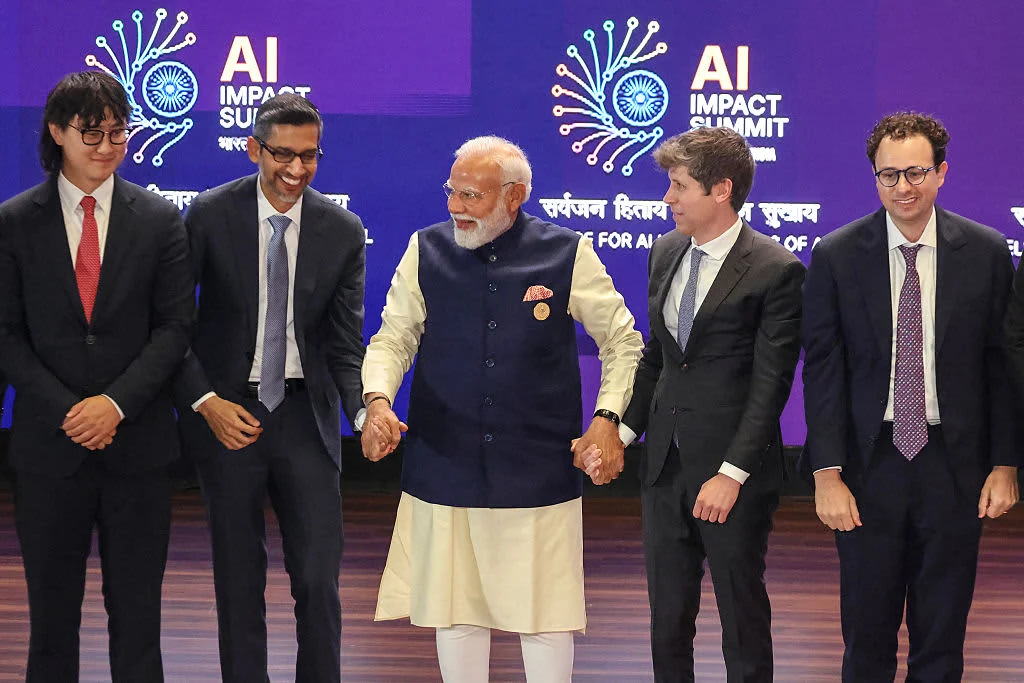
The global landscape of geopolitical diplomacy is undergoing a fundamental shift as the race for Artificial Intelligence (AI) supremacy intensifies. No longer confined to the halls of trade ministries or regulatory bodies, the pursuit of technological leadership has moved into the realm of personal high-stakes diplomacy. Leading this charge are French President Emmanuel Macron and Indian Prime Minister Narendra Modi, both of whom have launched aggressive, personalized "charm offensives" designed to court the world’s most powerful technology CEOs. By leveraging direct relationships, personal text messaging, and high-profile summits, these two leaders are bypassing traditional bureaucratic channels to secure tens of billions of dollars in investment and critical AI infrastructure projects.
As nations scramble to develop the data centers, semiconductor ecosystems, and sovereign foundation models required to power the next industrial revolution, France and India have emerged as frontrunners in using executive-level persuasion to anchor global tech giants within their borders. This strategy reflects a broader understanding that AI is not merely a commercial tool but a cornerstone of national security and economic sovereignty.
The French Strategy: Nuclear Power and Personal Persuasion
President Emmanuel Macron has positioned France as Europe’s premier destination for AI investment by emphasizing the country’s unique infrastructure advantages and his own accessibility. Central to Macron’s strategy is the "Choose France" initiative, which he has used to signal that the French state is a willing and active partner for Silicon Valley and global venture capital.
The most significant recent victory for the French administration came in May 2026, when SoftBank announced a massive €75 billion program to roll out 5 gigawatts (GW) of AI data center capacity across Europe. Of this, 3.1 GW is slated for construction in France by 2031. The deal was not the result of standard tender processes but was instead forged through direct communication between Macron and SoftBank CEO Masayoshi Son.
According to Son, the relationship began with a personal request from Macron for a meeting to discuss the project. Over the following months, the two leaders exchanged text messages to hash out technical details. A critical turning point in the negotiations occurred when Macron offered to secure 3 GW of power capacity for SoftBank’s projects—exceeding the 2 GW originally suggested by the French government. Macron’s primary "carrot" was France’s robust nuclear energy sector, which provides a stable, low-carbon source of electricity—a prerequisite for the massive energy demands of modern AI clusters.
This personal touch extended to the G7 summit in June 2026. Macron, as the host, organized a high-level working lunch that brought together world leaders, including U.S. President Donald Trump, and a "who’s who" of the AI world. Attendees included OpenAI CEO Sam Altman, Anthropic’s Dario Amodei, and Google DeepMind’s Demis Hassabis. By placing these CEOs at the same table as heads of state, Macron reinforced the idea that AI leaders are now pivotal geopolitical actors. The presence of domestic champions like Mistral AI’s Arthur Mensch alongside international giants like Cohere’s Aidan Gomez and Black Forest Labs’ Robin Rombach further signaled Macron’s intent to build a hybrid ecosystem of local talent and foreign capital.
India’s Ambition: Scaling the "India Stack" for AI
While Macron leverages energy and proximity to European markets, Prime Minister Narendra Modi is utilizing India’s massive scale, data potential, and demographic dividend to attract tech leaders. For Modi, the urgency is driven by a need to catch up. Despite its prowess in software services, India has historically lagged in hardware manufacturing and the development of frontier-scale foundation models.
Modi’s strategy has been to frame India as the "future of AI" rather than a mere consumer. At the Global AI Summit in New Delhi in February 2026, Modi told an audience of global executives that India does not fear AI but sees it as a "fortune." He urged companies to "Design and Develop in India," promising that the country would serve as the world’s testing ground for scalable AI solutions.
The results of this outreach have been substantial. Last Thursday, Modi met with Amazon CEO Andy Jassy, welcoming a record $48 billion investment commitment in the country. Of this total, $21 billion is specifically earmarked for AI and cloud infrastructure. This follows a string of similar successes:
- Microsoft: Secured its largest investment in Asia to date in India, focused on building "sovereign AI" capabilities.
- Google: Announced a $15 billion investment to establish its largest AI hub outside the United States.
- Intel: CEO Lip-Bu Tan committed to helping develop the local chip ecosystem, signing on as a prospective buyer for chips produced by domestic firms.
To facilitate these investments, the Modi government has introduced aggressive fiscal incentives, including long-term tax breaks for "hyperscalers" (large-scale cloud providers) who build data centers on Indian soil. This is part of a broader effort to ensure that India is not vulnerable to foreign export controls on computing hardware.
A Chronology of Personal Diplomacy (2023–2026)
The current surge in investment is the culmination of a multi-year effort by both leaders to cultivate the tech elite:
- December 2023: PM Modi meets with Intel’s Lip-Bu Tan to discuss the "India Semiconductor Mission," laying the groundwork for hardware manufacturing.
- June 2025: President Macron hosts the first "AI Sovereignty Forum" in Paris, inviting venture capitalists and researchers to discuss European autonomy.
- October 2025: Google announces its $15 billion AI hub in India following a series of virtual meetings between Modi and Sundar Pichai.
- February 2026: The Global AI Impact Summit in New Delhi sees commitments from Meta, OpenAI, and Anthropic to support India’s local language AI models.
- May 2026: SoftBank’s Masayoshi Son and Macron finalize the 3.1 GW data center deal via personal correspondence.
- June 2026: Macron hosts the G7 AI lunch, bridging the gap between Silicon Valley and the world’s largest economies.
- July 2026: Amazon confirms its $48 billion investment in India, the largest in the company’s history in the region.
The Semiconductor Pillar: ASML and Tata Electronics
A critical component of the AI race is the underlying hardware—specifically, the semiconductors required to train large language models. India has made significant strides here by linking AI infrastructure with manufacturing. During a state visit to the Netherlands in May 2026, Modi witnessed the signing of a landmark agreement between Dutch lithography giant ASML and Tata Electronics.
ASML, which holds a virtual monopoly on the advanced machines needed to print the world’s most sophisticated chips, agreed to supply lithography tools for a 300mm semiconductor fab being established by Tata. This move is intended to break India’s reliance on foreign chip imports, which currently makes its AI ambitions vulnerable to global supply chain disruptions and geopolitical export directives. By securing both the "brains" (AI models) and the "bricks" (silicon manufacturing), Modi is attempting to create a self-sustaining technological loop.
Comparative Analysis: Two Paths to Sovereignty
While both Macron and Modi are pursuing "Sovereign AI," their approaches differ based on national strengths:
- Energy vs. Labor: Macron’s primary leverage is France’s energy independence through nuclear power. AI data centers are notoriously energy-hungry; by guaranteeing 3 GW of clean power, Macron solves the single biggest bottleneck for companies like SoftBank. Modi, conversely, offers the world’s largest pool of developers and a massive, diverse dataset that is essential for training AI to be globally representative.
- Regulatory Philosophy: France operates within the European Union’s regulatory framework, including the AI Act. Macron’s charm offensive is partly an attempt to show that "regulation does not mean a lack of innovation." India, meanwhile, has taken a more "pro-innovation" stance, offering tax breaks and fewer initial hurdles to encourage rapid deployment.
- Domestic Champions: France has successfully nurtured domestic "frontier" companies like Mistral AI, which Macron frequently showcases as evidence that Europe can compete with the U.S. India is still in the phase of attracting foreign platforms while building the underlying "India Stack" to ensure that these platforms benefit the local economy.
Broader Implications and Geopolitical Risks
The personal involvement of Macron and Modi highlights a new reality: the tech industry is now a branch of national defense. The "sovereign AI" movement seeks to ensure that a country’s data, culture, and economic future are not entirely dependent on proprietary models from a single foreign power—namely the United States or China.
However, this rush to attract investment also carries risks. The global AI stock rally has largely skipped India’s domestic markets because the country lacks a large-scale, publicly traded AI "pure play" company. Most of the investment is flowing into the Indian subsidiaries of U.S. giants. This explains Modi’s urgency; without domestic hardware and foundational models, India risks becoming a "digital colony" that provides labor and data but does not own the intellectual property.
For France, the challenge lies in scaling. While 3 GW of data center capacity is a massive achievement, it requires a significant upgrade to the national grid and could face local environmental opposition. Furthermore, the reliance on personal relationships between a President and a CEO can be fragile; should political leadership change, the "handshake deals" may face scrutiny or reversal.
Conclusion
The "charm offensives" of Emmanuel Macron and Narendra Modi represent a maturation of the AI era. As the technology moves from experimental chat-bots to critical national infrastructure, the leaders of the world’s major economies are increasingly acting as "Closers-in-Chief." By offering direct access, infrastructure guarantees, and a clear vision for the future, France and India are setting a blueprint for how nations must compete in a world where silicon and code are the new currency of power. The success of these personal diplomatic efforts will likely determine which nations lead the AI-driven economy of the 2030s and which are left to follow.
