

A recurring market update from Intrepid Investment Bankers highlights transaction activity, valuation trends, and capital markets developments affecting middle-market companies. This latest analysis, focusing on the second quarter of 2026 and extending through September, reveals a dynamic landscape characterized by a significant surge in global freight spot rates juxtaposed with stable industrial margins and improving industrial production growth. The implications of these diverging trends for middle-market businesses are substantial, particularly concerning valuation, strategic positioning, and the timing of potential transactions.
Freight Rates Surge Amidst Stable Industrial Margins: A Divergent Market Signal
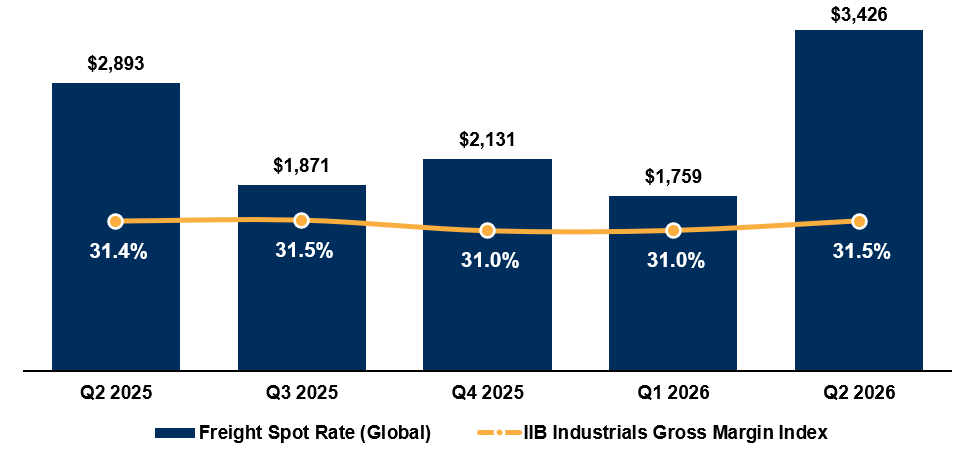
The second quarter of 2026 witnessed a dramatic escalation in global freight spot rates, a stark contrast to the relatively subdued activity observed in late 2025 and early 2026. These elevated rates persisted through September, signaling a potential shift in transportation cost dynamics. Concurrently, industrial margins, a key indicator of operational health for a broad spectrum of businesses, remained remarkably stable. Industrial production growth, while modest, also demonstrated an upward trend towards the end of the period.
This divergence presents a critical question for middle-market companies: are the recent spikes in freight costs a temporary anomaly or the harbinger of a more sustained increase in transportation expenditures? While freight costs are particularly pertinent to industrial sectors, the underlying message resonates across the entire M&A landscape. Capital providers and strategic buyers are increasingly prioritizing businesses that can unequivocally demonstrate resilience in their profit margins, possess demonstrable pricing power, and exhibit a robust capacity to navigate and mitigate volatile input costs.
The Freight Frenzy: A Deep Dive into Rate Fluctuations
The data paints a clear picture of this market dichotomy. Global freight spot rates, as tracked by the Freightos Baltic Index, experienced a significant jump from an average of $1,759 in the first quarter of 2026 to $3,426 in the second quarter. This upward trajectory continued, with rates peaking at $3,627 in July before moderating slightly to $3,380 by September. This represents an increase of nearly 100% from Q1 to Q2.
In parallel, Intrepid Investment Bankers’ proprietary industrial margins index, which meticulously monitors gross margins across approximately 150 publicly traded companies spanning the entirety of the industrial value chain, indicated minimal fluctuation. From the second quarter of 2025 through the second quarter of 2026, this index maintained a tight range, fluctuating between 31.0% and 31.5%. This stability in industrial margins, despite the dramatic rise in shipping costs, suggests that many companies have managed to absorb or pass on increased freight expenses without significantly impacting their core profitability.
Further monthly data from April to September 2026 corroborates this trend. Freight rates escalated from $1,889 in April to their July peak, then settled to $3,380 in September. During this same period, industrial production growth, a key economic barometer, remained positive, ticking up from a modest 0.1% in August to 0.7% in September. This indicates that while freight costs were soaring, the underlying engine of industrial activity was showing signs of improvement, rather than contraction.
Implications for Middle-Market M&A: Resilience as the New Premium
The stability of industrial margins in the face of soaring freight costs is a critical insight for the M&A market. It suggests that while transportation is a significant cost component, companies with strong operational fundamentals and effective pricing strategies can mitigate its impact. For potential buyers and investors, this period of cost volatility underscores the paramount importance of scrutinizing a target company’s ability to protect its profit margins.
Businesses that can showcase:
- Robust Pricing Power: The ability to adjust prices to reflect rising input costs without experiencing a significant drop in demand. This is often a function of brand strength, product differentiation, or a loyal customer base.
- Flexible Cost Structures: Agility in adjusting operational expenses in response to market shifts. This could involve diversified supply chains, lean manufacturing processes, or adaptable labor models.
- Diversified Supplier and Vendor Relationships: Reducing reliance on any single supplier or vendor minimizes the risk of disruption and price gouging. A broad network allows for greater negotiation leverage and alternative sourcing options.
These characteristics are increasingly becoming key differentiators, positioning companies more favorably for navigating market volatility and supporting a more durable and predictable earnings profile, which is highly valued by acquirers and capital providers.
Valuation Considerations in a Volatile Cost Environment
The current market environment necessitates a nuanced approach to valuation. Buyers will be meticulously assessing whether the recent performance in industrial margins can be sustained, particularly if key input costs, such as freight, continue to be volatile. Companies that can provide a clear and compelling narrative of effective cost recovery mechanisms, disciplined pricing strategies, and demonstrated margin resilience will likely command higher valuations.
The ability to pass on increased costs is no longer a given; it’s a proven capability that adds significant value. Furthermore, businesses that have proactively diversified their supply chains, explored alternative logistics solutions, or invested in technology to optimize their transportation spend will be viewed as more attractive acquisition targets. The "normalized" earnings of a business will be scrutinized more closely, with a focus on the underlying operational strength that allows for margin protection.
Strategic Positioning: The Premium on Operational Flexibility
In an era marked by unpredictable economic shifts, operational flexibility is emerging as a crucial competitive advantage. Middle-market companies that can demonstrate agility in their operations will be better positioned to attract investment and achieve favorable transaction terms. This includes:
- Agile Supply Chains: The capacity to quickly adapt to changes in supplier availability, lead times, or shipping routes. This might involve nearshoring or reshoring strategies, or maintaining relationships with a wider array of global suppliers.
- Dynamic Pricing Models: Implementing pricing strategies that can adjust rapidly to fluctuations in input costs or market demand, without alienating customer bases.
- Technological Adoption: Leveraging technology for demand forecasting, inventory management, and logistics optimization can significantly enhance a company’s ability to control costs and respond to market changes.
- Strong Customer Relationships: Deeply embedded relationships with customers, often built on a foundation of reliable service and high-quality products, can provide a buffer against pricing pressures.
The emphasis is shifting from simply having a good product or service to demonstrating the operational fortitude to deliver it consistently and profitably, regardless of external market shocks.
Timing the Market: Clarity on Underlying Performance
For owners considering a strategic transaction, the current environment demands meticulous preparation and clear communication. It is imperative to be prepared to articulate precisely how changing costs, particularly freight, have impacted profitability and working capital requirements. Distinguishing between temporary, cyclical impacts and fundamental shifts in operating performance is crucial.
Buyers and capital providers will be seeking to understand the "true" earnings power of a business, adjusted for any transient cost pressures. This requires detailed financial reporting and a transparent explanation of any non-recurring expenses or revenue impacts. By clearly demonstrating the durability of margins and the underlying strength of their business model, owners can facilitate a smoother and more favorable valuation process. The narrative should focus on resilience and the strategic initiatives that have enabled the business to thrive amidst challenging conditions.
Broader Economic Context and Historical Parallels
The surge in freight rates in 2026 is not an isolated event but rather part of a broader global economic recalibration. Following the disruptions of the early 2020s, which saw supply chain bottlenecks and elevated shipping costs due to increased demand and port congestion, the market has been in a state of flux. While there were periods of cooling in late 2025 and early 2026, the resurgence in Q2 2026 suggests that underlying pressures, potentially including renewed global trade activity, geopolitical factors affecting shipping lanes, or even shifts in consumer demand patterns, have resurfaced.
Historically, periods of significant freight cost increases have often been followed by either sustained inflation across the economy or a strategic re-evaluation of supply chain strategies by businesses. The stability of industrial margins in this instance is a positive sign, suggesting that the manufacturing and industrial sectors have learned from past experiences and have implemented more robust cost management and pricing strategies. However, the longevity of this stability remains a key watchpoint for market participants.
Expert Commentary and Outlook
While this report is based on data compiled by Intrepid Investment Bankers and its data partners, market participants consistently emphasize the importance of proactive strategic planning. Industry analysts have noted that companies that have invested in logistics optimization, diversified their transportation partners, and secured long-term freight contracts are better insulated from spot market volatility. The ability to forecast and manage transportation spend effectively is no longer a secondary operational concern but a primary driver of profitability.
The outlook suggests a continued focus on resilience and adaptability within the middle market. As businesses navigate this period of elevated transportation costs and potential inflationary pressures, those that can demonstrate strong operational control, strategic foresight, and a clear path to sustained profitability will be the most attractive to investors and acquirers.
About Intrepid Investment Bankers
Intrepid Investment Bankers is a premier middle-market investment bank dedicated to providing comprehensive M&A, capital raising, and strategic advisory services. As a proud member of MUFG, one of the world’s largest and most respected financial institutions, Intrepid leverages its deep industry expertise, senior-level execution capabilities, and extensive global resources to empower clients in achieving their most ambitious strategic objectives.
Connect with Intrepid
For business owners, investors, and corporate leaders seeking to understand the intricate dynamics of today’s market, Intrepid Investment Bankers offers expert guidance. Whether your interests lie in understanding current market conditions, navigating valuation complexities, exploring capital raising opportunities, or analyzing transaction activity, Intrepid’s seasoned team is available to discuss the trends shaping the M&A environment and their potential implications for your enterprise.
