

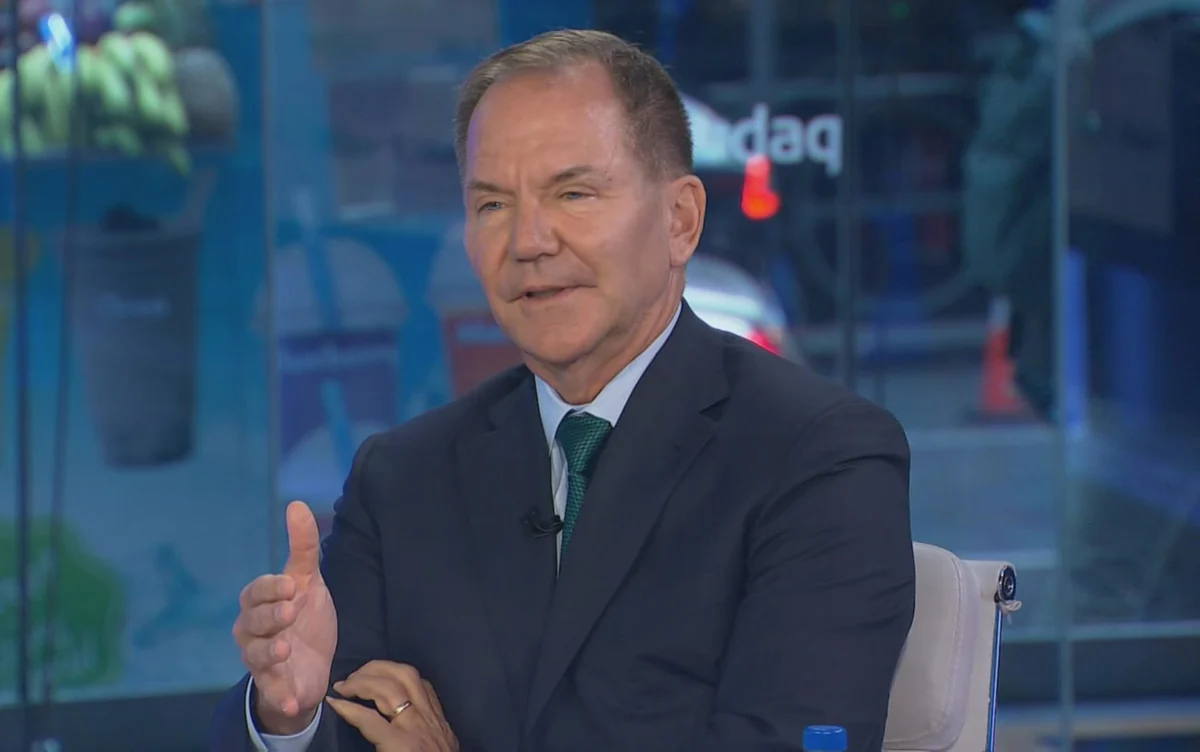
Incoming Federal Reserve Chair Kevin Warsh is unlikely to pursue interest rate cuts and may even consider increasing them, according to prominent investor Paul Tudor Jones. This perspective challenges the prevailing sentiment and offers a glimpse into the potential policy direction under Warsh’s leadership, particularly as the central bank navigates a complex economic landscape marked by persistent inflation and geopolitical uncertainties.
Jones, speaking on CNBC’s "Squawk Box," expressed strong conviction against any immediate move towards rate reductions. "Do I think he’ll cut rates? No chance," he stated definitively. This assertion comes at a time when the Federal Reserve’s benchmark overnight interest rate remains in a range of 3.5%-3.75%, a level it has held since December. While previous signals from Warsh have suggested an openness to monetary easing, the incoming Chair will face a Federal Open Market Committee (FOMC) grappling with significant internal dissent. The committee’s most recent meeting saw the highest number of dissenting votes in nearly 34 years, with regional Federal Reserve presidents voicing objections to language in the post-meeting statement that was interpreted as an inclination towards further rate cuts. These regional leaders had specifically opposed any hint of a future easing cycle, particularly following the three rate reductions implemented in the latter half of 2025.
A Case for Monetary Tightening
Paul Tudor Jones elaborated on his reasoning, suggesting that a more hawkish approach might be warranted. "Well, I’d be thinking about raising them," he remarked, emphasizing the need to closely monitor incoming economic data. "But I mean, for sure you’d be thinking about it. And I think he’s going to be constrained before the election." This sentiment underscores a broader debate within financial circles about the appropriate monetary policy response to current economic conditions.
The economic environment facing the Federal Reserve is characterized by a seemingly stable labor market, which has shown resilience despite earlier concerns. However, this stability is juxtaposed with significant inflationary pressures. The prolonged conflict in Iran, coupled with the ongoing tariffs imposed by the Trump administration, has contributed to inflation remaining substantially above the Federal Reserve’s target of 2%. The latest Personal Consumption Expenditures (PCE) price index data for March 2026, released on April 30th, confirmed this persistent inflation challenge, highlighting the delicate balancing act for policymakers.
Market Expectations and the FedWatch Gauge
Futures traders, as reflected in the CME Group’s FedWatch gauge, are currently pricing in a scenario where the Federal Reserve maintains its current interest rate throughout the year. The gauge indicates slight and roughly equal probabilities of either a rate cut or a rate hike by year-end, suggesting a high degree of uncertainty and a divided market outlook. This divergence in market expectations mirrors the internal divisions within the FOMC, setting the stage for a potentially dynamic period under Warsh’s leadership.
Background Context: The Path to Warsh’s Chairmanship
Kevin Warsh’s nomination for the Federal Reserve Chair position followed a period of intense scrutiny and debate regarding the central bank’s monetary policy trajectory. Appointed by President Donald Trump, Warsh’s views on monetary policy have often been characterized as more aligned with a traditionalist approach, emphasizing price stability and fiscal discipline. His confirmation hearing, held on April 21, 2026, provided an early platform for him to articulate his economic philosophy. During this hearing, Warsh acknowledged the Federal Reserve’s mandate to foster maximum employment and stable prices, while also hinting at a more cautious approach to monetary easing.
The period leading up to Warsh’s potential tenure has been marked by a series of interest rate adjustments. The Fed implemented three rate cuts in the latter half of 2025, a move that aimed to stimulate economic growth amidst lingering uncertainties. However, these cuts were met with skepticism by some regional Fed presidents, who expressed concerns that they might inadvertently fuel inflation or signal a premature shift away from monetary restraint. The dissents registered at the April 2026 FOMC meeting, as reported on April 29th, underscored these internal disagreements, with several regional presidents specifically objecting to any language that could be construed as a commitment to further easing. This internal discord highlights the challenges Warsh will face in forging a unified policy path.
Economic Indicators and Inflationary Pressures
The economic backdrop against which Warsh will assume leadership is complex. While the labor market has demonstrated resilience, with unemployment rates holding steady and job creation continuing, inflation has proven to be a stubborn adversary. The persistence of inflation above the 2% target can be attributed to a confluence of factors. The ongoing geopolitical tensions, particularly the war in Iran, have disrupted global supply chains and contributed to higher energy prices. Additionally, the trade policies enacted by the Trump administration, including the imposition of tariffs on various goods, have had an impact on the cost of imported products, further contributing to inflationary pressures.
Data released by the Bureau of Economic Analysis (BEA) has consistently shown inflation metrics, such as the PCE price index, exceeding the Federal Reserve’s desired level. For instance, the PCE price index, a key inflation gauge favored by the Fed, has shown a sustained upward trend, prompting concerns about the erosion of purchasing power and the potential for wage-price spirals. The Fed’s dual mandate of maintaining price stability and fostering maximum employment means that any policy decision must carefully weigh these competing objectives.
The Presidential Election Factor
Paul Tudor Jones’s observation that Warsh will be "constrained before the election" alludes to the significant political considerations that often influence the Federal Reserve’s actions, particularly in an election year. The Federal Reserve operates with a mandate of independence from direct political pressure. However, the economic performance and the public’s perception of the central bank’s effectiveness can have a profound impact on the political landscape.
In an election year, policymakers may feel an implicit pressure to avoid actions that could be perceived as detrimental to economic growth or that could exacerbate inflation, both of which could become focal points of political campaigns. This dynamic can create a challenging environment for monetary policy, where decisions are often scrutinized through a political lens. Warsh, as the incoming Chair, will need to navigate this delicate balance, ensuring that policy decisions are guided by economic fundamentals rather than short-term political expediency. The upcoming presidential election will undoubtedly add another layer of complexity to the already intricate economic challenges.
Implications of a Hawkish Stance
If Kevin Warsh indeed steers the Federal Reserve towards a more hawkish monetary policy, the implications for financial markets and the broader economy could be significant. A sustained period of higher interest rates could lead to:
- Increased Borrowing Costs: Businesses and consumers would face higher costs for loans, potentially dampening investment and consumer spending. This could slow down economic growth.
- Strengthened U.S. Dollar: Higher interest rates can attract foreign capital, leading to a stronger U.S. dollar. This would make U.S. exports more expensive and imports cheaper, potentially impacting trade balances.
- Impact on Asset Prices: Higher interest rates can put downward pressure on asset prices, including stocks and bonds, as investors seek higher yields elsewhere.
- Inflation Control: The primary objective of a hawkish stance is to curb inflation. By making borrowing more expensive and reducing aggregate demand, higher interest rates can help cool down an overheating economy and bring inflation back towards the Fed’s target.
Conversely, a premature or overly aggressive tightening of monetary policy could risk triggering a recession, especially if the economy is already showing signs of weakness. The challenge for Warsh and the FOMC will be to calibrate policy finely, striking a balance between combating inflation and supporting sustainable economic growth.
Potential Reactions from Other Parties
While official statements from other key economic actors are not yet available, one can anticipate a range of reactions to a potential shift towards higher interest rates.
- Financial Markets: Market participants, including banks, investment firms, and individual investors, will closely monitor the Fed’s actions and statements. A move towards rate hikes could lead to increased volatility in bond and equity markets.
- Businesses: Corporations, particularly those with significant debt, may express concerns about rising borrowing costs. Small businesses, which often have tighter margins, could be particularly affected.
- Consumers: Households with variable-rate debt, such as mortgages or credit cards, would see their payments increase. Consumers may also face higher costs for major purchases financed by loans.
- International Bodies: International organizations like the International Monetary Fund (IMF) and the World Bank would likely observe the Fed’s policy decisions, as they can have ripple effects on the global economy.
The Federal Reserve’s decisions are closely watched globally, and any significant shift in its monetary policy stance will undoubtedly be a subject of extensive analysis and discussion among policymakers, economists, and market participants worldwide. The coming months will reveal whether Paul Tudor Jones’s prediction of a more hawkish Federal Reserve under Kevin Warsh proves accurate, and how this potential policy shift will shape the economic landscape.
