

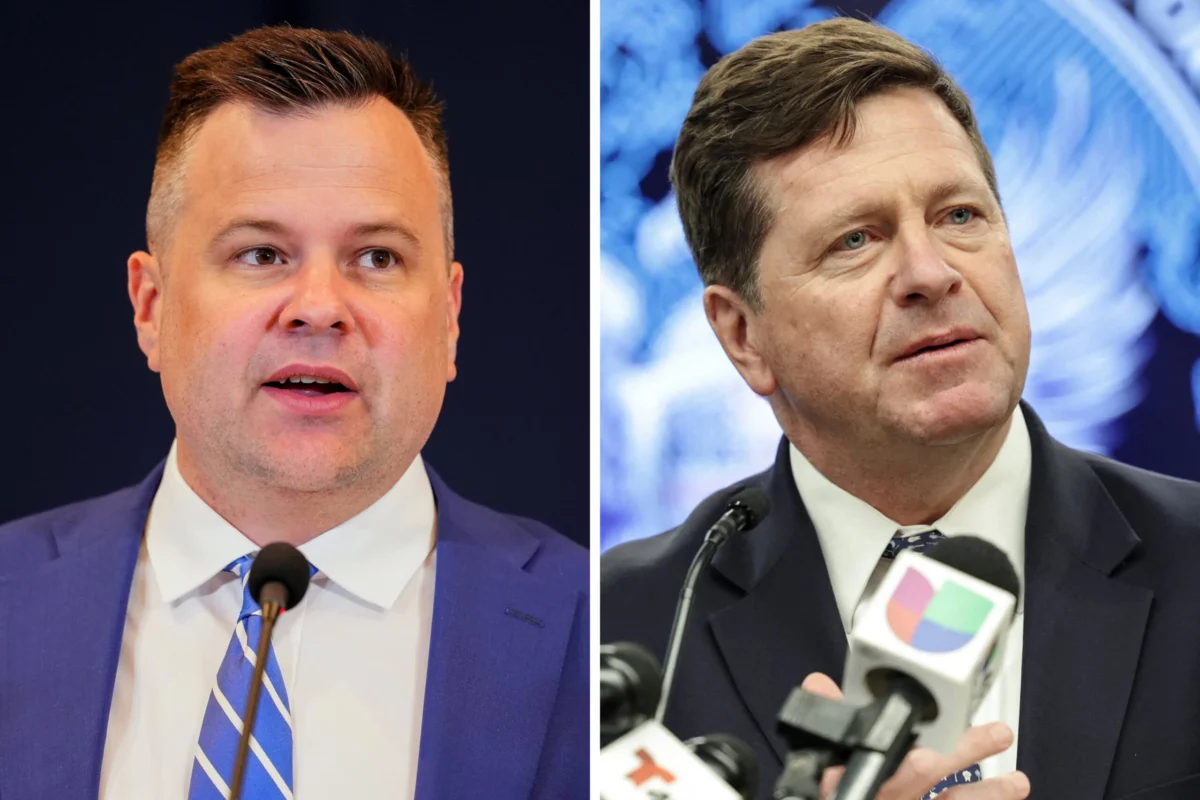
President Donald Trump on Wednesday unexpectedly announced the cancellation of the Senate confirmation hearing for Jay Clayton, his nominee for Director of National Intelligence (DNI), a move that immediately cast a shadow over efforts to reauthorize a crucial intelligence-gathering authority, Section 702 of the Foreign Intelligence Surveillance Act (FISA), which had already lapsed. Clayton, currently serving as the U.S. Attorney for the Southern District of New York (SDNY), was widely seen as a candidate with a strong legal background and potential for bipartisan support, making his stalled confirmation a significant blow to the administration’s national security agenda. The president’s decision, communicated via social media hours before the scheduled hearing, triggered a cascade of reactions from Capitol Hill, highlighting deep partisan divisions and raising concerns about the functionality of key government processes during a critical period for national security.
Background to the DNI Nomination and Its Significance
The role of the Director of National Intelligence was established in 2004 by the Intelligence Reform and Terrorism Prevention Act, a direct response to failures identified by the 9/11 Commission. Tasked with overseeing and integrating the efforts of the entire U.S. Intelligence Community (IC), which comprises 18 agencies, the DNI serves as the principal intelligence advisor to the President. This position is vital for ensuring coherence, effectiveness, and accountability across the IC, especially in an era of complex global threats ranging from terrorism and cyber warfare to foreign adversary influence. Jay Clayton, with his background as a prominent attorney and federal prosecutor, was nominated by President Trump to fill this pivotal role. His previous experience at the helm of the SDNY, a highly influential and independent U.S. Attorney’s office known for its aggressive pursuit of financial crimes, terrorism, and public corruption, was often cited as a qualification demonstrating his capacity for leadership and legal acumen. Despite his lack of direct intelligence community experience, Clayton’s nomination had garnered some bipartisan interest, with hopes that his confirmation could help stabilize the DNI office, which had seen several acting directors.
A Day of Political Tumult: The Chronology of Cancellation
The dramatic turn of events unfolded rapidly on Wednesday morning. The Senate Intelligence Committee had scheduled Clayton’s confirmation hearing for the afternoon, anticipating a relatively straightforward process given the perceived qualifications of the nominee. However, before the committee could convene, President Trump took to Truth Social, his preferred social media platform, to declare the hearing canceled. In a series of posts, he articulated a list of grievances and demands that effectively halted the confirmation process.
Firstly, Trump explicitly linked Clayton’s confirmation to the approval of Jamie McDonald, his pick to succeed Clayton as U.S. Attorney for the SDNY. "Regarding the approval of our Great Patriot, Jay Clayton, we are cancelling the Senate Hearing RE: DNI today, and will not be going forward until Jamie McDonald is approved to be U.S. Attorney," Trump wrote. This demand introduced a new layer of complexity, as sources familiar with McDonald’s nomination indicated that the White House had not even formally sent it to the Senate for consideration, suggesting a potentially lengthy delay before any progress could be made on that front.
Secondly, the president reiterated his support for Bill Pulte, the current acting Director of National Intelligence, stating, "In the meantime, Bill Pulte will remain as the Acting Director of National Intelligence." This was a direct response to a major point of contention with Democrats, who had vehemently opposed Pulte’s continued presence in the acting role, citing his lack of intelligence experience and concerns about his perceived partisanship.
Hours after the president’s social media pronouncements, Senator Tom Cotton, R-Ark., who chairs the Senate Intelligence Committee, confirmed the cancellation. Cotton expressed regret over the development but reaffirmed his support for Clayton, stating in an X post, "It’s regrettable that the president has directed Jay Clayton not to appear at his confirmation hearing today. Mr. Clayton is a patriot and a highly qualified nominee, as the president has said repeatedly. While today’s hearing is now unfortunately postponed, I look forward to proceeding with his confirmation in the near future." This official confirmation underscored the severity of the president’s intervention and its immediate impact on the legislative calendar.
The Crucial Stakes: FISA Section 702 Reauthorization
The immediate and most significant casualty of Clayton’s stalled confirmation is the reauthorization of Section 702 of the Foreign Intelligence Surveillance Act (FISA). This critical intelligence authority, which allows for the warrantless surveillance of non-U.S. persons located outside the United States for foreign intelligence purposes, expired last week. Section 702 is a cornerstone of U.S. national security efforts, providing intelligence agencies like the National Security Agency (NSA), the Federal Bureau of Investigation (FBI), and the Central Intelligence Agency (CIA) with vital tools to track terrorists, cybercriminals, and foreign adversaries. The intelligence gathered under Section 702 is often described as some of the most crucial and timely information used to protect the nation from a wide array of threats.
Despite its recognized importance, Section 702 has also been a perennial source of controversy. Critics, including civil liberties advocates and some lawmakers, have raised concerns about the potential for "incidental collection" of communications involving U.S. persons. While the primary target must be a non-U.S. person abroad, communications between foreign targets and Americans can be collected. Although strict rules govern access to and querying of this data, past instances of FBI analysts improperly searching U.S. persons’ data have fueled calls for reform and greater oversight. Consequently, the reauthorization process has often been fraught with intense debate over balancing national security needs with privacy protections. The current lapse means that intelligence agencies are operating without a key legal authority, potentially creating gaps in critical intelligence gathering at a time of heightened global instability.

The Pulte Factor: A Partisan Flashpoint
Central to the ongoing gridlock is the figure of Bill Pulte, whom President Trump insists should remain as acting DNI. Pulte’s appointment as acting DNI, following his previous role at the Federal Housing Finance Agency (FHFA), has been met with fierce opposition from Democrats. Their objections stem primarily from his perceived lack of experience in intelligence matters and accusations of partisanship. Critics view Pulte as a political operative rather than an impartial intelligence leader, alleging that he used his position within a federal housing agency to initiate investigations or prosecutions against individuals deemed "enemies" of the president. This perception has led Democrats to vow that they would not support the reauthorization of FISA Section 702 as long as Pulte remained in the acting DNI post. They argue that the integrity and independence of the intelligence community are paramount, and that an acting DNI seen as highly partisan undermines these principles, especially in the sensitive role of overseeing the nation’s intelligence apparatus. President Trump’s insistence on Pulte’s interim leadership, despite widespread Democratic opposition and even some Republican discomfort, demonstrates a clear willingness to use the DNI position as a leverage point in broader political battles.
The "SAVE America Act" Demand: Merging National Security with Domestic Politics
Adding another layer of complexity to an already convoluted situation, President Trump also demanded that the controversial "SAVE America Act" be attached to the FISA reauthorization bill. "Therefore, to add a slight bit of intrigue but, for the Good of the Nation, and the People of our Country, I will not approve FISA without THE SAVE AMERICA ACT going along with it," he stated on Truth Social. The SAVE America Act is a proposed piece of legislation focused on voter identification and electoral reforms, which Democrats view as a restrictive voter-ID bill designed to suppress voting access. This demand effectively intertwines a critical national security measure with a highly divisive domestic political issue, further complicating the path to any legislative agreement. Democrats have consistently stated their opposition to the SAVE America Act, making it highly improbable that they would agree to its inclusion in a must-pass intelligence bill. This strategic maneuver by the president significantly raises the stakes, transforming what should be a bipartisan effort to safeguard national security into a multi-front political battleground.
Reactions from Capitol Hill: Frustration and Uncertainty
The president’s abrupt intervention sent ripples of frustration across Capitol Hill, even among some of his Republican allies. Senate Majority Leader John Thune, R-S.D., acknowledged the new reality, stating that the Senate would "have to take it a day at a time til we get more clarity on kind of what the White House position is." This sentiment reflects the uncertainty that now surrounds both Clayton’s nomination and the future of FISA reauthorization.
Senator Kevin Cramer, R-N.D., a known Trump ally, openly expressed his disappointment: "Frankly, I was disappointed again that while Sen. Thune has very meticulously and skillfully managed a process that ends up with another Trump victory gets upended by an impulsive post of some sort. It’s frustrating, but it’s also not that abnormal these days." Cramer’s comments highlight a recurring theme in the Trump administration: the president’s tendency to disrupt carefully orchestrated legislative strategies with last-minute, unilateral declarations.
Democrats, meanwhile, seized on the moment to criticize the White House’s handling of critical national security matters. Senator Mark Warner, D-Va., the ranking member of the Intelligence Committee, characterized Trump’s about-face as an "extraordinary display of dysfunction." He further elaborated, "The president’s latest intervention only underscores a simple reality: the biggest obstacle to resolving these issues has not been Senate Democrats or Senate Republicans. It has been the chaos and confusion coming from the White House itself." Warner’s remarks underscore a prevalent Democratic narrative that attributes the current political paralysis to the president’s unpredictable decision-making and willingness to prioritize political demands over established governmental processes. He even publicly questioned Clayton’s true status, musing, "I wonder whether Jay Clayton knows whether he has been postponed or withdrawn," highlighting the ambiguity created by the president’s social media directive.
Broader Implications and the Path Forward
The cancellation of Jay Clayton’s DNI confirmation hearing, coupled with the president’s new demands, has profound implications for national security, inter-branch relations, and the overall functionality of the U.S. government. The prolonged lapse of FISA Section 702 represents a tangible risk to the nation’s ability to detect and neutralize foreign threats, potentially leaving intelligence gaps that adversaries could exploit. The politicization of the DNI role, particularly with an acting director seen as unqualified and partisan by a significant portion of Congress, further exacerbates concerns about the integrity and independence of the intelligence community.
Moreover, the attempt to link a vital national security reauthorization to a controversial domestic voter ID bill introduces an unprecedented level of political leverage that threatens to gridlock legislative progress indefinitely. It suggests a willingness to hold essential government functions hostage to unrelated political agendas, a strategy that could have far-reaching negative consequences for the nation. The episode also underscores the challenges faced by Senate leadership in managing a complex legislative agenda when confronted with unexpected directives from the executive branch.
The path forward appears fraught with obstacles. Resolution would likely require either President Trump to relent on his demands regarding Jamie McDonald, Bill Pulte, and the SAVE America Act, or for a significant compromise to be brokered between the White House and Congress. Given the entrenched positions and high stakes involved, such a compromise seems elusive in the immediate future. The fate of Jay Clayton’s nomination remains uncertain, caught in a broader political maelstrom that prioritizes leverage and partisan battles over the expeditious fulfillment of critical national security roles. The "chaos and confusion" noted by Senator Warner may well continue to define the landscape of national security policymaking for the foreseeable future, with potentially serious ramifications for the safety and stability of the nation.
