

Community bonds have emerged as a pivotal financial instrument in Canada, bridging the gap between local capital and social infrastructure projects while offering a unique alternative to traditional global investment markets. This financial model, which has matured over several decades, currently represents an estimated $170 million in investments across the country, according to data from the Coalition for Community Capital. By allowing citizens to invest directly in the projects that shape their own neighborhoods—ranging from affordable housing developments to renewable energy cooperatives—community bonds are redefining the relationship between residents and the economic resilience of their regions.
The contemporary success of these securities is not an overnight phenomenon but rather the result of a long-evolving history of grassroots wealth-building. From the struggle of 1980s farmers in the Prairies to the credit-starved fishing villages of the Maritimes, the Canadian experience with community-led finance provides a blueprint for how "patient capital" can address systemic economic challenges that traditional banking and venture capital often overlook.
The Saskatchewan Catalyst: Responding to Economic Crisis
The formalization of community bonds in Canada can be traced back to the economic turbulence of the 1980s. During this period, Saskatchewan was grappling with a severe recession characterized by a perfect storm of high interest rates, plummeting commodity prices, and a multi-year drought that devastated the agricultural sector. Traditional lending institutions were retreating from rural areas, leaving a vacuum of capital for local enterprises.
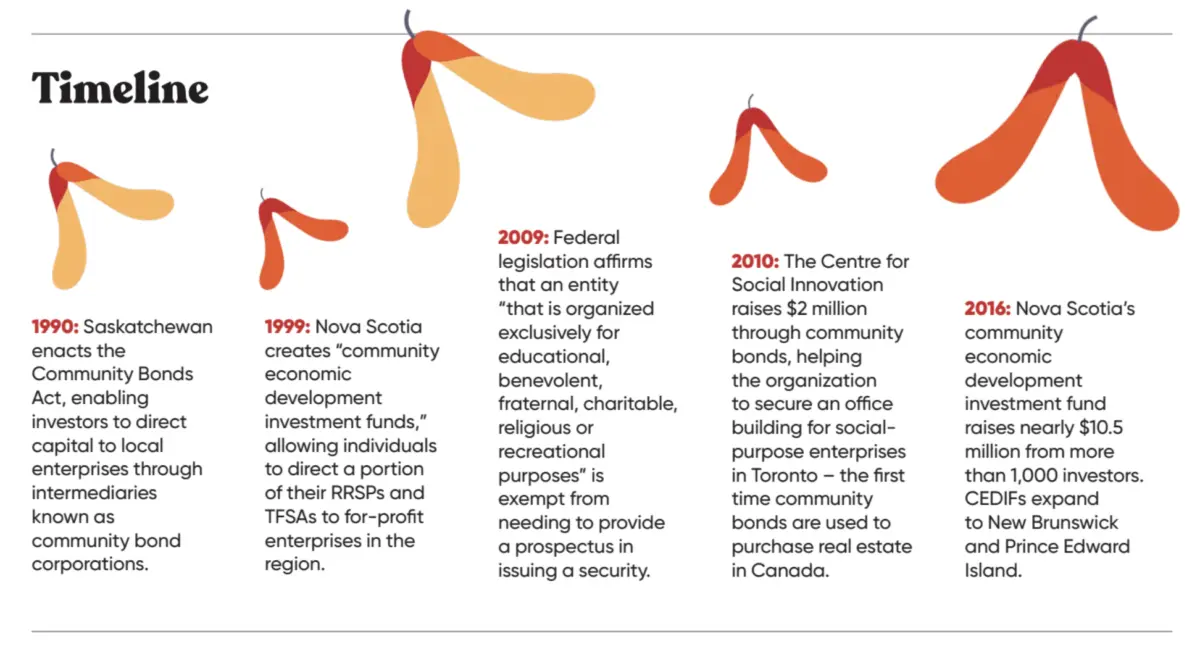
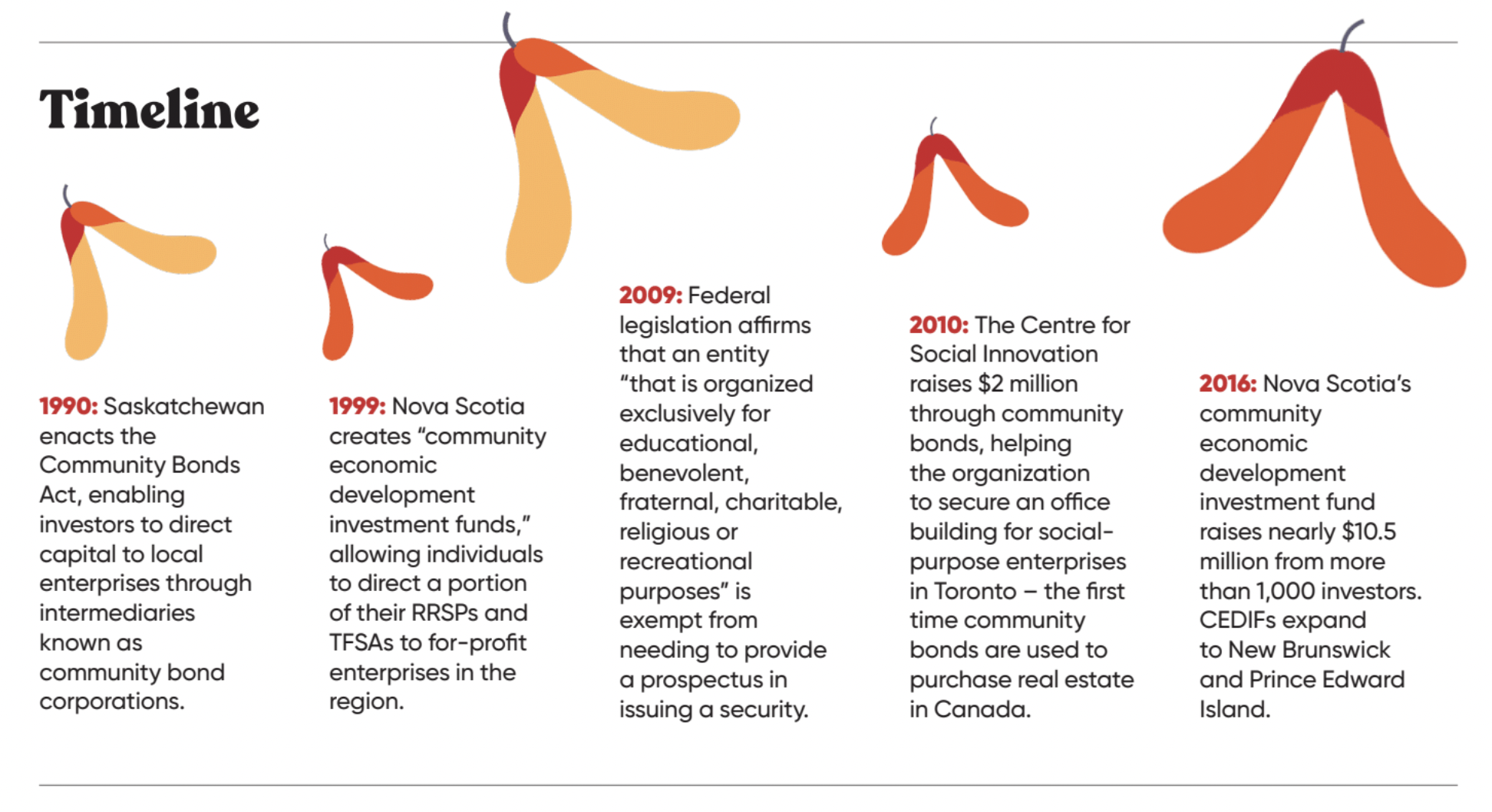
In response, the provincial government introduced a novel tool to stimulate investment in rural diversification. This culminated in the 1990 Community Bonds Act, which established a specialized entity known as a community bond corporation. Unlike modern bonds where individuals might invest directly in a specific non-profit, these 1990s-era corporations were locally owned issuers that raised funds from residents to make equity investments in regional projects. To mitigate risk for cautious investors during a period of high volatility, the provincial government provided a guarantee on the principal investment.
The results were immediate and tangible. By 1993, more than 5,000 individual investors had pooled nearly $13 million. These funds were directed into essential local industries, including a metal fabrication facility and a farm equipment manufacturer, which helped stabilize the local employment base during a time of significant rural flight. This era proved that local citizens were willing to put their savings toward the survival of their towns if provided with a secure and structured mechanism to do so.

Nova Scotia and the Challenge of Capital Flight
While Saskatchewan was innovating in the West, Nova Scotia was facing its own financial dilemma: capital flight. In the 1990s, provincial policymakers observed a troubling trend in the investment habits of Nova Scotians. Despite a strong desire to see the province thrive, residents were largely disconnected from their local economy in their personal portfolios. Data at the time revealed that only 2% of the equity investments made by Nova Scotians through Registered Retirement Savings Plans (RRSPs) remained within the province.
This meant that hundreds of millions of dollars were being funneled into national and international markets every year, while local businesses and cooperatives struggled to secure the financing needed for growth. To reverse this trend, the province launched Community Economic Development Investment Funds (CEDIFs) in 1999.
The CEDIF model offered a significant incentive: an income tax credit for citizens who invested in local businesses. This approach incentivized "socially responsible" investing before the term became a mainstream financial buzzword. While the program had a slow start, it eventually became a cornerstone of regional development, raising millions annually and supporting the launch or expansion of more than 100 businesses. The Nova Scotia experience highlighted that tax policy could be a powerful lever in directing private savings toward public good.
A Century of Grassroots Cooperation
The legislative successes of the 1990s were built upon a foundation of informal community finance that dates back over a century in Canada. In the early 1900s, miners and fishermen in Nova Scotia, often living in conditions of extreme poverty and exploited by "company stores," began forming cooperatives. These groups pooled their meager resources to build housing, secure better prices for their catches, and establish their own lines of credit. This "Antigonish Movement" became a global model for community-led economic development.
Similarly, following the Second World War, Dutch immigrants arriving in Canada faced significant barriers to accessing capital from established Canadian banks. To overcome these hurdles, they established their own credit unions, relying on communal trust and shared goals to fund the purchase of farms and homes.
Suzanne Faiza, policy manager at Tapestry Community Capital, notes that while the tools have become more sophisticated, the underlying motivation remains unchanged. "Humans have been doing community investment across various societies for a long time," Faiza explains. "A community bond is like a more formalized version of thinking, ‘How do we get people who often aren’t related to one another investing together?’"

The Modern Regulatory Shift: Prospectus Exemptions
The modern era of community bonds was ushered in by a critical shift in Canadian securities regulations. Historically, issuing bonds or shares required a "prospectus"—a massive, legally complex document detailing every facet of an organization’s finances and operations. For a small non-profit or a community land trust, the cost and time required to produce a prospectus were prohibitive.
Recognizing this barrier, securities regulators across Canada’s provinces and territories introduced a prospectus exemption for non-profits and charities. This allowed these organizations to issue securities to the public without the onerous reporting requirements faced by large corporations. This regulatory "unlock" has been the single most important factor in the recent surge of community bonds.
Today, these laws facilitate a simplified process where organizations can deal directly with their supporters. These investors are often willing to accept a "social return"—a lower interest rate than they might find on the stock market—in exchange for knowing their money is building a local daycare, an affordable apartment building, or a community-owned solar farm.
Current Applications and the Rise of "Patient Capital"
The versatility of community bonds is currently being tested across a wide range of sectors. Tessa Hebb, a distinguished research fellow at Carleton University’s Centre for Community Innovation, describes these investments as "patient capital." Unlike the high-frequency trading of modern markets, community bonds are designed for the long term, providing stable funding for projects that may take years to realize their full social value.
Since the late 2000s, this capital has been deployed in several key areas:
- Affordable Housing: Non-profit housing providers use bonds to bridge the gap between government grants and traditional mortgages, allowing them to purchase land or renovate existing units.
- Renewable Energy: Cooperatives have raised millions to install wind turbines and solar arrays, with the profits from energy sales returning to the bondholders.
- Social Hubs: Community centers and co-working spaces have utilized bonds to renovate historic buildings that would otherwise be sold to private developers.
The Coalition for Community Capital estimates that the $170 million currently invested represents only a fraction of the potential market, as more non-profits become aware of the tool.
Policy Barriers and the Path Forward
Despite the growth of the sector, experts argue that significant policy hurdles remain that prevent community bonds from becoming a mainstream investment choice for the average Canadian. One of the primary obstacles is the difficulty of including community bonds in Tax-Free Savings Accounts (TFSAs) and RRSPs.
Currently, placing a community bond in these tax-sheltered accounts requires a complex and often expensive "workaround" that is out of reach for many small issuers. Hebb and Faiza both advocate for federal changes to increase eligibility. Faiza suggests that opening up TFSAs and RRSPs to community bonds, perhaps with a $20,000 cap for unsecured debt, would allow millions of Canadians to align their retirement savings with their local values without compromising the safety of their accounts.
Furthermore, the sector lacks a specialized third-party rating agency. In the traditional bond market, agencies like Moody’s or S&P provide risk assessments that help investors make informed decisions. Establishing a similar framework for community bonds would provide the transparency needed to attract larger-scale institutional investors, such as pension funds or foundations.
The Coalition for Community Capital has also recommended tax amendments to further mobilize investment. These include:
- Direct Tax Credits: Similar to the Nova Scotia CEDIF model, a federal or provincial tax credit would incentivize participation.
- Loss Deductibility: Allowing investors to deduct any losses incurred from community bonds against their other income, reducing the perceived risk of investing in unproven social enterprises.
Conclusion: Building Resilience in Uncertain Times
As Canada faces the dual challenges of a national housing crisis and the urgent need for an energy transition, community bonds offer a proven mechanism for mobilizing local resources. They represent a return to an older form of economic solidarity, updated for the 21st-century regulatory environment.
By turning neighbors into investors and residents into stakeholders, community bonds do more than just fund buildings; they build social cohesion. As Faiza emphasizes, these instruments allow communities to build resilience against global economic forces that are often beyond their control. In an era of market volatility and social disconnection, the ability to invest in the "home front" may be one of Canada’s most vital economic innovations.
