


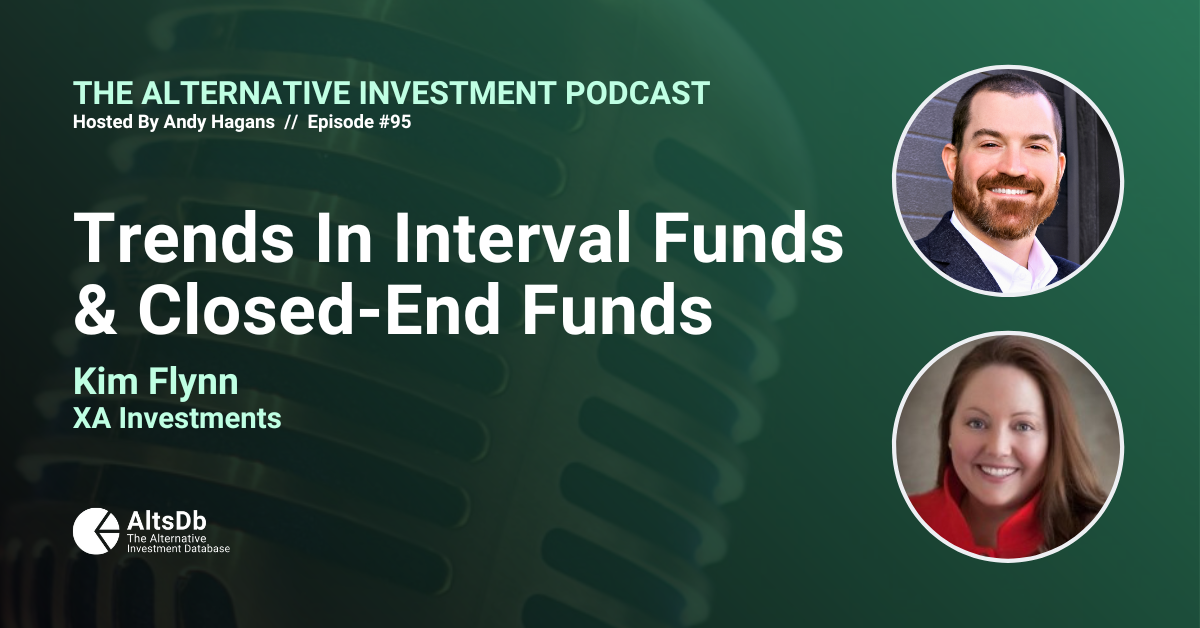
Interval funds have emerged as a significant success story within the rapidly expanding alternative investments industry over the past five years. Their unique structure and growing appeal have attracted substantial capital, prompting a closer examination of their role, the challenges faced by their sponsors, and the opportunities they present to investors. Kim Flynn, Managing Director at XA Investments, a firm specializing in product development and distribution within the alternative investment space, recently shared her insights on this dynamic sector in a comprehensive interview.
The Rise of Interval Funds in the Alternatives Landscape
The broader alternative investments industry has experienced exponential growth, driven by a persistent search for yield and diversification beyond traditional asset classes like stocks and bonds. Within this burgeoning market, interval funds have carved out a notable niche. These vehicles offer a compelling solution for investors seeking exposure to less liquid, alternative assets while maintaining a degree of periodic liquidity, a characteristic that sets them apart from traditional private equity or venture capital funds and even from some listed closed-end funds.
Kim Flynn, with extensive experience in product development, particularly in the closed-end fund space during her nearly 12-year tenure at Nuveen, where she was instrumental in developing over 40 closed-end funds, highlights the evolution of these structures. "Nuveen is a market leader in the listed closed-end fund market, really because of the municipal bond heritage that Nuveen is well-known for," Flynn explained. Her work at Nuveen often involved partnering with external portfolio managers, a strategy that informed her later endeavors.
"When I left Nuveen in 2016, I launched an asset management platform as part of an investment bank here in Chicago, to do just that, to focus on alternatives, and to do it in partnership with sub-advisors," Flynn stated. This approach allowed XA Investments to engage with a wide spectrum of asset managers, from boutique firms to global wealth managers, understanding their needs and the market’s evolving demands for accessible alternative investment products.
Understanding the Appeal of Closed-End and Interval Funds
The appeal of closed-end funds, and by extension interval funds, lies in their ability to package less liquid or alternative assets in a structure that offers certain advantages over traditional open-ended mutual funds or direct private investments.
Listed closed-end funds, a precursor to the current interval fund boom, have historically been sought by investors looking for income. Unlike ETFs, which have creation and redemption mechanisms to keep their market price close to their net asset value (NAV), closed-end funds are typically listed on an exchange after their initial public offering and are not designed to expand or shrink based on daily investor flows. This structural difference can lead to closed-end funds trading at a discount or premium to their NAV.
"The historical average discount for listed closed-end funds is about 4.5%," Flynn noted. "And not surprisingly, closed-end funds used to be sold with loads that equaled 4.5%." However, market conditions can significantly influence these discounts. "Right now, the listed market is a bit dislocated. So, the discounts are averaging eight-plus percent," she added, indicating potential opportunities for secondary market buyers.
A key advantage of closed-end funds, particularly those focused on income generation, is the judicious use of leverage. "Leverage is typical. It’s modest leverage, but it’s usually used with income enhancement in mind," Flynn explained. This leverage can amplify returns, making them attractive for income-seeking investors. For instance, in municipal bond funds, leverage can enhance yields by approximately 1% compared to a similar mutual fund.
The Evolution Towards Interval Funds
The industry has witnessed a significant shift, with interval funds gaining prominence. While still a type of closed-end fund structure, interval funds differ from listed closed-end funds in their liquidity features and the types of assets they can hold.
"Interval funds, tender offer funds – it’s just a different type of closed-ended structure, but it’s being used now for alternative strategies," Flynn elaborated. Unlike a traditional listed closed-end fund that may have a daily NAV and liquid holdings to facilitate this, interval funds are continuously offered and can grow over time.
"Investors can invest on a daily basis, to the extent that that fund has a daily NAV. But the exit is typically gated or limited to 5% a quarter," Flynn described. This controlled liquidity is what enables interval funds to invest more heavily in illiquid securities, such as real estate, credit, private equity, and venture capital. This structure is particularly appealing for asset managers looking to offer strategies that require longer investment hold periods.
Challenges and Opportunities for Sponsors
The rapid growth of interval funds presents both opportunities and challenges for sponsors. The increasing demand has led to a proliferation of new funds, creating a competitive landscape.
"There are a lot of new entrants to the interval fund market, so it is attracting a lot of attention. And, you know, there’s a lot of boutiques in the mix, too," Flynn observed. The increasing size of these funds, with many exceeding a billion dollars in assets under management, signifies a maturation of the market. "Sophisticated alternative managers, they’re not gonna get out of bed for less than a billion dollars," she commented, reflecting the industry’s focus on scale.
However, managing investor expectations regarding liquidity is paramount. "I do find that as we observe industry participants, a lot of them gloss over, and they frankly oversell the liquidity of an interval fund," Flynn cautioned. The 5% quarterly redemption limit means that during periods of high redemption requests, investors may face prorated payouts, potentially for multiple quarters. This can be a source of frustration and concern for investors who might not fully grasp the implications of this intermittent liquidity.
"These are not mutual funds, and they should not be sold in that fashion," she stressed, emphasizing the need for robust investor education. Sponsors who are disciplined in managing liquidity, setting appropriate growth caps, and ensuring they attract long-term investors are better positioned for success.
Supporting Data and Market Trends
The interval fund market has seen significant capital inflows. While specific recent figures are not provided in the transcript, industry reports indicate that the alternatives industry, including interval funds, has attracted hundreds of billions of dollars in recent years. The trend towards more accessible alternative investments through vehicles like interval funds is a direct response to investor demand for higher yields and diversification.
The increasing popularity of interval funds is also a response to the saturation in some traditional listed closed-end fund markets. "From the beginning of 2000 until sort of 2015, there was a rapid expansion of the listed closed-end fund market into new asset classes, new strategies, new sectors," Flynn recalled. However, market volatility, such as the energy MLP funds in 2015, led to a pause in new IPOs for listed closed-end funds, prompting sponsors to explore other structures like interval funds.
XA Investments’ Role in Product Development
XA Investments positions itself as a key player in facilitating the growth of interval funds and other alternative investment vehicles. The firm partners with asset managers, acting as a catalyst for product development and distribution.
"We set up the practice where, because we do not have in-house wealth management, we partner externally with asset managers," Flynn explained. XA Investments assists in launching listed closed-end funds and has a strong focus on the burgeoning interval fund space. Their services extend to consulting, helping asset managers navigate the complexities of launching their own funds for proprietary platforms.
"Most of our clients are curious and most interested in the growing interval fund space. So that’s a lot of where we spend our time," she stated, underscoring the firm’s specialization and commitment to this sector.
Emerging Trends in the Alternatives Industry
Looking ahead, Flynn identifies several emerging trends that are likely to shape the alternatives industry in the coming years.
One significant trend is the increasing number of Registered Investment Advisors (RIAs) who are considering launching their own proprietary interval funds. "The RIA, the wealth manager, who has become acquainted with interval funds and says, ‘Hey, I’m gonna launch my own. You know, I’m gonna build my own proprietary interval fund because I’m the one with the relationship with the client’," Flynn noted. This move allows RIAs to capture more of the fee structure and leverage their existing client relationships.
A related trend is the rise of direct-to-consumer FinTech platforms that are also launching interval funds. Firms like Fundrise have demonstrated success in this area, offering accessible alternative investments to a broader audience, including potentially non-accredited investors. These platforms aim to build proprietary funds rather than simply allocating to external managers.
"The third trend that is still sort of newer, and frankly, there’s been some ESG backlash, I think, in the U.S., but we have seen five impact funds launched," Flynn added. These impact-oriented interval funds, investing in alternative or illiquid securities, are offering a different approach to ESG investing, potentially appealing to investors seeking both financial returns and positive social or environmental impact.
The Importance of Education and Investor Suitability
Throughout the discussion, a recurring theme is the critical need for investor education and ensuring product suitability. The complexity of interval funds and other alternative structures demands a thorough understanding of their risks, liquidity constraints, and investment horizons.
"The buyer base for these funds initially is largely RIAs, but it’s still fairly concentrated," Flynn observed. Expanding this buyer base requires advisors to be well-informed and comfortable with alternative investments. "The education is really what’s important, so that, you know, the right investors are getting into the product, and they understand it, and the advisors understand it," she emphasized.
The challenges lie in the rapid proliferation of products without a commensurate expansion in the understanding and adoption by a broader investor base. This dynamic puts pressure on sponsors to not only innovate but also to prioritize transparency and investor education.
Conclusion
Interval funds represent a significant evolution in the alternative investments landscape, offering a structured approach to accessing less liquid assets while providing a degree of managed liquidity. As Kim Flynn of XA Investments highlights, their growth is a testament to their appeal for both investors seeking diversification and yield, and for asset managers aiming to deliver specialized strategies. However, the continued success and responsible growth of this sector hinge on robust investor education, clear communication of liquidity terms, and disciplined product development that prioritizes investor suitability and long-term alignment. The ongoing innovation and emerging trends suggest that interval funds will continue to be a focal point in the evolving world of alternative investments for the foreseeable future.
