

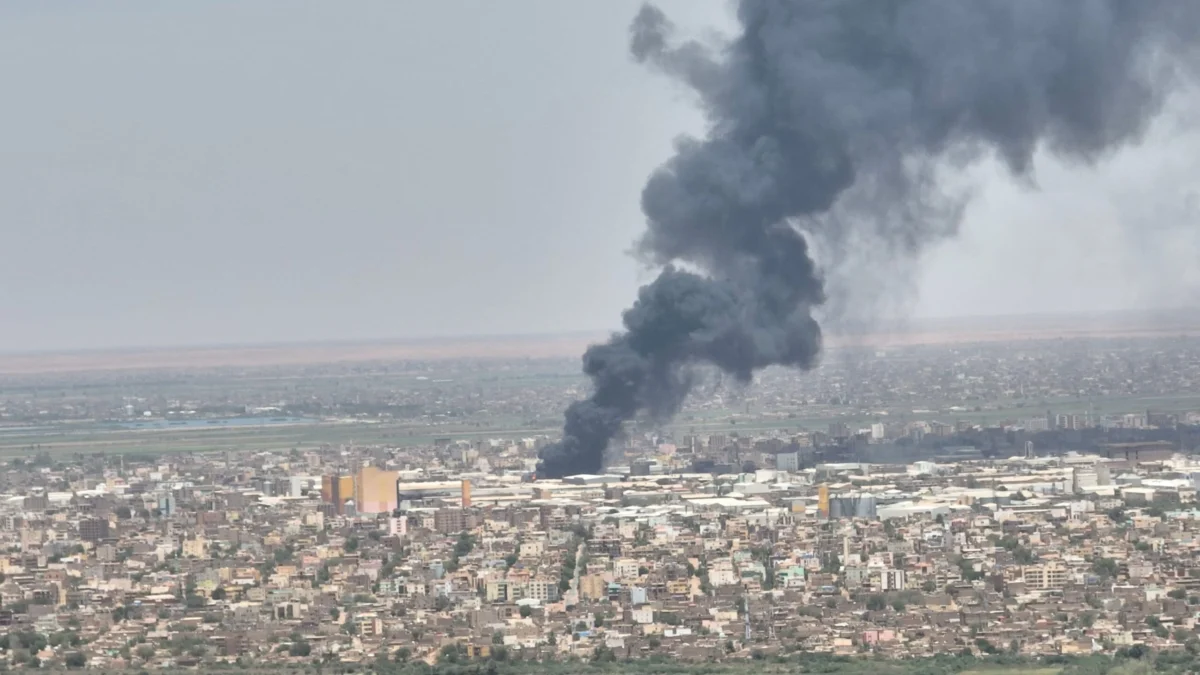
The diplomatic corridors of the Saudi Arabian port city of Jeddah have become the focal point of international efforts to avert a total collapse of the Sudanese state, as representatives from the Sudanese Armed Forces (SAF) and the paramilitary Rapid Support Forces (RSF) arrived for preliminary discussions on Saturday. This U.S.-Saudi initiative represents the first significant attempt to establish a direct line of communication between the warring factions since the outbreak of hostilities on April 15, 2023. While the international community views these "pre-negotiation talks" as a critical opening, the atmosphere on the ground in Khartoum remains defined by the thunder of heavy artillery and the rising plumes of black smoke that have come to characterize the capital’s skyline.
As the delegations gathered in the Red Sea city, the urgency of their task was underscored by the worsening situation within Sudan. According to international observers and humanitarian agencies, the conflict has already claimed hundreds of lives, injured thousands, and forced an estimated 100,000 people to seek refuge in neighboring countries. The violence has effectively turned residential neighborhoods in Khartoum, Omdurman, and Bahri into active war zones, derailing a fragile, internationally backed transition toward civilian-led democracy that had been years in the making.
The Jeddah Initiative: A Precarious Path to De-escalation
The joint initiative led by Riyadh and Washington is designed to address the immediate humanitarian needs of the Sudanese population before tackling the more complex political issues that ignited the war. Both the United States and Saudi Arabia have officially welcomed the willingness of the SAF and the RSF to send representatives, yet they have maintained a cautious stance, urging both sides to engage "actively and seriously" following a string of violated ceasefires that had previously been brokered through various international channels.
White House National Security Adviser Jake Sullivan is scheduled to travel to Saudi Arabia this weekend, a move that signals the high level of priority the Biden administration is placing on stabilizing the region. Saudi Arabia’s involvement is equally pivotal; the Kingdom has long-standing ties with both General Abdel Fattah al-Burhan, the head of the SAF, and General Mohamed Hamdan Dagalo, popularly known as Hemedti, who leads the RSF. Both commanders had previously provided troops to the Saudi-led coalition in Yemen, and Riyadh views the stability of Sudan—a country sharing a long coastline along the Red Sea—as vital to its own national security and economic interests.
Despite the formal start of talks, the expectations for a comprehensive peace treaty remain low in the short term. Sudanese army officials have clarified that their delegation is in Jeddah primarily to discuss the technicalities of a humanitarian truce rather than a permanent end to the fighting. General Dafallah Alhaj, a special envoy for the army, emphasized that the military would not engage in direct political negotiations with a group they now officially categorize as "rebellious." This sentiment is echoed by the RSF, which has expressed a commitment to humanitarian access but has shown little sign of backing down from its military objectives.
A Chronology of Escalation: From Partnership to Civil War
To understand the current impasse in Jeddah, one must look at the rapid deterioration of the relationship between Sudan’s two most powerful military figures. The roots of the current conflict are deeply embedded in the power vacuum left by the 2019 ouster of long-time autocrat Omar al-Bashir.
- April 2019: Following months of mass protests, the Sudanese military removes Omar al-Bashir. A Transitional Military Council is formed, with Burhan as chair and Hemedti as his deputy.
- August 2019: A power-sharing agreement is signed between the military and civilian leaders (the Forces for Freedom and Change), creating a Sovereignty Council to lead the country toward elections.
- October 2021: General Burhan, supported by Hemedti, leads a military coup that dissolves the civilian-led government and detains Prime Minister Abdalla Hamdok, stalling the democratic transition.
- December 2022: Under intense international pressure, the military and various civilian groups sign a "Framework Agreement" to return to a civilian-led government. However, tensions begin to simmer over the timeline for integrating the RSF into the regular army.
- April 15, 2023: Armed clashes erupt in Khartoum and other cities after weeks of mobilization. The SAF and RSF trade blame for the first shots fired, and the country plunges into a full-scale military confrontation.
The central point of contention remains the integration of the RSF. While the SAF demanded a two-year timeline for the paramilitary group to be absorbed into the national army, Hemedti pushed for a ten-year window, seeking to preserve his autonomous power base and political influence.
Humanitarian Catastrophe: Data and On-the-Ground Realities
As the generals negotiate in the luxury of Jeddah, the humanitarian situation in Sudan has reached a breaking point. The World Health Organization (WHO) and the United Nations have issued increasingly dire warnings about the collapse of essential services.
Data from the Sudanese Doctors’ Union suggests that approximately 70% of hospitals in conflict-affected areas are currently out of service. Those that remain open are operating with severe shortages of electricity, water, and life-saving medical supplies. On Saturday, the WHO confirmed that while medical aid had been successfully delivered to Port Sudan, the "last mile" delivery to Khartoum remains impossible due to the lack of security guarantees.
The displacement crisis is equally staggering. The UN Refugee Agency (UNHCR) reports that over 100,000 people have crossed into Egypt, Chad, South Sudan, and Ethiopia. Internally, hundreds of thousands more are displaced, trapped in their homes without consistent access to food or water. In the city of Bahri, residents report a terrifying existence under constant aerial bombardment. Drone footage obtained by Reuters shows massive clouds of black smoke rising from industrial zones and residential blocks alike, illustrating the indiscriminate nature of the urban warfare currently taking place.
Official Responses and Regional Implications
The international response has been a mix of condemnation and frantic mediation. UN Secretary-General António Guterres has repeatedly called for an immediate cessation of hostilities, noting that "there is no military solution to this crisis." The African Union (AU) and the Intergovernmental Authority on Development (IGAD) have also sought to intervene, though the Jeddah talks have currently taken center stage.
From a regional perspective, the stakes could not be higher. Sudan sits at a strategic crossroads, bordering seven countries, many of which are already struggling with their own internal instabilities. A prolonged civil war in Sudan threatens to destabilize the entire Sahel region and the Horn of Africa. Egypt, which views the SAF as a traditional ally and a guarantor of Nile water security, is watching the rise of the RSF with significant concern. Conversely, other regional players have historically maintained murky ties with Hemedti, whose control over gold mines in Darfur has provided him with substantial independent wealth and foreign patronage.
Analysis: The Obstacles to a Lasting Peace
The primary obstacle to a breakthrough in Jeddah is the "zero-sum" mentality adopted by both Burhan and Hemedti. Both leaders appear to believe that a total military victory is still possible. For Burhan, the RSF is an existential threat to the state’s monopoly on force. For Hemedti, the war is a struggle for survival and a bid to prevent his marginalization by the traditional military elite.
Furthermore, the "pre-negotiation" label of the current talks is telling. It suggests that neither side is ready to discuss the underlying political grievances. If the talks only result in a temporary humanitarian pause, there is a high risk that both sides will simply use the time to regroup, resupply, and launch new offensives. The history of the conflict so far—marked by at least half a dozen failed ceasefires—supports this skeptical view.
For a lasting peace to take hold, the Jeddah talks must eventually transition from humanitarian logistics to a broader political dialogue that includes civilian stakeholders. The exclusion of civilian leaders from the current talks in Jeddah is a point of contention for many pro-democracy activists in Sudan, who fear that a deal between the two generals will merely result in a new form of military rule, rather than a return to the democratic path envisioned in 2019.
Looking Ahead: The Fragile Hope for Sudan
As Saturday’s talks progress, the world remains focused on whether the SAF and RSF can agree to at least a verifiable and monitored ceasefire. The delivery of aid to Khartoum and the restoration of basic services like water and electricity are the immediate benchmarks for success. However, the deep-seated animosity between the two factions and the sheer scale of the destruction already wrought suggest that the road to recovery will be long and fraught with peril.
The drone footage of black smoke over Bahri serves as a stark reminder of what is at stake. Without a significant shift in the calculus of the warring parties, the "pre-negotiation talks" in Jeddah may become just another footnote in a tragic chapter of Sudanese history. For now, the people of Sudan wait in the shadows of their homes, listening to the sounds of war and hoping that the diplomacy in the Red Sea city can finally silence the guns.
