

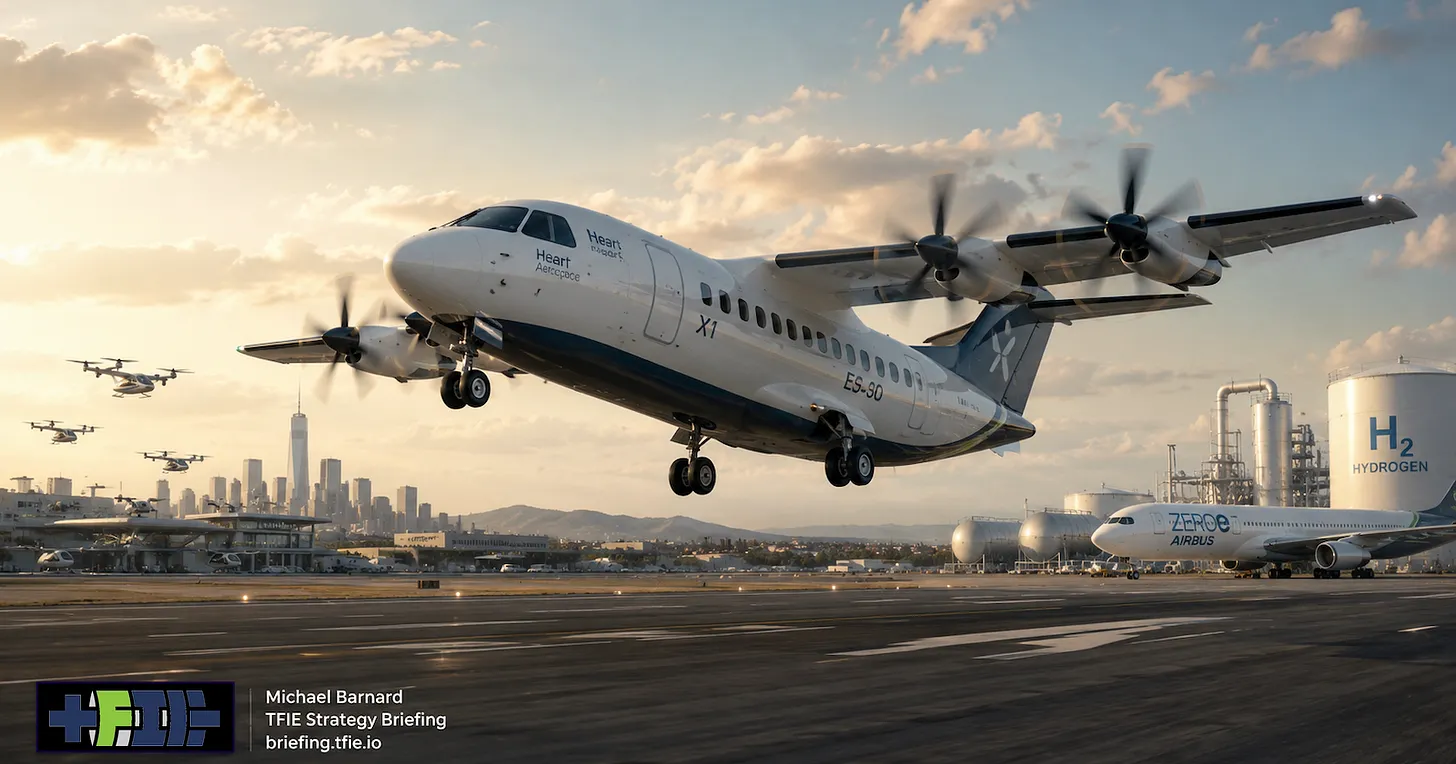
On August 12, at Plattsburgh International Airport in New York, a significant milestone in the decarbonization of the aviation industry was achieved when the Heart Aerospace X1 demonstrator completed a 27-minute maiden flight powered entirely by battery-electric propulsion. The aircraft, which features a 106-foot wingspan and weighed more than 25,000 pounds at takeoff, represents what the company describes as the largest battery-electric aircraft ever to take to the skies. During the peak of its ascent, the aircraft drew more than a megawatt of power, a technical feat that underscores the immense energy requirements of heavy-lift electric flight. However, the significance of the X1’s flight extends far beyond the setting of a new weight or power record; it marks a shift in the aviation transition from speculative, high-concept transportation models toward the electrification of existing regional markets using conventional infrastructure.
The X1 is a full-scale technology demonstrator designed to validate the flight characteristics and power management systems required for Heart Aerospace’s upcoming commercial offering, the ES-30. Unlike many contemporary competitors in the electric aviation space that seek to invent entirely new categories of transport—such as Urban Air Mobility (UAM) or hydrogen-based long-haul flight—Heart Aerospace is focusing its engineering and capital on the regional aviation sector. This strategy targets established airports, existing flight routes, and a pre-existing passenger base, aiming to replace traditional turboprop aircraft with cleaner, quieter, and more cost-effective electric and hybrid-electric alternatives.
A Chronology of Development and the Path to the X1
Heart Aerospace, headquartered in Gothenburg, Sweden, has undergone a rapid evolution since its founding in 2018. The company originally gained international attention with the ES-19, a proposed 19-seat all-electric regional aircraft. However, as the company engaged with potential airline customers and analyzed the limitations of current battery energy density, it pivoted in 2022 to a larger, more versatile design: the ES-30. This new configuration is a 30-seat regional airplane designed to operate with a hybrid-electric propulsion system, allowing for an all-electric range for short hops and a hybrid mode for longer distances.
The development of the X1 demonstrator serves as the primary "evidence rung" in this development cycle. While the X1 used for the August 12 flight is a battery-electric version of the airframe, it provides the critical real-world data necessary to refine the aerodynamics and electrical architecture of the production-level ES-30. The flight in Plattsburgh followed years of ground testing and computational modeling, representing the transition from laboratory theory to atmospheric reality.
Looking forward, the company’s timeline is ambitious but grounded in the realities of aerospace manufacturing. Heart Aerospace aims to achieve type certification for the ES-30 by the end of the decade, with a current service entry target set for 2031. This timeline accounts for the rigorous safety standards of the Federal Aviation Administration (FAA) and the European Union Aviation Safety Agency (EASA), as well as the need to industrialize a manufacturing process capable of producing aircraft at scale.
Technical Specifications and the Power Challenge
The X1 demonstrator provides a glimpse into the massive engineering requirements of electric flight. To lift 25,000 pounds, the aircraft required a peak power output exceeding one megawatt. To put this in perspective, one megawatt is enough to power roughly 750 to 1,000 homes simultaneously. Managing this level of discharge from a battery system while maintaining thermal stability and safety in an aviation environment is one of the primary hurdles the X1 was designed to test.
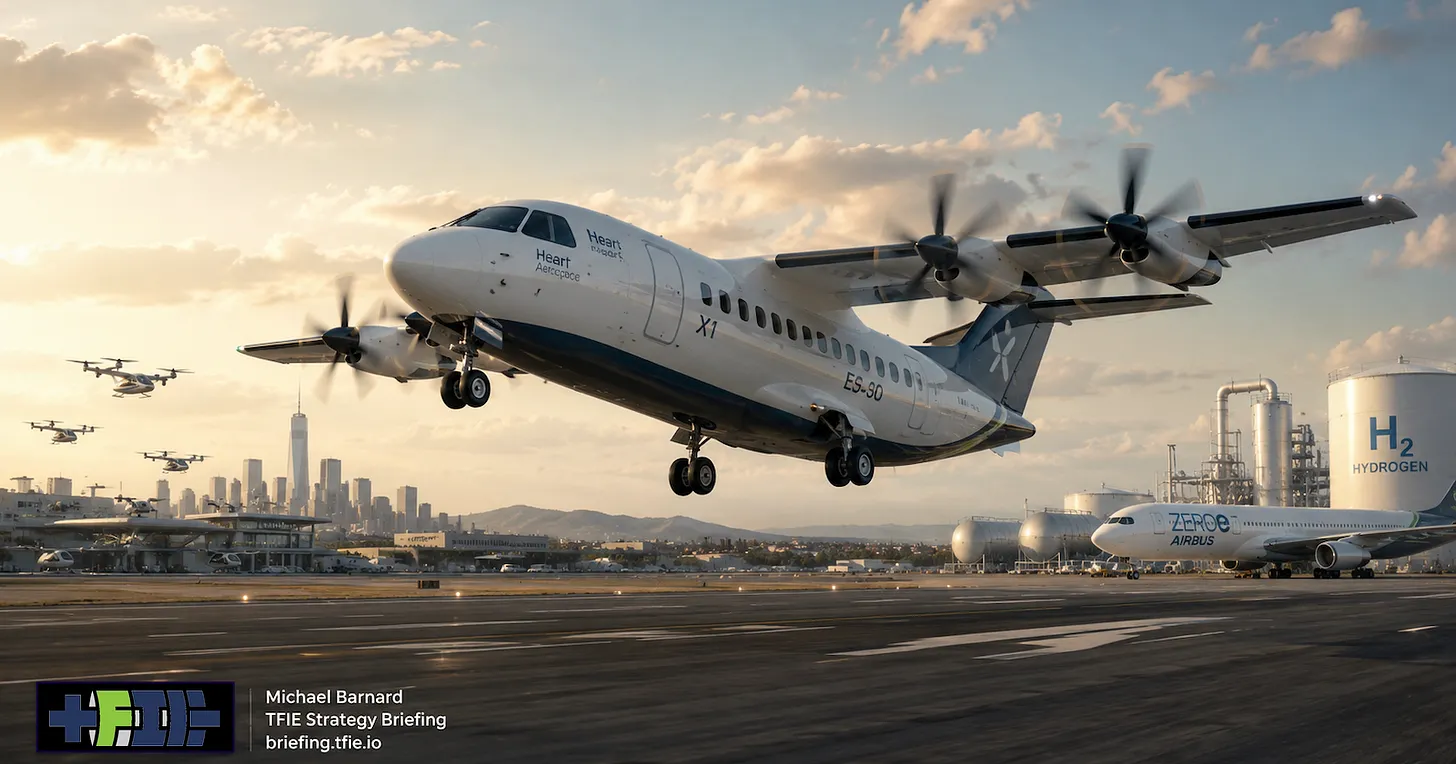
The production model, the ES-30, will build upon these findings. It is envisioned as a four-motor aircraft with a high-wing configuration. Its hybrid-electric powertrain will utilize two battery-driven electric motors for takeoff and landing—the most energy-intensive phases of flight—while integrating turbo-generators that can run on sustainable aviation fuel (SAF) to extend the range. The projected all-electric range is approximately 200 kilometers (124 miles), which can be extended to 400 kilometers (248 miles) in hybrid mode with 30 passengers, or up to 800 kilometers (497 miles) with a reduced load of 25 passengers.
The reliance on batteries necessitates a massive leap in airport infrastructure. For electric regional aviation to become viable, airports must be equipped with megawatt-scale charging stations and robust grid connections. The X1 flight proved that the aircraft can handle the power, but the next phase of analysis must focus on whether the global airport network can supply it.
The Capital Landscape: eVTOLs vs. Regional Electric
The aviation industry has seen an unprecedented influx of speculative capital over the last five years, with analysts from Jefferies estimating that approximately $12 billion has been poured into the electric Vertical Takeoff and Landing (eVTOL) sector. Major aerospace and automotive players have placed significant bets: Boeing invested $450 million into Wisk Aero, and Hyundai has backed Supernal with over $1 billion.
Despite these massive investments, the eVTOL sector has faced severe headwinds. Companies like Lilium and Volocopter have struggled with insolvency and the immense technical difficulty of certifying "powered-lift" aircraft that can safely transition from vertical hover to horizontal flight. Beyond the engineering challenges, the commercial viability of eVTOLs remains unproven. These aircraft require the construction of entirely new "vertiports" and the creation of urban air traffic management systems that do not currently exist.
Heart Aerospace’s approach offers a stark contrast. By focusing on regional aviation, Heart is addressing a market that already functions. Regional airlines already have gates, pilots, maintenance crews, and a steady stream of passengers. If Heart can prove that the ES-30 offers lower operating costs through reduced fuel consumption and simplified engine maintenance, the "denominator" of the business case—the existing market—is already in place. The investment risk is therefore shifted from "will people use this?" to "can we build and certify this?"
The Hydrogen Alternative and Infrastructure Barriers
While battery-electric and hybrid systems like Heart’s are gaining traction for short-haul flights, hydrogen has often been touted as the solution for medium-to-long-haul decarbonization. However, hydrogen aviation faces a "denominator problem" of its own. The challenge is not merely the propulsion—hydrogen fuel cells or combustion—but the entire ecosystem.
Hydrogen requires cryogenic storage at extremely low temperatures or high-pressure tanks, both of which add significant weight and volume to an aircraft. Furthermore, the infrastructure required to produce, liquefy, transport, and pump green hydrogen at airports is currently non-existent. The energy losses associated with converting electricity to hydrogen and then back into thrust are substantial.

Heart Aerospace avoids these systemic burdens by sticking to the electrical grid. While battery mass remains a significant constraint, the pathway to charging an aircraft is more direct than the pathway to a global hydrogen fuel network. This makes the electric regional aircraft a more plausible "near-term" solution for the 2030s, leaving hydrogen and advanced biofuels to compete for the long-haul missions that batteries simply cannot serve.
Implications for Global Aviation Decarbonization
The successful flight of the X1 serves as a reality check for the aviation transition. It suggests that the most credible shape of decarbonization will be a tiered approach based on mission requirements.
- Short-Range/Regional: All-electric or hybrid-electric aircraft (like the ES-30) utilizing existing regional airports.
- Medium-Range: Hybrid-electric systems with a heavy reliance on Sustainable Aviation Fuels (SAF).
- Long-Range: Traditional airframes powered entirely by high-density SAF or, eventually, liquid hydrogen.
By proving that a 25,000-pound aircraft can fly on battery power alone, Heart Aerospace has moved one rung up the "evidence ladder." This progress is vital for maintaining investor confidence as the industry moves away from the "spectacle" of air taxis and toward the "utility" of regional transit.
Challenges and Economic Realities Ahead
Despite the triumph of the X1 flight, Heart Aerospace faces a grueling decade ahead. The transition from a demonstrator to a certified commercial airliner is a path littered with the remains of ambitious startups. The company must resolve several critical uncertainties:
- Battery Mass: Current battery technology limits the payload-to-range ratio. Heart must bank on incremental improvements in energy density over the next seven years.
- High-Cycle Durability: Airlines require aircraft that can fly multiple legs a day with minimal downtime. The longevity of batteries under constant fast-charging cycles remains a question.
- Certification: The ES-30 will be one of the first aircraft of its kind to seek Part 25 certification (for large transport aircraft). Navigating these safety regulations will require thousands of hours of flight testing.
- Supply Chain: Moving from a single demonstrator to mass production requires an industrialized supply chain for electric motors, specialized power electronics, and composite airframes.
Conclusion: A Pragmatic Step Forward
The Heart Aerospace X1 flight at Plattsburgh International Airport is a testament to what can be achieved when engineering effort is directed at a plausible energy pathway and a real-world market. It validates the possibility of heavy-lift electric flight and provides a data-rich foundation for the ES-30.
As the next aviation investment cycle begins, the focus is likely to shift away from the "urban air taxi" hype and toward the "less glamorous" but more consequential task of cleaning up the regional flights that already connect our cities. Heart’s X1 does not yet prove that electric aviation will be profitable, but it does prove that the technology is ready to step out of the hangar and into the sky. For an industry responsible for roughly 2.5% of global CO2 emissions, this pragmatic, regional-first approach may be the most viable flight path toward a net-zero future.
