

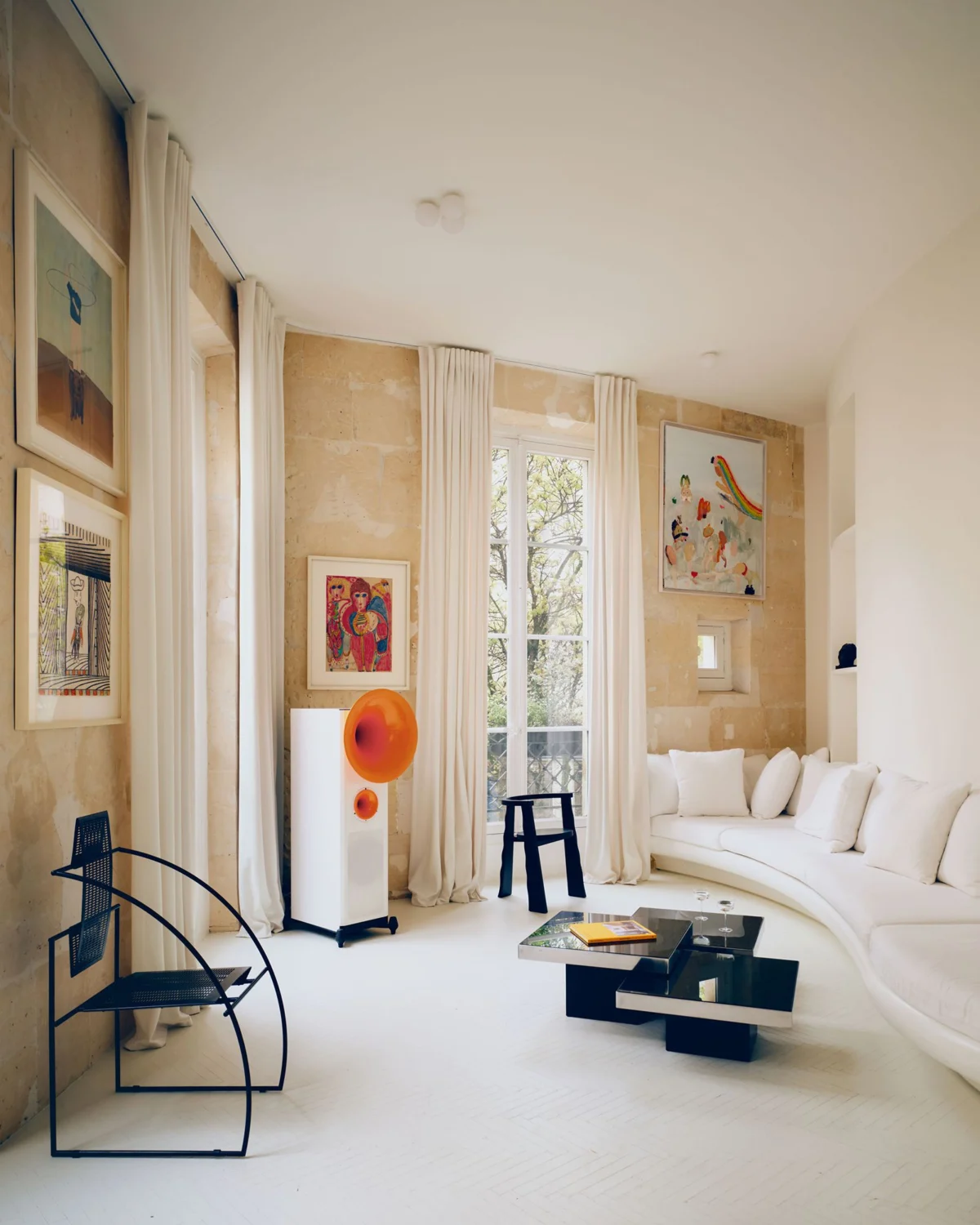
In the heart of Paris’s historic Marais district, where the weight of architectural heritage often stifles modern intervention, architect Clément Lesnoff-Rocard has completed a radical restoration of a 1,722-square-foot apartment. Located within the storied Aubert building on a quiet side street, the residence dates back to approximately 1775. By stripping away decades of "soulless" modern alterations, Lesnoff-Rocard has unearthed the original 18th-century proportions of the home, transforming it into what he describes as a "happy Gothic" sanctuary for a young family of six. The project represents a sophisticated intersection of historical preservation, avant-garde art curation, and high-performance technical engineering, proving that even the most rigid Parisian structures can be adapted for contemporary communal living without losing their ancestral identity.

Historical Context: The Aubert Building and the Evolution of the Marais
The Marais, or "the marsh," occupies a unique position in the topography of Paris. Once a swampy outskirts of the medieval city, the area underwent a massive transformation during the 17th and 18th centuries. By the reign of Louis XVI, the district had become a fashionable enclave for the nobility and the burgeoning bourgeois class. The construction of the Temple du Marais and the drainage of the surrounding lands paved the way for a new era of urban density.
The Aubert building, the site of Lesnoff-Rocard’s latest project, was a pioneer in what might now be called "collective living." It was an experimental venture initiated by the sculptor Denis Aubert and his brother, the architect André Aubert. At its inception, the building was designed to house a community of artists, fostering an environment where pragmatism met high-concept imagination. This creative DNA remains embedded in the limestone walls, though it had been obscured by a series of 20th-century renovations that the architect found sterile and devoid of character.

"The apartment had been perfectly renovated, and yet it was completely soulless," Lesnoff-Rocard observed regarding the state of the property prior to the intervention. His objective was not merely to update the space, but to conduct an architectural excavation to rediscover the "fundamentals" of the home.
The Architectural Vision: Rediscovering the "Happy Gothic"
The term "Gothic" is frequently misunderstood in a contemporary context, often associated with the macabre or the somber. However, in architectural history, the Gothic movement was defined by optimism, the pursuit of light, and the engineering of height. Lesnoff-Rocard’s "happy Gothic" concept leans into these original tenets. By removing modern partitions and false ceilings, the architect allowed the apartment to breathe, harnessing the natural light that filters through the historic windows and emphasizing the verticality of the 18th-century structure.

The layout of the apartment follows the original 1775 dynamics. A circular courtyard located at the rear of the property serves as the geometric anchor for the entire floor plan. This circularity is reflected in the interior through rounded walls and custom furniture, most notably a large circular seating area that serves as the family’s primary gathering point. The spatial organization creates a clear division between the public and private spheres: the living area and kitchen occupy one wing, while the principal bedroom and children’s quarters are situated at the opposite end of the 160-square-meter floor plate.
Chronology of the Transformation
The renovation of the Aubert apartment was an intensive process that required over a year of planning and execution. The timeline of the project highlights the technical challenges of working within a protected historical structure:

- The Demolition Phase: Lesnoff-Rocard began by removing four distinct layers of previous flooring. This was necessary to reach the original structural level and to prepare the site for modern infrastructure.
- Structural Restoration: The removal of modern drywall revealed original Parisian limestone walls. These were cleaned and stabilized, serving as a raw, textural backdrop for the family’s art collection.
- Infrastructure Installation: A high-efficiency underfloor heating system was installed—a significant technical feat in a building of this age. This allowed for the removal of unsightly radiators, maintaining the clean lines of the "happy Gothic" aesthetic.
- Artistic Collaboration: Parallel to the construction, Lesnoff-Rocard commissioned bespoke works from international artists. This included a year-long collaboration with New York-based artist Justin Giunta to create relief sculptures for the kitchen doors.
- Final Finishes: The project concluded with the meticulous restoration of a historically protected ceiling fresco in the principal bedroom, featuring two angelic figures that overlook the sanctuary of the parents.
Materiality and Technical Precision
While the aesthetic of the apartment is one of airy, artistic exuberance, the technical execution is rooted in industrial precision. Lesnoff-Rocard utilized a minimalist material palette to ensure a cohesive flow between the disparate rooms.
A primary material throughout the utility spaces is stainless steel, sourced from the Italian brand Abimis. Specifically, the Solitär kitchen line was adapted not only for the culinary space but also for bathroom vanities, shelving units, and door frames. This choice provides a sharp, hygienic contrast to the soft, porous nature of the 250-year-old limestone.

In the bathrooms, the architect paired Carrara marble with fiery red fixtures designed by Marcel Wanders for Boffi Fantini. The lighting, provided by Flos, consists of small spherical sconces and ceiling lights that mimic the appearance of helium balloons, adding a sense of levity to the monumental stone surroundings.
Sustainability and climate control were addressed through passive means. Eschewing the complex and energy-intensive installation of central air conditioning, Lesnoff-Rocard opted for a natural ventilation concept. High-design ceiling fans from Boffi were installed to maintain airflow, a solution that respects both the environment and the architectural integrity of the Louis XVI-era building.

Art as an Architectural Element
The clients, professionals in the fashion industry with a deep affinity for literature and Art Brut, viewed the apartment not as a gallery, but as a living canvas. The interior design is punctuated by works that challenge traditional domestic aesthetics.
- The Kitchen: Two cloud paintings by American artist Mimi Gross were created specifically for the space, bringing a sense of the outdoors into the functional heart of the home.
- The Living Area: A blue painting titled Leave the Light On by James Owens hangs prominently, while works by Aloïse Corbaz and Thornton Dial offer a directness and emotional depth that anchors the rooms.
- Symbolism: A wooden chair by Antoni Gaudí features a heart motif, a theme that is replicated in the mirrored door of the parents’ bathroom.
One of the most personal elements of the renovation is found on the bespoke white-painted double doors in the kitchen. Lesnoff-Rocard worked with Justin Giunta and a local Parisian sculptor to develop reliefs that represent the homeowners’ heritage. One side features a gaucha with a fish and a fig leaf, representing the wife’s French-Corsican roots. The other side depicts a gaucho with a cat and a Mutisia virreina, a plant native to Patagonia, honoring the husband’s Argentine background.

Broader Implications and Market Impact
The successful restoration of the Aubert apartment carries significant implications for the Parisian real estate and architectural landscape. In a city where strict heritage laws often discourage bold renovations, Lesnoff-Rocard has demonstrated that it is possible to modernize a historic property while enhancing its original character.
Market analysts note that properties in the Marais that successfully blend 18th-century charm with high-end modern amenities command a significant premium. The 4th Arrondissement remains one of the most competitive real estate markets in Europe, with prices for renovated historic apartments often exceeding €20,000 per square meter. By uncovering the "soul" of the Aubert building, Lesnoff-Rocard has not only created a functional family home but has also significantly appreciated the cultural and financial value of the asset.

Furthermore, the project reflects a growing trend in luxury interior design: the move away from "minimalist beige" toward "curated maximalism." The integration of Art Brut and bespoke sculptural elements indicates a shift toward homes that serve as reflections of the owner’s intellectual and cultural biography.
Conclusion: A Legacy of Light and Humor
Clément Lesnoff-Rocard’s work in the Marais is a testament to the idea that architecture is a living, breathing entity. By "undoing" the mistakes of the past, he has allowed the 18th-century spirit of the Aubert building to re-emerge in a way that is relevant for the 21st century.

The "happy Gothic" apartment is a space where a family of six can find both communal joy and individual sanctuary. It is a place where stainless steel meets limestone, and where angelic frescoes look down upon modern fashion icons. Ultimately, the project suggests that the best way to honor history is not to preserve it in amber, but to invite it to participate in the messy, vibrant, and humorous reality of modern life. As Lesnoff-Rocard’s design proves, it is indeed possible to look toward the heavens and smile.
