

The first half of 2026 has been a tempestuous period for global business, marked by escalating geopolitical conflicts, persistent trade disruptions, and a volatile landscape of policy reversals and unexpected shifts. This turbulent environment has fundamentally altered the strategic outlook for chief executive officers, compelling a recalibration of priorities from ambitious expansion plans to a more focused drive for revenue and market share growth. A mid-year survey conducted by Chief Executive reveals a significant pivot, with Artificial Intelligence (AI) emerging as a critical tool in this intensified pursuit of growth, even as concerns about talent and business resilience are paradoxically relegated to lower strategic importance by many.
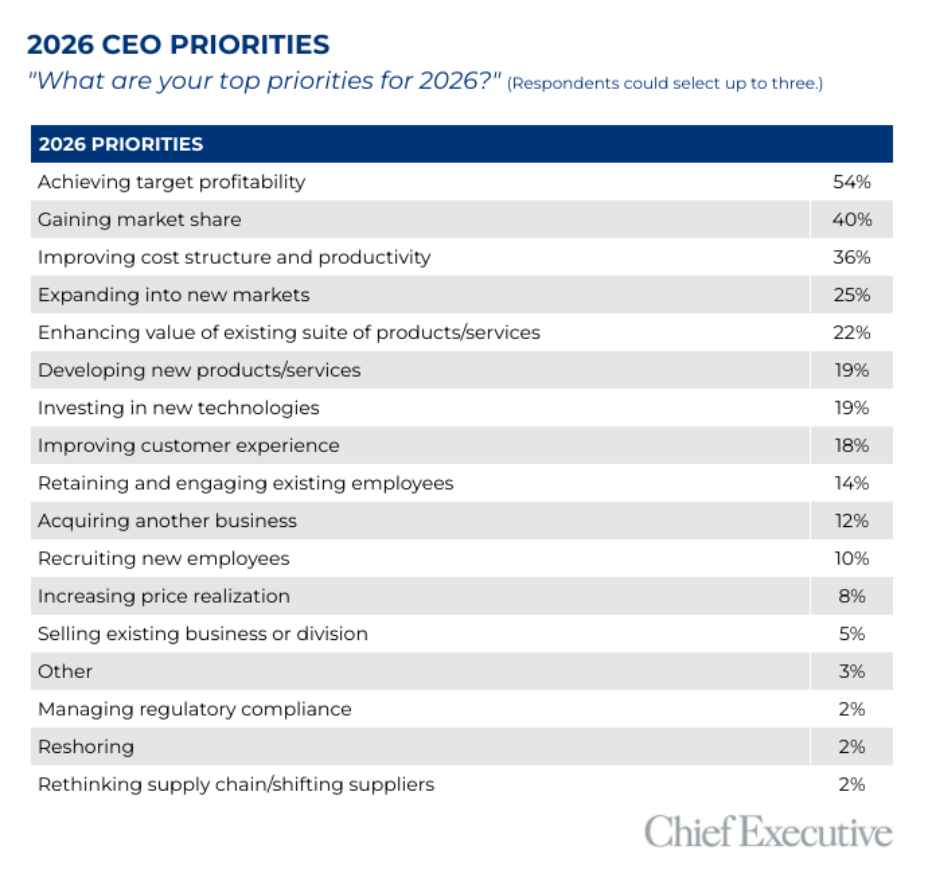
At the dawn of 2026, the executive suite was abuzz with forward-looking ambitions. CEOs articulated agendas brimming with intent: to penetrate new international markets, to innovate through novel product development, to refine and enhance existing offerings, to embrace technological advancements, to elevate the customer experience, and to significantly boost overall productivity. These aspirations painted a picture of a business world poised for broad-based expansion and strategic investment.
However, the subsequent eight months have delivered a relentless barrage of geopolitical and policy surprises. From unexpected trade tariffs and sanctions to shifts in regulatory frameworks and international alliances, the global operating environment has become increasingly unpredictable. In response, Chief Executive sought to understand how these seismic shifts have reshaped executive focus for the remainder of the year. The August CEO Confidence Index, which surveyed 285 CEOs on August 4-5, indicates a markedly more concentrated strategic approach.
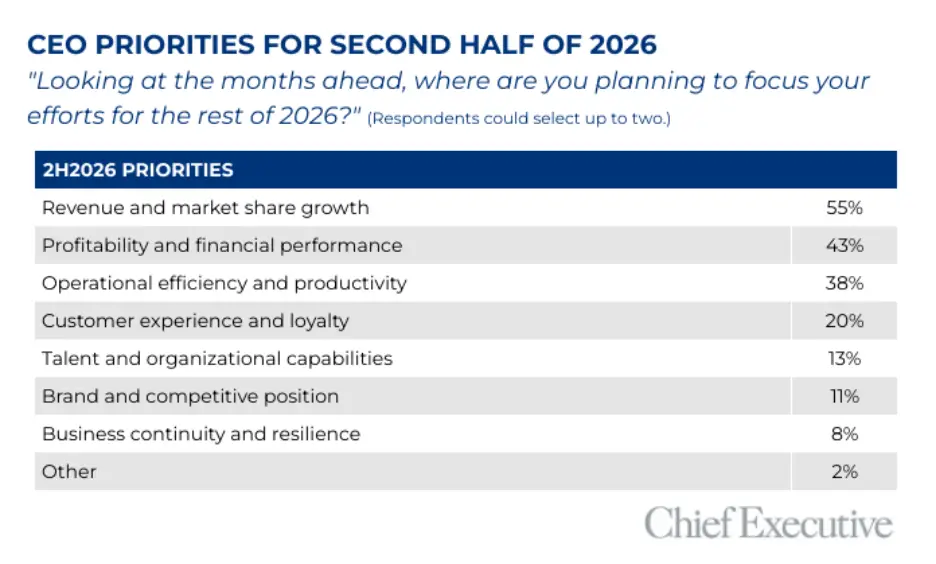
The survey results underscore a decisive shift towards immediate financial imperatives. Revenue and market-share growth have ascended to the apex of CEO priorities, with a commanding 55 percent of respondents identifying these as their primary focus. This is closely followed by profitability and overall financial performance, cited by 43 percent. Operational efficiency and productivity, while still significant, have seen a relative decrease in stated priority, ranked by 38 percent of CEOs. Other previously high-flying objectives have fallen considerably in prominence, suggesting a strategic consolidation driven by the prevailing uncertainties.
The Ascendancy of AI as a Growth Catalyst
While direct comparisons between the January and August surveys must acknowledge methodological differences – the former allowing for up to three priorities from a broader list, and the latter focusing on two overarching areas – the trend is unmistakable. The groundwork laid in early 2026 is now being leveraged for tangible results, with AI increasingly positioned as a pivotal engine for achieving these outcomes.
Several chief executives highlighted the critical need for organizational agility and adaptability to support this intensified growth push. One executive articulated the challenge as "managing growth pace against operational structures and consistencies," emphasizing the delicate balance required to scale effectively amidst dynamic market conditions.
For a significant number of these leaders, AI is not merely an operational enhancement but a strategic imperative for generating new revenue streams. One CEO, prioritizing revenue growth and operational efficiency in the latter half of 2026, candidly stated the challenge as the need to "spin up new business lines in AI to make up for legacy product stagnation." This sentiment reflects a growing recognition of AI’s potential to disrupt established markets and create entirely new ones, offering a pathway to overcome the limitations of mature product cycles.
The tangible impact of AI on efficiency and data intelligence is already being observed. Bill Estes, president of Geokon, a manufacturer of geotechnical and structural instrumentation, shared his firsthand experience: "Adoption of AI is significantly improving efficiency and data intelligence." This underscores the practical benefits that early AI integration can yield, providing a competitive edge through enhanced decision-making and streamlined operations.
At Wayne Bank, a Honesdale, PA-based institution, CEO Jim Donnelly is actively pursuing operational efficiency through the implementation and scaling of new technologies. His focus is on leveraging these advancements to "minimize operational constraints," a crucial objective in an environment where efficiency directly impacts profitability and the ability to compete.
This intensified focus on AI builds directly upon the strategic pillars identified at the beginning of the year. The earlier emphasis on entering new markets, enhancing existing products and services, developing new offerings, investing in new technologies, and improving customer experience are now being fused with AI capabilities to accelerate progress.
Paul Riedl, Jr., CEO of River Run, a managed IT and cybersecurity services firm based in Glendale, Wisconsin, stressed the imperative for companies to master AI’s application to drive growth. "Our business is affected by AI," he stated, cautioning that the pressure to adapt and innovate will only intensify. His personal focus for the coming months is on "AI Implementation and getting people to use it as a tool to leap forward." This highlights the dual challenge of technological integration and organizational adoption, where human capacity to leverage AI is as critical as the technology itself.
The Paradox of Unaddressed Priorities: Talent and Resilience
Perhaps one of the most striking revelations from the August survey is the de-prioritization of certain critical areas, particularly talent and organizational capabilities. Only 13 percent of the polled CEOs designated talent and organizational capabilities as one of their top two focus areas for the remainder of 2026. This stands in stark contrast to the pervasive concerns surrounding workforce issues that are evident elsewhere in the survey data.
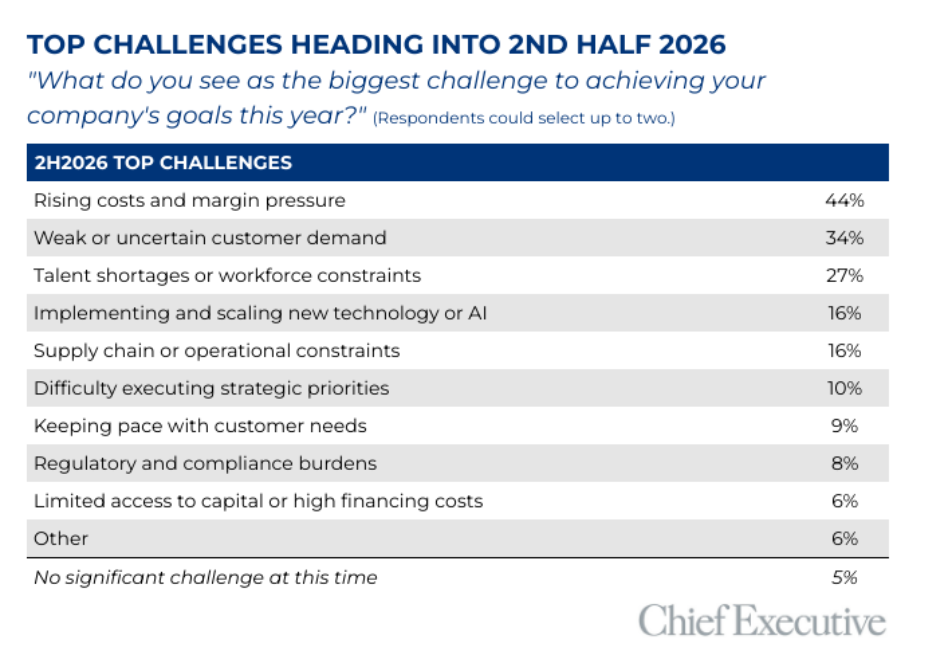
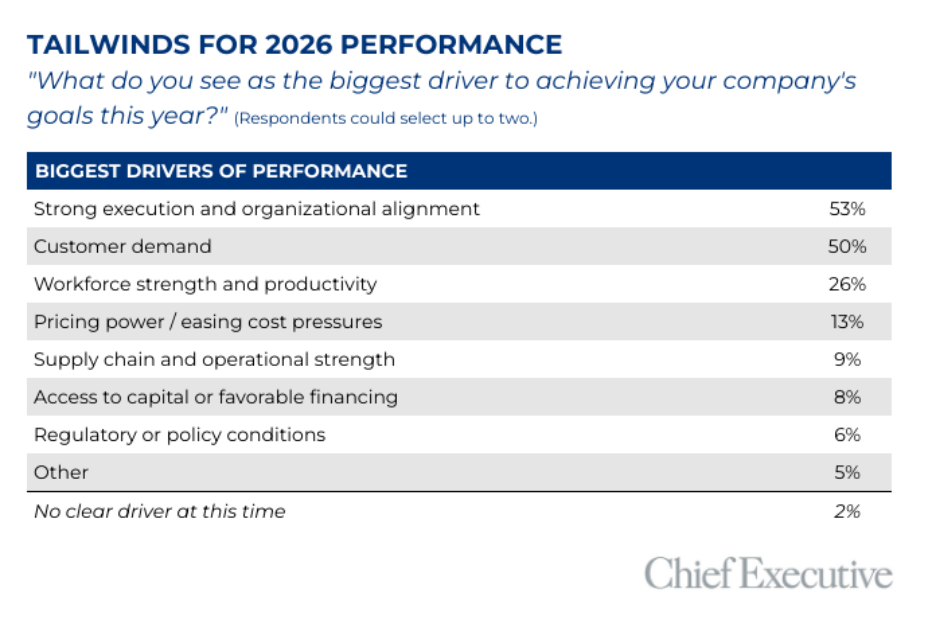
A substantial 27 percent of CEOs identify talent shortages or workforce constraints as one of the most significant hurdles to achieving their strategic goals. Furthermore, 26 percent acknowledge workforce strength and productivity as a key driver of their success, while 22 percent perceive workforce availability and labor costs as a major external risk. This disconnect between the recognized challenges and the stated priorities suggests a potential blind spot in executive strategy, where the immediate pressures of revenue generation may be overshadowing long-term human capital development.
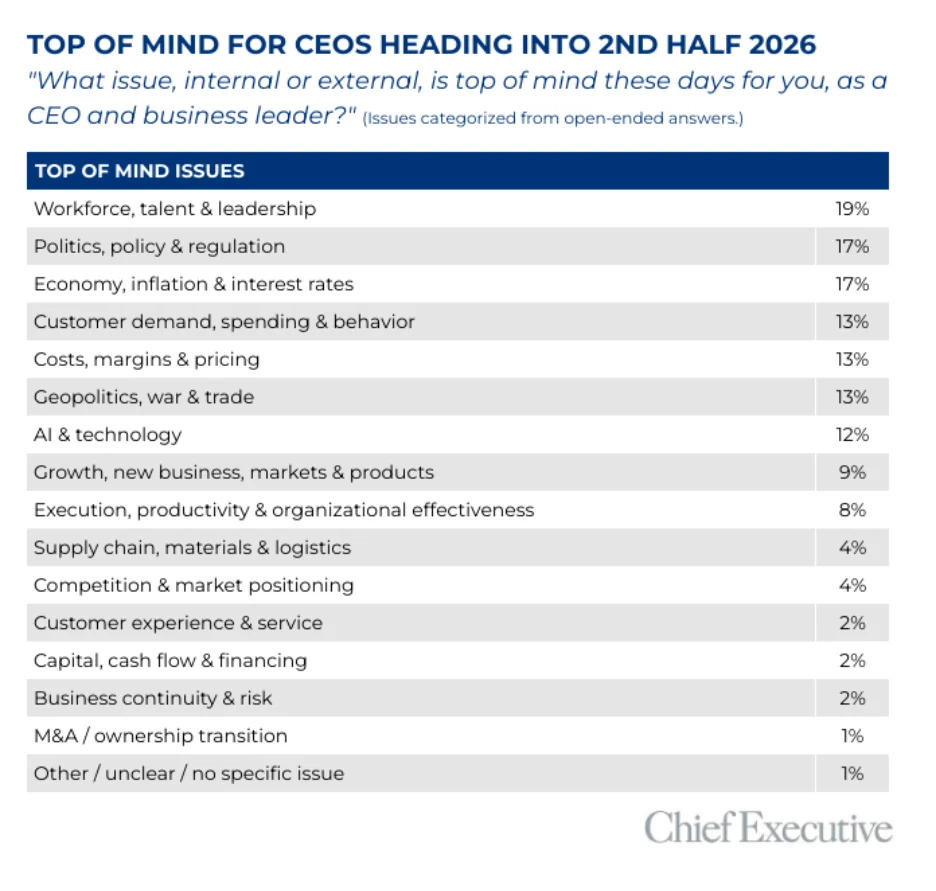
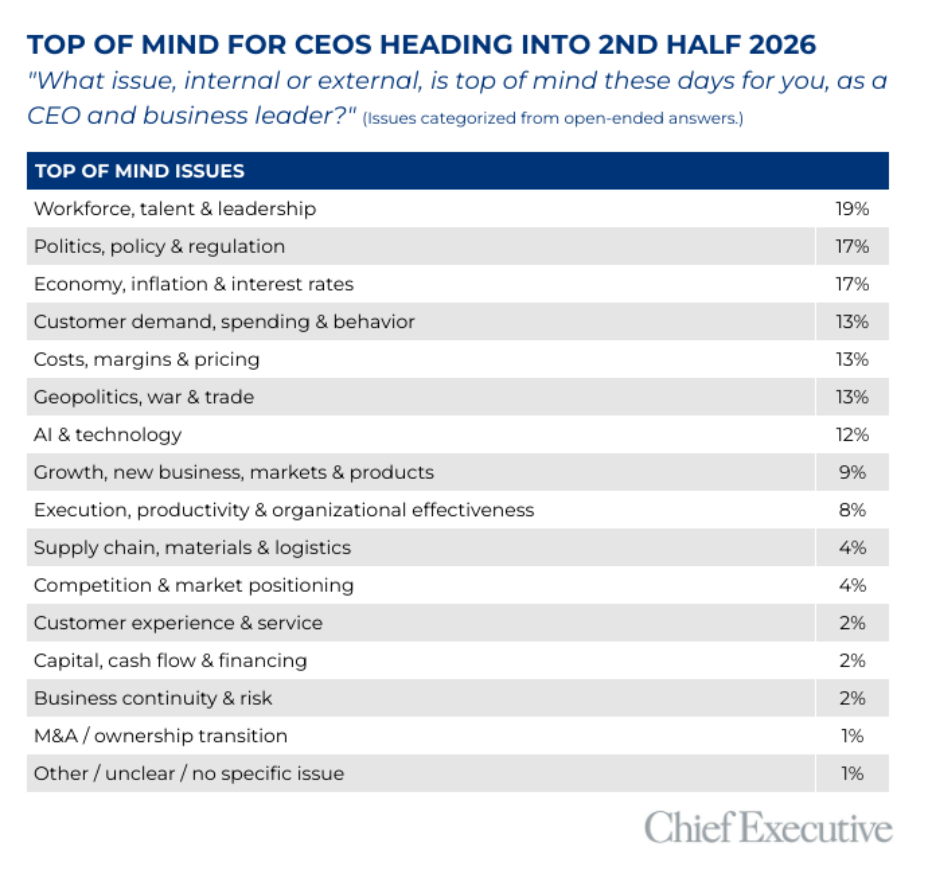
The divergence becomes even more pronounced when CEOs are given the freedom to articulate their most pressing concerns in their own words. When asked about the issue, internal or external, currently at the forefront of their minds, "workforce," "talent," and "leadership" emerged as the most frequently cited themes, appearing in 19 percent of open-ended responses. This qualitative data strongly indicates that despite the quantitative shift in stated priorities, the human element remains a dominant concern in the executive consciousness.
Gladiola Unzueta, founder and CEO of MultiGla Strategies, a provider of integrated financial services and business consulting, emphasizes the critical role of talent in future success. "The companies that will lead in the coming years will not simply adopt new technology; they will build strong cultures, invest in their people, and remain adaptable," she asserts. Unzueta’s perspective underscores a fundamental truth: "AI is transforming business, but trust, leadership, and execution will continue to be the true competitive advantages." This highlights that while technology offers new capabilities, the human qualities of leadership, culture, and execution are irreplaceable differentiators.
Chris Burkhard, president and founder of Placers Staffing & Recruitment, observes an acceleration in the pace of workforce dynamics. "There is a normalization to the market churn that is just beginning," he notes, adding that persistent labor shortages and skill gaps are re-emphasizing the relevance of a robust workforce strategy. Burkhard’s insight is particularly pertinent in the context of AI’s rise: "AI falls short in replacing humans." This statement serves as a crucial reminder that technological advancements, while powerful, cannot fully substitute for the complex skills, adaptability, and critical thinking that human employees bring to the table.
Interestingly, CEOs who are explicitly prioritizing talent are also more likely to project robust growth. Nearly 90 percent of these leaders anticipate revenue increases in the current year, a significantly higher proportion compared to the 73 percent among CEOs who did not select talent as a top priority. Similarly, 63 percent of talent-focused CEOs expect to expand their headcount, versus 44 percent of their counterparts. This correlation suggests that investing in human capital may, in fact, be a key enabler of aggressive growth strategies.
A similar paradox emerges concerning business continuity and resilience. Only 8 percent of CEOs placed this among their top focus areas. This is despite the fact that 45 percent identify inflation and economic conditions as major external risks, and 39 percent cite geopolitical conflict or trade disruption. The apparent disconnect suggests that while CEOs acknowledge these macro-level risks, they are not translating them into a top-tier strategic priority for organizational resilience, potentially leaving businesses vulnerable to unforeseen shocks.
Navigating Competitive Currents and External Headwinds
The competitive landscape also presents a notable tension within the survey data. Just 11 percent of CEOs selected brand and competitive position as a primary focus. Yet, a significant 25 percent identify competition and market disruption as a major external risk. When asked to identify top-of-mind issues without predefined options, 12 percent of CEOs independently raised AI or technology, often expressing concerns about AI-driven disruption and the imperative to adapt business models rapidly. This indicates an awareness of competitive threats, particularly from technological advancements, but a reluctance to elevate brand and competitive positioning as a proactive strategic priority.
Potential Obstacles on the Horizon
Despite the determined focus on growth and AI adoption, several challenges loom large for businesses navigating the remainder of 2026. Rising costs and margin pressure remain the most frequently cited impediment to achieving company goals, identified by 44 percent of CEOs. Weak or uncertain customer demand follows closely at 34 percent, while talent shortages or workforce constraints are cited by 27 percent.
The sentiment regarding customer demand is notably divided. While half of the polled CEOs view it as a significant tailwind, propelling their growth initiatives, roughly a third perceive weak or uncertain demand as a challenge, a potential drag on their ambitions. For some, the market conditions are favorable: one CEO reported, "Demand is accelerating," while another observed, "the market has remained stronger than expected for longer than expected." However, for others, the economic climate is proving more restrictive. One respondent lamented that "high costs/inflation is finally shrinking consumer demand," painting a picture of a bifurcated market where economic pressures are beginning to impact consumer spending.
External risks continue to present a substantial threat landscape. Inflation and economic conditions stand as the foremost concerns, trailed by geopolitical conflict or trade disruption, competition and market disruption, workforce availability and labor costs, and changing customer behavior. These multifaceted risks underscore the complex and interconnected nature of the global business environment.
Notwithstanding these considerable challenges, the overwhelming majority of CEOs, 55 percent, remain committed to revenue and market-share growth as their primary objective through the end of the year. A strong majority of 53 percent also cite robust execution and organizational alignment as crucial drivers for achieving their goals. This indicates a collective determination to push forward, leveraging operational discipline and strategic focus to navigate the prevailing uncertainties and capitalize on emerging opportunities. The strategic recalibration of 2026, driven by external shocks, has firmly anchored CEO attention on immediate financial performance and the transformative potential of AI, even as critical long-term considerations like talent and resilience may warrant greater strategic emphasis.
