


Canada stands at the precipice of a radical industrial and economic transformation that will redefine the nation’s landscape over the next three decades. To meet its international climate commitments and achieve a net-zero economy by 2050, the country must facilitate an unprecedented flow of capital into green infrastructure. While the public imagination often focuses on "megaprojects"—massive hydroelectric dams in the north, sprawling transmission corridors, and multi-billion-dollar utility-scale wind farms—a significant portion of the energy transition will occur at a granular, local level. This shift represents a move away from a centralized, fuel-burning economy toward a decentralized, capital-intensive system where the "power plants" of the future are located on the rooftops of suburban homes, in the basements of apartment buildings, and within the batteries of electric vehicle fleets.
According to a comprehensive "Climate Dollars" analysis by Corporate Knights, putting Canada on a deep-decarbonization pathway will require an estimated $2.17 trillion in capital investment between now and 2050. This equates to an average annual investment of $86 billion. Of this total, approximately 42% is destined for demand-side technologies—those that use energy in buildings, vehicles, and industrial processes—while the remaining 58% will support the electricity systems that supply them. This massive capital requirement is not merely a cost to be borne; it represents a generational opportunity for community economic development, provided the financial architecture is designed to allow for local ownership and participation.
The Chronology of Canada’s Decarbonization Mandate
The path to this $2.17 trillion investment requirement has been paved by a series of domestic and international policy shifts. The timeline of Canada’s commitment highlights the urgency of the current financial challenge:
- 2015: Canada signs the Paris Agreement, committing to reduce greenhouse gas (GHG) emissions by 30% below 2005 levels by 2030.
- 2016: The Pan-Canadian Framework on Clean Growth and Climate Change is established, marking the first time federal, provincial, and territorial governments agree on a national plan.
- 2020: The federal government introduces the Canadian Net-Zero Emissions Accountability Act, legally binding the government to a process to achieve net-zero emissions by 2050.
- 2021: Canada enhances its 2030 target, aiming for a 40% to 45% reduction in emissions.
- 2023-2024: Major federal tax credits for clean technology and electricity are introduced to catalyze private investment, setting the stage for the massive capital mobilization described in the Corporate Knights analysis.
As these targets approach, the focus is shifting from policy-making to implementation. The "Climate Dollars" report underscores that the success of these mandates depends on whether the required $86 billion a year can be effectively deployed into both large-scale and distributed assets.
A $1.2 Trillion Opportunity for Local Participation
A critical finding of the Corporate Knights modelling is that more than $1.2 trillion of the projected investment through 2050 falls into asset classes where local or community participation is highly feasible. This "community-compatible" territory includes wind and solar generation, building decarbonization, vehicle-to-grid (V2G) infrastructure, and local electricity distribution.
While traditional utility companies and large-scale developers will continue to play a major role, the inherently distributed nature of renewable energy creates an opening for "proximity finance." Unlike fossil fuel systems, which are centralized around refineries and pipelines, a renewable system harvests energy over vast areas. In this new model, every building becomes an energy asset, every vehicle becomes a mobile storage unit, and every community has the potential to become a micro-utility.

The $1.2 trillion figure is not a forecast of guaranteed community bonds or cooperative shares, but rather a measure of the "contestable space" where community finance can operate. If even a fraction of this capital is funneled through local institutions—such as Indigenous nations, housing cooperatives, and municipal non-profits—the economic returns of the energy transition will remain within the communities that host the infrastructure.
Shifting the Economic Paradigm: From Buying Fuel to Building Capital
The most profound economic shift described in the transition is the movement from an opex-heavy (operating expenditure) fossil fuel economy to a capex-heavy (capital expenditure) clean energy economy. Currently, Canadians spend approximately $235 billion annually on energy, with $179 billion of that going toward natural gas and petroleum products. This money is spent on fuels that are consumed and gone the moment they are used.
In a low-carbon scenario, the financial mechanics change. For example, Canadian households and local commercial fleets currently spend roughly $65 billion a year on fuel. For a mid-sized community of 50,000 people, this represents an annual energy bill of approximately $83 million. Under the Climate Dollars electrification scenario, that same community’s energy bill for transportation would drop to about $19 million.
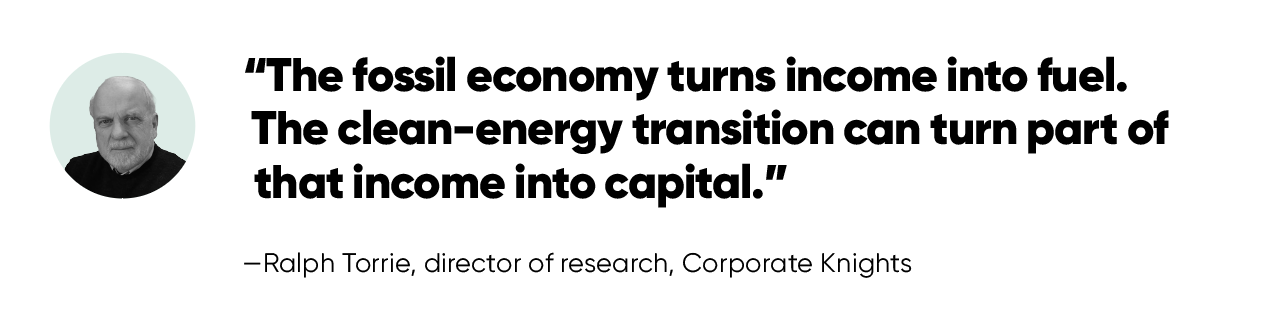
The "missing" millions do not simply vanish; they represent the capital that must be invested upfront in electric vehicles, charging infrastructure, and grid enhancements. The fossil economy turns income into smoke; the clean-energy transition turns that same income into lasting capital assets. This shift provides a unique opening for community finance, as local investors can fund the assets—like community solar or charging networks—that generate long-term savings and dividends.
Decarbonizing the Built Environment: A Localized Labor Force
The scale of the building transition is particularly illustrative of the need for local involvement. Corporate Knights estimates that decarbonizing residential buildings in Canada will require $183 billion in incremental capital, with commercial buildings requiring another $191 billion. This $374 billion total represents millions of individual projects: insulating attics in Sudbury, installing heat pumps in Regina, and upgrading electrical panels in Halifax.
From a technical standpoint, these projects cannot be outsourced. A building envelope must be retrofitted on-site by local tradespeople, and equipment must be maintained by local technicians. This creates a powerful engine for local job creation. However, the ownership of these projects determines where the profit goes. While a corporate-owned office tower will likely be financed through global capital markets, schools, community centers, and affordable housing portfolios are prime candidates for community bonds. By using community finance to fund these retrofits, the interest payments on the debt stay within the community rather than flowing to international financial centers.
Overcoming Transaction Costs through Aggregation
One of the primary hurdles for the distributed transition is the "transaction cost" problem. Large-scale financial institutions are designed for large-scale deals. Financing a single $50,000 home retrofit is inefficient for a major bank compared to financing a $500 million gas plant.
This is where community finance institutions—such as credit unions, green banks, and local investment co-ops—become essential. These organizations possess the local knowledge required to assess risk at the neighborhood level. By aggregating 50 or 100 smaller projects into a single investment vehicle, they can create the scale necessary to attract larger tranches of capital while maintaining local control. In this model, the unit of finance (the bond or the fund) does not have to match the unit of technology (the individual heat pump).
Social License and the "Host vs. Participant" Dynamic
Beyond the purely financial metrics, the Corporate Knights report highlights the social implications of ownership. There is a growing body of research suggesting that renewable energy projects face less local opposition when the community has a meaningful equity stake.
When a multinational corporation proposes a wind farm, residents may view themselves as "hosts" who bear the burden of the infrastructure while the profits disappear elsewhere. However, when an Indigenous nation or a local cooperative owns a stake in the project, the community becomes a "participant." This sense of ownership can mitigate disputes over land use and noise, as the benefits of the project are directly tied to local prosperity. Community finance, therefore, serves as a tool for building "social license," ensuring that the energy transition is seen as something built by the community rather than something happening to it.
Implications for the Future of Canadian Finance
The transition to a net-zero economy requires more than just new technology; it requires a new financial architecture. The current system is highly centralized, mirroring the fossil fuel infrastructure it was built to support. To manage a $2.17 trillion shift toward distributed assets, Canada needs a financial system that is equally distributed.
The implications for policy-makers and financial institutions are clear:
- Support for Community Bonds: Governments can play a role in de-risking community investments through first-loss capital or loan guarantees.
- Indigenous Equity Partnerships: The trend toward Indigenous-led energy projects (seen in provinces like Ontario and British Columbia) must be scaled nationally to ensure reconciliation is baked into the transition.
- Hybrid Financing Models: Community finance should not be viewed as a replacement for conventional capital but as a complement. A project might be funded with 20% community equity and 80% senior debt from a commercial bank or the Canada Infrastructure Bank.
As Ralph Torrie, director of research at Corporate Knights, suggests, the energy system is becoming physically more distributed. To succeed, the financial structures supporting it must follow suit. Whether the $2 trillion in new assets helps build community wealth or merely extracts it will depend on the choices made today regarding who owns, manages, and finances the tools of the clean energy future. The transition is inevitable; the distribution of its rewards, however, remains to be decided.
