

The 2026 proxy season in the United States concluded with a notable surge in Chief Executive Officer (CEO) compensation, reaching unprecedented levels, and a significant resurgence in one-time equity awards. Counterintuitively, this period of heightened executive pay coincided with remarkably robust shareholder support for compensation packages. Equity awards, in particular, continued to be the primary engine of pay growth, both through increased award values and a greater frequency of special grants. Concurrently, companies demonstrated an increasing reliance on security-related perquisites for their executives, reflecting a growing emphasis on executive safety and comprehensive risk management strategies.
This analysis, drawing on insights from Pranav Pradeep, Tim Sessing, and Chris Sayo of ISS-Corporate, a division of ISS-STOXX, highlights key trends and potential future shifts in the executive compensation landscape. Subodh Mishra, Global Head of Communications at ISS-STOXX, provided commentary on the findings.
Key Takeaways from the 2026 Proxy Season:
- Record CEO Pay Levels: Despite economic uncertainties, CEO compensation reached new heights, largely driven by equity awards.
- Resurgence of One-Time Equity Awards: Companies increased their use of special equity grants, a trend not seen since the pandemic.
- Strong Shareholder Support: Say-on-Pay (SOP) votes achieved five-year highs, with a multi-year low in failed SOP proposals, indicating investor confidence in compensation alignment with performance.
- Economic Uncertainty Impacts Design: Increased market volatility led to a spike in discretionary pay adjustments, reminiscent of pandemic-era practices.
- Impending Regulatory Changes: Proposed SEC amendments could significantly alter compensation disclosure and voting requirements for a substantial portion of public companies.
CEO Compensation Trends: S&P 500 Outpaces the Broader Market
A significant divergence in CEO pay growth was observed between the S&P 500 and the broader Russell 3000 index (excluding S&P 500 constituents). Median CEO pay remained relatively stable for companies within the Russell 3000 but outside the S&P 500, holding steady at approximately $5.5 million in both fiscal years 2024 and 2025. In stark contrast, median pay for S&P 500 CEOs continued its upward trajectory, reaching $17.5 million in FY2025. Since 2021, median pay within the S&P 500 has surged by 20%, a considerably higher rate than the 5% increase seen among the rest of the Russell 3000 companies.
Industry-Specific Pay Growth Varied
The trend of increasing median CEO pay was widespread across most industries between FY2021 and FY2025. However, the extent of these increases varied significantly. Telecommunications Services emerged as the sector with the most substantial growth, reporting a 54% rise in median CEO pay, far exceeding the Russell 3000 median increase of 10% during the same period. Conversely, some sectors experienced a decline in median CEO pay, including Real Estate Management & Development, Automobiles & Components, Banks, and Energy. This suggests that while executive compensation generally trended upwards, industry-specific economic conditions and performance played a crucial role in shaping these outcomes.
Incentive Compensation Driving CEO Pay Increase
The overall increase in median CEO pay from FY2024 to FY2025 was propelled by a rise in all major compensation elements. However, the pattern of this growth differed across market segments. For Russell 3000 companies outside the S&P 500, short-term incentives (annual bonuses) saw the most significant percentage increase, climbing by 19%. This was closely followed by a 14% rise in "All Other Compensation," which often includes perquisites and other benefits.

In contrast, within the S&P 500, long-term incentives (primarily equity awards) experienced the largest increase, rising by 8%. Base salary and annual incentives saw more modest growth of 3% each. Despite the varying growth rates of different compensation components, long-term incentives remained the principal contributor to the absolute dollar increase in CEO pay for S&P 500 companies. The substantial 8% rise in long-term incentive values among this group significantly outpaced the increases in other pay elements, reinforcing the ongoing significance of equity awards as the primary driver of executive compensation growth in FY2025.
Resurgence of One-Time Equity Awards Contributes to Pay Growth
The upward trend in equity compensation was not solely attributed to standard annual long-term incentive programs. A notable factor was the resurgence of off-cycle, one-time equity awards. Following the initial impact of the COVID-19 pandemic, numerous companies began to more frequently utilize special equity grants. These awards were often implemented to address executive retention concerns, facilitate leadership transitions, or mitigate the effects of unprecedented business uncertainty.
The prevalence of such awards saw a peak in 2021, with nearly 30% of Russell 3000 companies granting a special equity award to at least one Named Executive Officer (NEO). While the use of these awards subsequently declined as market conditions stabilized in 2022, fiscal year 2025 marked the first year-over-year increase since the pandemic-era peak. In FY2025, 27.3% of companies reported granting a one-time award, up from 25.1% in fiscal year 2024. This revival of special equity grants played a significant role in the overall growth of equity compensation observed during the year, contributing to the record CEO pay levels.
Analysis of One-Time Awards: Larger Grants Become More Prevalent
The growing use of one-time equity awards was accompanied by an increase in their magnitude. While grants valued at less than $1 million continued to constitute the majority of awards in FY2025, their proportion decreased to 58.4%, down from approximately 62% to 66% in the preceding four years. Concurrently, the proportion of awards exceeding $20 million more than doubled, rising from 1.5% in FY2024 to 3.3% in FY2025. This observed increase in the value of larger awards aligns with the heightened prevalence of one-time grants, suggesting that companies are not only more inclined to utilize these special equity awards but are also granting them at higher financial values. This strategy may be employed to attract and retain top talent in a competitive market or to reward executives for achieving specific, ambitious performance targets.
Increased Focus on Executive Safety and Security
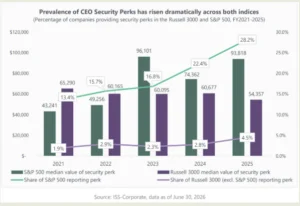
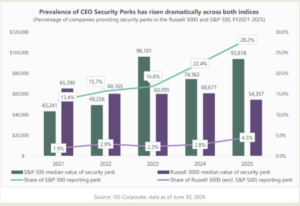
The slight increase in the "all other compensation" category across both the S&P 500 and Russell 3000 indices was largely attributed to a record-high prevalence of CEO perquisites, with a particular emphasis on security-related benefits. This trend has been observed over the past few years, indicating a heightened focus by corporate boards on ensuring the safety and security of their chief executives. Data reveals that the number of companies disclosing CEO security benefits within both major indices has more than doubled since 2021. While this practice remains relatively uncommon among smaller companies, its growing adoption among larger corporations signifies a strategic response to potential risks and an acknowledgment of the demanding roles held by top executives.
The value of these security benefits for S&P 500 CEOs peaked in 2023, but the number of companies reporting such benefits for their CEOs saw a significant spike in FY2025. Prevalence in the Russell 3000 increased by 61% compared to FY2024, while the S&P 500 saw a 26% increase. Notably, for Russell 3000 companies, this rise in the prevalence of security benefits correlated with a decrease in the median value of these perks, with the highest reported value for the index occurring in 2021. This suggests a shift towards broader adoption of these benefits, even if at a lower individual cost per company.
Say-on-Pay: Investor Confidence Remains High Despite Compensation Trends
A significant development in the 2026 proxy season was the strong shareholder support for executive compensation proposals, as evidenced by the Say-on-Pay (SOP) votes. Typically, periods of increased one-time equity awards or significant pay hikes have been associated with a decline in SOP support and a rise in failed votes. However, this year’s proxy season defied that trend.
During the first half of 2026, median SOP support reached five-year highs, with S&P 500 companies receiving 93.3% approval and Russell 3000 companies garnering 96% approval. Correspondingly, the rate of failed SOP votes across major indices decreased significantly compared to 2025, remaining well below the elevated levels seen in 2022 and 2023.
This robust shareholder endorsement, even amidst a resurgence in one-time equity awards and overall increases in CEO pay, suggests that companies have been effective in demonstrating a clear alignment between executive compensation and company performance. Thoughtful compensation design, coupled with transparent and comprehensive disclosures, appears to have resonated positively with investors, fostering a climate of trust and support.
Impending SEC Rule Changes Could Reshape Compensation Landscape
Despite the current positive shareholder sentiment, significant proposed rule changes from the U.S. Securities and Exchange Commission (SEC) could potentially disrupt the established landscape of executive compensation disclosure and voting. These proposed amendments aim to simplify the reporting categories for public companies. Currently, five categories exist, but the SEC proposes to consolidate them into just two: Large Accelerated Filers (LAF) and Non-Accelerated Filers (NAF). A company would be classified as an LAF if it has a public capital float of $2 billion or more and a consecutive reporting history of 60 months. All other companies would fall into the NAF category.
Under these proposed rules, NAFs would benefit from expanded exemptions and significantly reduced disclosure requirements. Specifically, NAFs would be exempt from Say-on-Pay, Say-on-Frequency, and Golden Parachute votes. Additionally, these companies would be required to disclose fewer NEOs and would be relieved of obligations related to compensation disclosure and analysis, certain compensation tables, and compensation committee interlocks disclosures. While companies retain the option to maintain their current practices, these proposed changes are poised to fundamentally alter how executive compensation is reported and how shareholders exercise their voting rights.
Implications of Proposed SEC Rule Changes Remain Uncertain
The exact timing and ultimate adoption of these SEC proposals are currently unknown. Furthermore, the potential reaction from investors to these changes is a subject of speculation. Both companies and investors have grown accustomed to detailed compensation disclosures that have evolved over time through extensive dialogue. A substantial reduction in disclosure requirements for NAFs could potentially obscure the crucial link between executive incentives and shareholder interests. The removal of Say-on-Pay votes for this group could limit their ability to formally express their views on executive remuneration, potentially necessitating alternative methods of shareholder engagement. For companies, diminished shareholder input might lead to a disconnect between investor expectations and actual compensation designs, raising questions about the long-term impact on executive behavior and corporate performance without the benefit of direct shareholder feedback.
Despite the evolving regulatory environment, the fundamental understanding that executive compensation serves as a vital mechanism for corporate accountability and the alignment of interests between leadership and shareholders is expected to persist. The principle that "pay matters" remains a cornerstone of corporate governance, irrespective of the specific disclosure and voting frameworks in place.
