

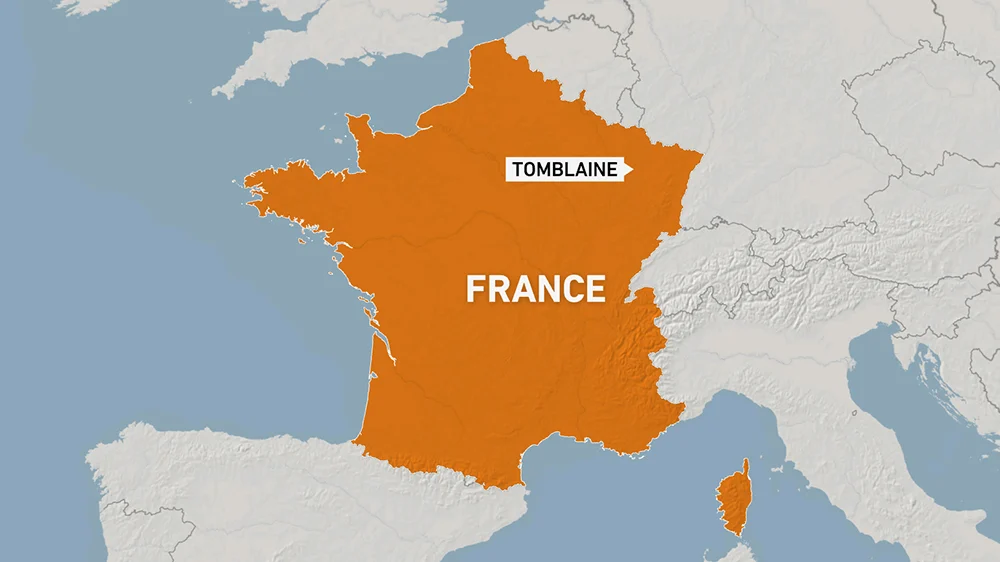
Tomblaine, France – A devastating aviation accident in Tomblaine, a commune in northeastern France, has claimed the lives of all eleven individuals on board a plane engaged in a skydiving excursion. The tragedy unfolded on Sunday, with local authorities confirming that the pilot and ten passengers – comprising five skydiving students and five instructors – perished when their aircraft went down at approximately 11:00 AM local time. The incident has triggered an immediate and comprehensive investigation by French aviation safety authorities and judicial bodies, drawing national attention and expressions of profound sorrow from officials and the public alike.
The serene Sunday morning was shattered by the catastrophic event near the Tomblaine airport, situated in the Meurthe-et-Moselle region. Yves Seguy, the prefect of the Meurthe-et-Moselle, was quick to arrive at the scene, addressing reporters amidst the solemn atmosphere. He confirmed the immediate response of emergency services, who were dispatched rapidly to the crash site. The urgency of the situation was underscored by police advisories urging the public to "strictly avoid" the area surrounding the airport, ensuring unimpeded access for the myriad of emergency responders, law enforcement personnel, and accident investigators converging on the scene. The gravity of the disaster was further highlighted by the announcement that Interior Minister Laurent Nunez was en route to Tomblaine, signaling a high-level government response to the tragic loss of life.
Chronology of a Tragic Morning
The day began as a routine skydiving operation, a popular recreational activity enjoyed by thousands across France annually. While specific details of the flight path and the moments leading up to the crash are under rigorous investigation, the general sequence of events for such an excursion typically involves a pre-flight briefing, boarding the aircraft at the airfield, and a gradual ascent to the required altitude for jumps. Skydiving aircraft, often robust and designed for multiple short ascents and descents, routinely carry a pilot, instructors, and students or experienced jumpers.
On this fateful Sunday, the aircraft departed from the Tomblaine airport, likely aiming for an altitude suitable for skydiving, which can range from 3,000 to 4,000 meters (approximately 10,000 to 13,000 feet). The crash occurred at 11:00 AM, suggesting the aircraft had been airborne for a relatively short duration, possibly during its ascent phase or shortly after reaching its target altitude. While official statements have not yet detailed witness accounts, initial reports from the scene indicated a sudden and catastrophic event. The wreckage site, secured within minutes of the impact, points to a high-energy impact, leaving little doubt about the immediate and tragic outcome for those on board.
Emergency services, including fire brigades, medical teams, and gendarmerie units, were mobilized almost instantly following reports of the crash. Their swift arrival at the Tomblaine airport perimeter and the adjacent crash zone initiated a complex recovery and investigation operation. The primary objective, tragically, quickly shifted from rescue to recovery, as the extent of the devastation became apparent. The establishment of a wide security cordon was paramount not only for public safety but also to preserve the integrity of the crash site, crucial for the subsequent forensic examination by accident investigators.
The Scene and Initial Response Efforts
The crash site in Tomblaine, a town with a population of just over 9,000 residents located in the eastern suburbs of Nancy, quickly transformed into a hub of coordinated emergency activity. The Tomblaine airport is a relatively modest facility, primarily serving general aviation, recreational flying, and activities like skydiving. The proximity of the crash to the airfield meant that initial reports were swift, enabling an almost immediate activation of the regional emergency response protocols.
Under the direct supervision of Prefect Yves Seguy, a command post was established, coordinating the efforts of numerous agencies. The French Gendarmerie, responsible for public order and security in rural and semi-rural areas, played a crucial role in securing the perimeter and managing access. Firefighters were on standby to mitigate any potential fuel leaks or fires, although initial reports did not indicate a post-impact blaze. Medical personnel from SAMU (Service d’Aide Médicale Urgente) were present, though their role, sadly, quickly became one of support for the responders and management of the deceased.
The preservation of the crash site is a critical phase in any aviation accident investigation. Every piece of wreckage, however small, can provide vital clues to the cause. Teams were meticulously cataloging and mapping the debris field, a process that can take days or even weeks depending on the complexity of the accident. This careful approach ensures that no potential evidence is overlooked, allowing investigators to reconstruct the sequence of events leading to the crash.
Deep Dive into the Investigation: BEA and Judicial Inquiries
The primary authority responsible for civil aviation accident investigations in France is the Bureau d’Enquêtes et d’Analyses pour la sécurité de l’aviation civile (BEA). Immediately upon notification of the Tomblaine crash, a team of expert investigators from the BEA would have been dispatched to the scene. Their mandate is to determine the technical circumstances and causes of the accident, and to formulate safety recommendations to prevent similar occurrences in the future. It is crucial to note that the BEA’s role is purely technical and aimed at safety improvement, not at assigning blame or fault.
The BEA’s investigation process is exhaustive and multi-faceted. It involves:
- On-site examination: Detailed inspection of the wreckage, distribution of debris, impact marks, and environmental factors.
- Data recovery: Retrieval and analysis of flight recorders, if the aircraft was equipped with them. Many smaller general aviation aircraft used for skydiving may not have sophisticated ‘black boxes’ as found in commercial airliners, but they may have other recording devices or engine monitoring systems.
- Witness interviews: Gathering statements from anyone who saw the aircraft before or during the crash, including air traffic controllers, ground personnel, and members of the public.
- Maintenance records review: Scrutiny of the aircraft’s logbooks, maintenance history, and compliance with airworthiness directives.
- Pilot and instructor qualifications: Verification of the pilot’s and instructors’ licenses, training, recent flight experience, and medical certificates.
- Operational procedures: Examination of the skydiving operator’s safety protocols, manifest procedures, and flight planning.
- Metallurgical and forensic analysis: Detailed examination of specific components of the aircraft for signs of fatigue, failure, or malfunction.
Concurrently, a judicial investigation will be launched by the local public prosecutor’s office. This inquiry aims to determine if any criminal negligence or wrongdoing contributed to the accident. While distinct from the BEA’s safety investigation, the two bodies often cooperate, sharing information while maintaining their independent mandates. The judicial investigation can lead to legal proceedings if criminal responsibility is identified. Given the tragic loss of life, the judicial inquiry is expected to be thorough and prolonged.
Background on Skydiving Aviation Safety
Skydiving, while perceived as a high-risk activity, operates within a stringent framework of safety regulations, particularly concerning the aircraft and pilot operations. France, like other European Union member states, adheres to the safety standards set by the European Union Aviation Safety Agency (EASA) and its own national civil aviation authority, the Direction Générale de l’Aviation Civile (DGAC).
Aircraft used for skydiving are typically robust, single or twin-engine propeller planes, modified to facilitate easy exits for jumpers. Common types include the Pilatus PC-6 Porter, Cessna Caravans, or De Havilland Twin Otters. These aircraft undergo rigorous maintenance schedules, often more frequently than standard general aviation aircraft due to the repetitive nature of their operations (multiple take-offs, climbs, and descents daily). Pilots operating these aircraft must possess specific qualifications, including commercial pilot licenses and often endorsements for high-performance aircraft and extensive experience in jump operations. Skydiving instructors are also highly trained and certified professionals, ensuring safety protocols are followed by students.
Despite these robust safety measures, aviation accidents, though rare, can occur. Statistics from organizations like the Aircraft Owners and Pilots Association (AOPA) and EASA consistently show that general aviation, which includes skydiving operations, has a higher accident rate than commercial airline travel, primarily due to factors such such as less stringent maintenance requirements (for privately owned aircraft, not typically jump planes), varied pilot experience, and flying in less controlled environments. However, multi-fatality accidents involving jump planes are relatively uncommon, making the Tomblaine incident particularly devastating. The investigation will undoubtedly scrutinize every aspect of the aircraft’s airworthiness, the pilot’s actions, and the operational environment to understand what went wrong.
Victims, Community Impact, and Official Condolences
The loss of eleven lives, particularly five students embarking on what should have been an exhilarating experience and five seasoned instructors dedicated to their craft, has sent shockwaves through the local community and the broader French skydiving fraternity. The names of the victims have not yet been officially released, pending family notifications, but their identities will soon emerge, bringing a painful human dimension to the tragedy. Each individual represented a unique life, a family, and a network of friends, all now grappling with unimaginable grief.
The emotional toll extends beyond the immediate families. First responders, who witnessed the horrific scene, will also require support. The psychological impact on those involved in the recovery efforts, as well as on witnesses, can be profound and long-lasting. Local authorities and community organizations are expected to mobilize resources for psychological first aid and grief counseling in the coming days and weeks.
Interior Minister Laurent Nunez’s visit to the crash site underscored the national significance of the tragedy. Such high-level government presence is customary in major incidents, demonstrating solidarity with the affected community and emphasizing the seriousness with which the government approaches public safety. Beyond Minister Nunez, statements of condolence and support are anticipated from other high-ranking officials, including potentially the Prime Minister or even the President, expressing the nation’s collective sorrow. Aviation federations and skydiving associations across France and Europe are also expected to offer their sympathies and support to the affected skydiving club and the families of the victims.
Broader Implications and Future Considerations
The Tomblaine crash will inevitably lead to a thorough re-evaluation of safety protocols within the French skydiving sector, and potentially across Europe. While the investigation is ongoing, and it is premature to draw conclusions, past aviation incidents have often led to enhanced regulations, revised training procedures, or technological advancements. The BEA’s final report, which could take months or even years to complete, will be critical in identifying systemic issues, if any, and proposing concrete recommendations.
For the specific skydiving club or operator involved, the implications are severe. Beyond the immediate operational halt and the devastating human cost, there will be a period of intense scrutiny and potential reputational damage. The long-term impact on their operations, and perhaps on the local skydiving community, could be significant.
This tragic event also serves as a somber reminder of the inherent risks, however small, associated with adventurous sports and aviation. While safety standards are continually improving, the potential for unforeseen circumstances or catastrophic failures remains. The focus now shifts to supporting the grieving families, conducting a meticulous investigation to uncover the truth, and implementing any necessary measures to prevent such a heartbreaking loss of life from occurring again. The memory of the eleven lives lost in Tomblaine will undoubtedly fuel the commitment of aviation safety professionals to make the skies safer for everyone.
