

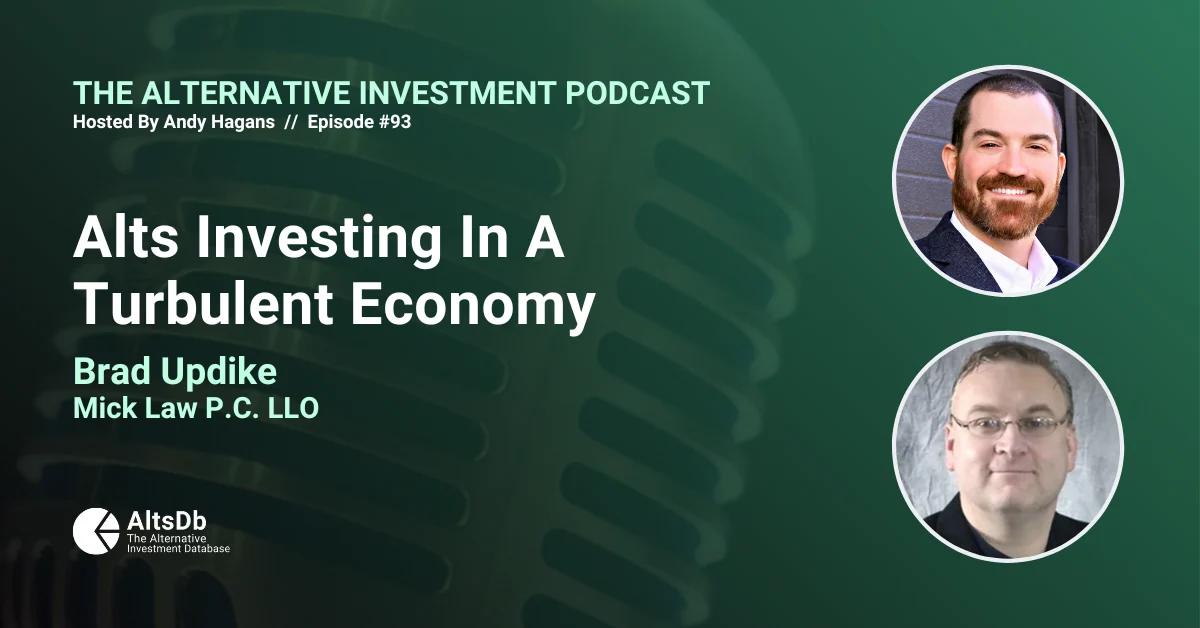
The landscape of alternative investments, encompassing private equity, venture capital, real estate, and other non-traditional assets, presents a complex and dynamic environment for financial advisors. As these asset classes become increasingly integrated into wealth management strategies, the rigor of due diligence becomes paramount. However, recent years have introduced significant challenges, characterized by economic volatility and a rapidly evolving alternative investment market, demanding enhanced scrutiny from wealth managers tasked with allocating client capital. Brad Updike, an attorney at Mick Law P.C. LLO, recently joined "The Alternative Investment Podcast" with host Andy Hagans to delve into the critical aspects of due diligence and navigating alternative investments amidst the current turbulent economic climate.
The Growing Importance of Alternative Investments
Alternative investments have transitioned from a niche offering to a core component of diversified portfolios. This shift is driven by the potential for enhanced returns, portfolio diversification, and inflation hedging. However, unlike publicly traded securities, alternative investments often lack readily available market data and regulatory oversight, necessitating a more in-depth due diligence process.
"We live in two worlds from a securities product perspective," explained Updike. "You have the public companies, whose debt and equity trade on public markets. Then you have the non-traded sector, the alternative investments, which is where our firm is involved. Alts include 1031 products sold by private placement, DSTs, real estate, LLCs and LPs, Qualified Opportunity Funds, oil and gas programs, and other private placement products. You also have the registered non-traded product universe, including non-traded REITs, BDCs, and interval funds."
The sheer volume of activity in the alternative investment space underscores the need for specialized expertise. Annually, approximately 20,000 Form D filings are made by companies seeking to raise capital through debt and equity, often amounting to around $1 trillion in sought capital. While not all filings result in successful capital raises, a significant portion, estimated at 15% to 20% involving FINRA firms, do make it to market.
Mick Law’s Role in Due Diligence
Mick Law P.C. LLO, based in Omaha, Nebraska, plays a crucial role in this ecosystem by providing underwriting and due diligence support to a network of approximately 300 broker-dealers, investment advisors, and family offices. The firm’s team of nine lawyers specializes in supporting the distribution of non-traded alternative investments.
Updike elaborated on the contrast between public and private markets: "On the public side, it’s a little bit more perhaps BD advisor-friendly. You have the periodic SEC filings that have to be made on a quarterly basis. You have an underwriter that’s actually in the process. That’s an investment banking firm that’s going out, researching the company, conducting interviews, assessing risk, valuing the company, and placing a price on that security. Whereas in the private placement side, you don’t have that. You don’t have periodic filings, you don’t have an underwriter. But what you do have is pretty stringent due diligence and suitability requirements, which is where we bring value."
Navigating Regulatory Requirements
The due diligence obligations for financial advisors, whether they operate under a suitability standard (broker-dealers) or a fiduciary standard (Registered Investment Advisors or RIAs), are robust. While the legal frameworks may differ, the underlying principle of acting in the client’s best interest necessitates thorough investigation.
"On paper, if you compare the due diligence obligation of a registered investment advisor to a BD, on paper, it looks like there are compelling differences, but not really," Updike stated. "Because if you think about it, the RIA, while they’re not subject to the FINRA rules, they do have fiduciary duties to act within their client’s best interests. So, I would say that a lot of the guidelines and things that you’re supposed to do as a broker-dealer, you should be doing as an RIA."
For broker-dealers, FINRA Rule 2111 mandates sufficient due diligence and research to ensure an investment is suitable for at least one type of investor. This is further amplified by Regulation Best Interest (Reg BI), which requires broker-dealers to understand conflicts of interest, fees, risks, and costs associated with all securities, and to undertake comparative analyses of different investment opportunities.
The Dual Pillars of Due Diligence: Sponsor and Offering
Effective due diligence in the alternative investment space hinges on two critical pillars: the sponsor or manager and the specific investment offering itself. Relying solely on a sponsor’s established reputation, while valuable, is insufficient. Market dynamics and economic cycles can significantly impact even the most experienced firms.
"Sponsor-level analysis, program-level analysis, both of them are very, very important processes that need to be prioritized and taken seriously," Updike emphasized. "Even with the highest-capitalized sponsors out there, things turn on a dime. I mean, look at our economy. Look how many cycles that we’ve went through. And even highly-capitalized, experienced sponsors can face times of distress."
Sponsor review involves an in-depth investigation into their operational and financial capabilities to manage a program successfully. Conversely, product review focuses on the fairness of the offering to investors, considering the associated risks, asset quality, and return potential.
The shelf life of a sponsor-level review typically spans two to four years. However, during product reviews, ongoing monitoring of financial statements and performance is essential. Substantial changes in a sponsor’s operations, financial health, or prospects for success may necessitate more frequent sponsor-level due diligence, potentially every 12 to 18 months.
A Universal Framework with Sector-Specific Nuances
Despite the diversity of alternative investments, a general framework for due diligence applies across sectors. Mick Law’s process consistently examines:
- Risk of Execution Failure: Assessing the likelihood of the sponsor failing to achieve the investment’s objectives.
- Reward Potential: Evaluating the realistic return potential under conservative economic assumptions.
- Quality of the Asset: Analyzing the underlying assets and their potential returns.
- Alignment of Offering Terms with Risk: Ensuring that the terms of the offering appropriately compensate investors for the risks taken.
- Disclosure of Material Risks: Verifying that all significant risks are clearly disclosed in offering documents.
- Fair Treatment of Investors: Examining investor access to financial information and their voting rights.
A key component of this framework is the "alignment of interest test," a formula developed by Brian Mick, the firm’s founder. This test assesses who is putting money in, who is taking money out, and whether the sponsor’s compensation is performance-based, providing insight into the alignment between investors, sponsors, and issuers.
While this general framework remains constant, the due diligence approach naturally adapts to the specific sector. For instance, oil and gas deals require the expertise of reservoir engineers and geologists to assess field potential and operating conditions. Real estate due diligence, on the other hand, relies on appraisers and professionals with designations like CCIM to analyze markets and assets.
Sectoral Differences in Due Diligence Timelines
The complexity and nature of certain alternative investments can influence the time required for thorough due diligence. Real estate offerings, particularly DSTs and 1031 products, often allow for a quicker turnaround, typically five to seven days, due to established appraisal processes and market data availability. In contrast, oil and gas due diligence is a more involved process, often taking four to five weeks due to the need for extensive geological and engineering assessments.
Current Economic Headwinds and Their Impact on Due Diligence
The current economic climate presents significant headwinds that directly impact the due diligence process for alternative investments. Rising borrowing costs and persistent inflation have created a challenging environment, particularly for real estate.
"Stating the obvious, it costs more to conduct business today," Updike noted. "Most notably, borrowing costs have gone way, way up. Go back two years ago, a year ago, prime rate was 3.25% for a couple years. And then, just couple months ago, we saw a pretty significant, gradually seen pretty significant spikes. Prime lending rate’s 7.5% today, so that’s a 450-basis-point uptick in the cost of capital, from a debt perspective. You’ve got to couple that with inflation, which is at 6.5% now. It becomes very difficult to drive NOI and to pay the distributions."
This has led to a compression of yields on certain products. For example, average year-one cash-on-cash returns for 1031 products were around 3.99% in Q4 2022, a notable decrease from previous years when yields were closer to 5% to 6.5%. Advisors must now rigorously evaluate whether a marketed yield is sustainable and can be supported by the underlying asset’s performance, especially considering the seven-to-nine-year exit horizons common in many DST offerings.
Common Pitfalls in Advisor Due Diligence
Despite the best intentions, advisors can fall into common traps when evaluating alternative investments. Updike highlighted several critical mistakes:
- "Paying Yield on a Non-Yielding Business": Investing in businesses whose plans are attractive but lack the underlying assets to generate sustainable distributions.
- Over-reliance on Outsourced Services in Energy: In oil and gas, sponsors heavily reliant on external geological and drilling expertise may underperform those with vertically integrated operations.
- Misunderstanding Sponsor Prior Performance: Prior success is only relevant if it occurred in strategies, fields, or sectors directly applicable to the current offering.
- Lack of Transparency and Accountability: Sponsors who fail to provide audits, quarterly financials, appraisals, or reserve reports raise significant red flags.
- Ignoring Voting Rights: The absence of adequate investor voting rights can leave investors vulnerable.
Best Practices for Advisors in Alternative Investment Due Diligence
Conversely, advisors who excel in due diligence exhibit several common threads:
- Regular and Ongoing Due Diligence: Maintaining a consistent and updated review of sponsors and offerings.
- Product Education: Deeply understanding the intricacies of alternative investment products and their differences from competing offerings.
- Knowing the Client: Ensuring that investments are appropriate for the client’s financial situation, risk tolerance, and investment objectives.
- Leveraging Expert Support: Partnering with specialized firms like Mick Law to supplement internal knowledge and resources.
"The advisors that don’t get into trouble and that do it right, they know the product," Updike stated. "And they use our due diligence reports to get to know the product, because product education is very, very important. It’s also very important to know the differences between competing products. That’s another area where our services can be critically important. Also, just knowing the client and treating the client fairly. That’s also important."
The Evolving Alternative Investment Landscape
The alternative investment industry has matured significantly, moving beyond its niche origins. As the sector continues to grow and innovate, the demand for robust and sophisticated due diligence will only intensify. Industry conferences, such as those organized by ADISA and TNDTA, alongside specialized events hosted by third-party providers like Mick Law, offer valuable platforms for education and networking.
Mick Law’s upcoming conferences, with their focus on energy and real estate, aim to equip advisors with the knowledge and tools necessary to navigate these complex markets effectively. By understanding the evolving landscape, regulatory requirements, and the critical importance of rigorous due diligence, financial advisors can better serve their clients and capitalize on the opportunities presented by alternative investments.
Brad Updike concluded by emphasizing the value of independent analysis and expert consultation. "We don’t put a hard valuation on the company and put a price on the security, but we do a lot of those other things. We’re going out, we’re doing the background checks, we’re looking at the quality of the assets, we’re looking at the quality and the relevance of the sponsor’s prior performance. We’ll also look at the balance in all key areas of operations." This comprehensive approach, combining legal expertise with financial and operational analysis, is crucial for ensuring investor protection and fostering long-term success in the dynamic world of alternative investments.
