

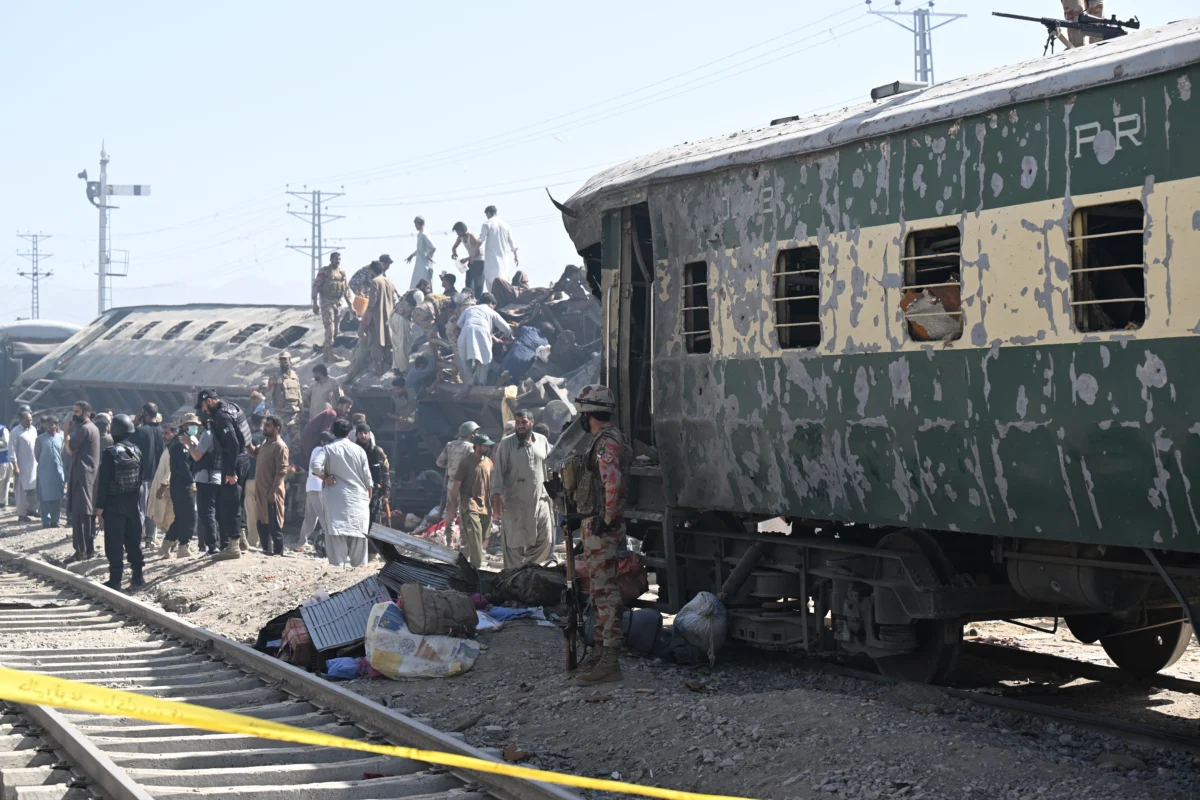
At least 24 individuals, including numerous army servicemen, were tragically killed on Sunday in a devastating blast targeting a train carrying military personnel in Pakistan’s restive southwestern province of Balochistan. The horrific incident, which also left more than 50 people wounded, occurred in the provincial capital of Quetta, further exacerbating the long-standing security challenges in the region. The Balochistan Liberation Army (BLA), a prominent separatist group, swiftly claimed responsibility for the audacious attack, underscoring the persistent threat posed by various insurgent factions operating within the mineral-rich but underdeveloped province.
The attack unfolded as the train was traversing the Chaman Pattak signal in Quetta. According to senior officials, an explosive-laden car detonated with immense force upon impact with one of the train’s carriages, triggering a massive explosion that ripped through the area. The sheer power of the blast caused two of the train’s carriages to overturn and immediately catch fire, sending thick plumes of black smoke billowing ominously into the sky, visible from a considerable distance and signaling the gravity of the unfolding disaster. The area where the attack occurred is known for the regular presence of security forces, indicating a deliberate and calculated targeting. The explosion also inflicted significant damage on several nearby buildings and shattered more than a dozen vehicles parked along the adjacent road, testament to its destructive radius.
The Immediate Aftermath and Rescue Operations
Following the deafening explosion, a scene of chaos and devastation ensued. Local residents, first responders, and security personnel rushed to the site to assist the injured and extract bodies from the mangled wreckage. Emergency services, including ambulances and fire brigades, were immediately dispatched to the scene, their sirens piercing the air as they navigated through the debris and panicked crowds. Firefighters battled the intense blazes engulfing the train carriages, working tirelessly to prevent further casualties and contain the inferno.
Rescue operations were complicated by the extensive damage and the risk of secondary explosions. Military and civilian medical teams worked in tandem to provide immediate first aid to the wounded before transporting them to various hospitals in Quetta, including the Combined Military Hospital (CMH) and Civil Hospital. Doctors and medical staff were placed on high alert, with emergency declarations made in local hospitals to accommodate the influx of casualties, many of whom sustained severe burns, shrapnel wounds, and blunt force trauma. Eyewitnesses recounted scenes of horror, with scattered body parts and the cries of the injured painting a grim picture of the attack’s brutality. Security forces quickly cordoned off the area, establishing a perimeter to secure the site for forensic investigation and to prevent any further untoward incidents.
A History of Insurgency: Understanding Balochistan’s Volatility
The attack is not an isolated incident but rather a stark reminder of the deeply entrenched and complex insurgency that has plagued Balochistan for decades. Pakistan’s largest province by area, Balochistan is strategically vital, bordering Iran and Afghanistan, and possessing vast reserves of natural gas, coal, copper, and gold. Despite its immense resource wealth, the province remains Pakistan’s poorest and least developed, fueling a sense of grievance and marginalization among its predominantly Baloch population.
The roots of the Balochistan conflict can be traced back to the region’s contentious accession to Pakistan in 1948, shortly after the partition of British India. Since then, several insurgencies have flared up, driven by a cocktail of factors including demands for greater provincial autonomy, control over natural resources, and, in some cases, complete independence. Baloch nationalists accuse the federal government of exploiting the province’s resources without adequately investing in its development or providing its people with a fair share of the profits. This perception of economic and political disenfranchisement has been a potent catalyst for armed resistance.
The Balochistan Liberation Army (BLA) is one of the most prominent separatist groups operating in the region. Formed in the early 2000s, the BLA, along with other allied groups like the Balochistan Republican Army (BRA) and the Balochistan Liberation Front (BLF), has waged a low-intensity insurgency against the Pakistani state. Their tactics typically involve targeted assassinations, bombings, and ambushes against security forces, government officials, and non-Baloch settlers, particularly those associated with development projects. The BLA has been designated as a terrorist organization by Pakistan, the United States, and the United Kingdom. Their stated objective is the establishment of an independent Balochistan, free from what they perceive as Pakistani occupation and exploitation.
The China-Pakistan Economic Corridor (CPEC) and Escalating Tensions
The security situation in Balochistan has become even more complex with the advent of the China-Pakistan Economic Corridor (CPEC), a flagship project of China’s Belt and Road Initiative. CPEC involves massive infrastructure development, including roads, railways, and energy projects, with the Gwadar Port in Balochistan serving as its lynchpin. While CPEC promises to bring significant economic development to Pakistan, it has also become a flashpoint for Baloch nationalists. They view CPEC as another form of exploitation, fearing that it will primarily benefit external powers and further marginalize the local population, leading to demographic shifts and increased military presence.
Consequently, CPEC-related projects and personnel have become frequent targets for Baloch insurgent groups. Attacks on Chinese workers, security forces protecting CPEC routes, and infrastructure critical to the corridor have been increasingly common. The targeting of a train carrying military personnel near Quetta could be interpreted as a message aimed not only at the Pakistani state but also implicitly at its strategic partners, signaling the insurgents’ capacity to disrupt vital security and economic interests. The Chaman Pattak signal, being a point along a major transportation artery, highlights the vulnerability of such infrastructure to sophisticated attacks.
Official Reactions and Condemnations
The deadly attack drew swift and widespread condemnation from across the Pakistani political spectrum and military leadership. Prime Minister of Pakistan, in a statement issued shortly after the incident, expressed profound sorrow over the loss of innocent lives, particularly the servicemen who sacrificed their lives in the line of duty. He reiterated the government’s unwavering resolve to eliminate terrorism from the country and vowed that the perpetrators would be brought to justice. The Prime Minister also extended his deepest condolences to the bereaved families and prayed for the swift recovery of the injured, directing relevant authorities to ensure the best possible medical care for all victims.
The Chief of Army Staff (COAS) also condemned the attack in strong terms, emphasizing that such cowardly acts by terrorists would not deter the nation’s resolve to achieve lasting peace and stability. The Inter-Services Public Relations (ISPR), the media wing of the Pakistan Armed Forces, released a statement acknowledging the sacrifices of the fallen soldiers and affirming the military’s commitment to continue its operations against all forms of terrorism and extremism. Provincial authorities, including the Chief Minister of Balochistan, also issued statements of condemnation, highlighting the challenges faced by the provincial government in maintaining law and order and appealing for national unity in confronting terrorism.
International reactions, while not detailed in the immediate aftermath, typically involve expressions of sympathy and condemnation of terrorism from allied nations and international bodies. The United Nations and major world powers often issue statements urging for calm, respect for human rights, and a concerted effort to combat terrorism in all its manifestations. Such attacks, particularly those targeting security forces, are frequently cited in reports on regional instability and counter-terrorism efforts.
Broader Implications and Future Challenges
The train bombing carries significant implications for Pakistan’s internal security and its broader regional standing. Firstly, it underscores the persistent and evolving threat posed by Baloch insurgent groups, demonstrating their capability to plan and execute complex attacks against hardened targets. The use of an explosive-laden car suggests a level of sophistication and resources that remains a serious concern for security agencies.
Secondly, the attack will likely lead to intensified counter-insurgency operations in Balochistan. The Pakistani military has historically employed a robust approach to combating separatism in the province, including intelligence-based operations and targeted raids. This incident may prompt a review of existing security protocols, particularly those governing the movement of military personnel and the protection of critical infrastructure. However, an overly heavy-handed approach could risk alienating the local population further, potentially fueling the very grievances that drive the insurgency.
Thirdly, the incident casts a shadow over the future of CPEC. While Pakistan has consistently reassured China of its commitment to ensuring the security of all CPEC projects and personnel, such attacks inevitably raise concerns among investors and project developers. Maintaining the pace and safety of CPEC initiatives in Balochistan remains a formidable challenge, requiring a delicate balance between security measures and addressing local grievances. The economic prosperity promised by CPEC is seen by the government as a long-term solution to the region’s instability, but its implementation is continually tested by such violent acts.
Finally, the attack highlights the humanitarian cost of prolonged conflict. The casualties include not only military personnel but also potentially civilians caught in the crossfire, and the incident leaves families shattered and communities traumatized. The ongoing violence exacerbates poverty, hinders development, and disrupts the social fabric of Balochistan, creating a vicious cycle of grievance and retribution. Addressing the underlying socio-economic and political issues through inclusive development, political dialogue, and genuine devolution of power remains crucial for achieving a lasting peace in Balochistan. The road to stability in this crucial province is fraught with peril, and the latest train bombing serves as a grim reminder of the profound challenges that lie ahead for Pakistan.
