

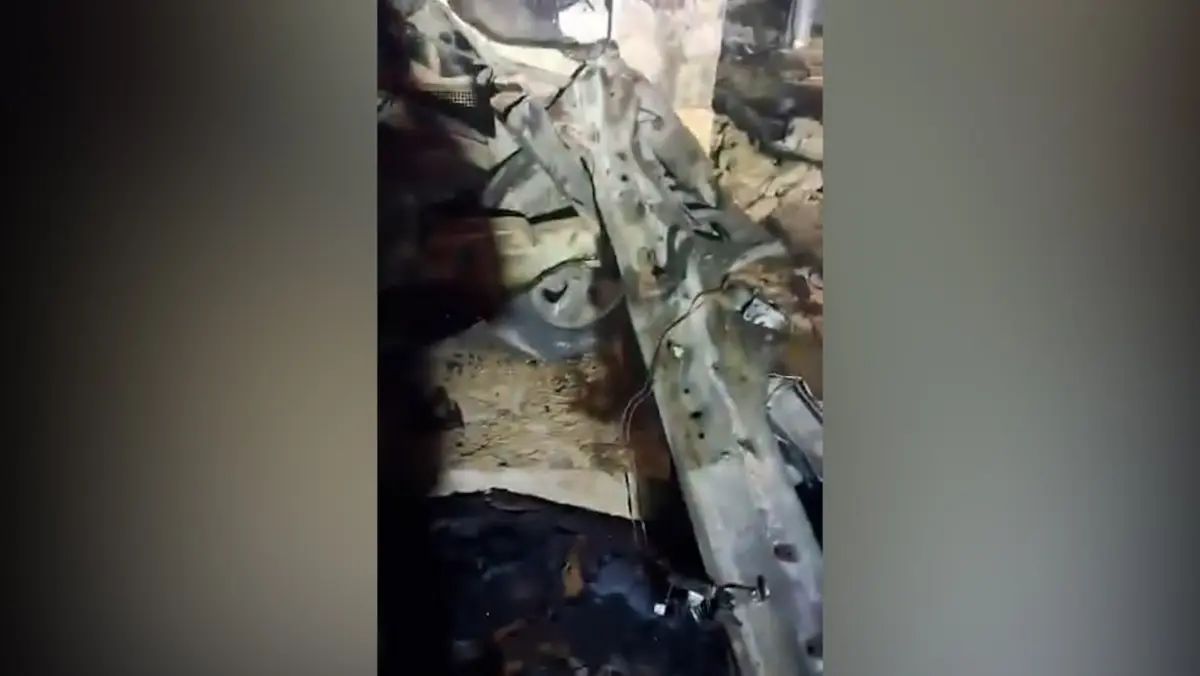
A violent explosion caused by a suspected improvised explosive device (IED) hidden within a civilian vehicle rocked the residential suburb of Jaramana on Saturday, claiming the lives of a man and his young daughter. The blast, which occurred on the southeastern outskirts of the Syrian capital, Damascus, has sent shockwaves through a community already grappling with the fragile security environment of the post-Assad era. According to local reports and emergency responders, a third individual—identified as the man’s wife—was critically injured in the explosion and remains in intensive care at a nearby medical facility.
Syria’s Internal Security Forces (ISF) arrived at the scene shortly after the detonation, cordoning off the perimeter and launching a comprehensive forensic investigation. The target vehicle, identified by witnesses as a silver Kia Rio, was parked in a narrow alleyway between two densely populated apartment blocks. The choice of location has raised significant concerns among security analysts, as Jaramana is traditionally regarded as a quiet, middle-class residential enclave. The sheer force of the blast caused localized damage to surrounding structures, shattering windows and peppering the facades of nearby buildings with shrapnel.
The Immediate Aftermath and Forensic Investigation
In the minutes following the blast, residents of Jaramana rushed to the scene to assist survivors before the arrival of the Syrian Red Crescent. Eyewitness accounts describe a scene of chaos and grief, with the mangled remains of the Kia Rio serving as a grim testament to the volatility that continues to plague the Damascus countryside. While no group has officially claimed responsibility for the attack, the Internal Security Forces have indicated that the methodology—a remotely detonated or timer-based explosive device planted under a vehicle—bears the hallmarks of insurgent cells that have remained active in the region.
Forensic teams are currently analyzing the chemical composition of the explosive residue to determine its origin. Preliminary assessments suggest a high-grade military explosive was utilized, intended to maximize lethality within a confined space. The ISF has also begun reviewing CCTV footage from nearby businesses to track the movements of the vehicle prior to the explosion and to identify any individuals who may have approached the car in the hours leading up to the tragedy.
Demographic Complexity and Local Tensions
The suburb of Jaramana holds a unique position in the socio-political fabric of the Damascus metropolitan area. It is home to a significant population of the Druze religious minority, alongside a diverse mix of Christians and displaced Sunnis from other parts of the country. Throughout the long years of the Syrian conflict, Jaramana remained largely loyal to the central authorities, serving as a bastion of relative stability.
However, the transition of power following the fall of Bashar al-Assad’s regime two years ago has introduced new friction points. The current government, led by President Ahmed al-Sharaa, has sought to maintain a delicate balance between the various sectarian and ethnic factions that comprise the modern Syrian state. In Jaramana, tensions have occasionally flared between members of the Druze community and the Sunni majority that forms the primary political base for the Al-Sharaa administration.
While some local residents fear the bombing may be an attempt to stoke sectarian animosity, security officials have urged caution. They suggest that the attack may instead be part of a broader campaign of destabilization orchestrated by remnants of extremist organizations looking to exploit existing societal fault lines.
A Timeline of Rising Instability in the Capital
The Saturday bombing is not an isolated incident but rather the latest in a series of high-profile security breaches that have challenged the Al-Sharaa government’s narrative of a "New Syria" characterized by law and order. Despite significant improvements in daily life since the transition of power, Damascus remains a "complex security environment," according to regional observers.
A look at the timeline of the past six months reveals a troubling trend of urban insurgency:
- July 2026: During a landmark state visit by French President Emmanuel Macron—intended to signal Syria’s reintegration into the international community—a "double-tap" bombing struck a busy district in central Damascus. The attack, which involved an initial blast followed by a second explosion aimed at first responders, was attributed by the Ministry of Interior to a clandestine cell affiliated with ISIL (ISIS).
- August 2026: A targeted assassination attempt took place near the Palace of Justice, striking the "Lawyer’s Cafe." This location had become a symbolic hub for the legal community involved in the high-profile trials of former high-ranking officials from the Assad regime. The attack killed three people and was seen as an attempt to intimidate the judiciary.
- September 27, 2026: Security forces announced the successful dismantling of a major sleeper cell. Four individuals were arrested and charged with planning a wave of coordinated attacks across Damascus, Homs, and Aleppo. Authorities seized a cache of weapons, suicide vests, and encrypted communication devices during the raid.
- November 3, 2026: Syrian state television reported that the ISF foiled a sophisticated plot to attack a police patrol in the Damascus countryside. The operation led to the discovery of a cell linked to ISIL that was also allegedly responsible for a string of assassinations and bombings in Raqqa and Idlib.
The ISIL Shadow and the International Coalition
The recurring theme in the government’s investigations is the persistent threat posed by the Islamic State of Iraq and the Levant (ISIL). Although the group lost its territorial "caliphate" years ago, it has successfully transitioned into a decentralized insurgency capable of executing lethal "hit-and-run" operations and urban bombings.
In a significant shift in foreign policy, the Al-Sharaa government formally joined the US-led international coalition against ISIL last year. This coalition, originally formed in 2014, has provided the Syrian security apparatus with enhanced intelligence-sharing capabilities, satellite surveillance, and technical training. The partnership represents a radical departure from the previous regime’s isolation and highlights the shared regional interest in preventing an extremist resurgence.
However, the collaboration has also made government-aligned areas and security personnel prime targets for ISIL retaliation. Most of the recent bombings have specifically targeted security patrols, checkpoints, and administrative buildings. The Saturday blast in Jaramana, which resulted in civilian casualties including a child, is viewed by some as a shift toward "soft targets" intended to erode public confidence in the state’s ability to provide protection.
Implications for the Al-Sharaa Administration
The death of a child in a quiet residential neighborhood puts immense pressure on President Ahmed al-Sharaa to deliver on his promises of national reconciliation and security. Since taking office, Al-Sharaa has emphasized the need for a professionalized police force and the integration of various militia groups into a unified national army. Events like the Jaramana bombing, however, underscore the difficulty of monitoring a sprawling urban landscape where sleeper cells can blend into the civilian population.
Political analysts suggest that these attacks are designed to provoke a heavy-handed security response, which could in turn alienate minority communities or those who feel marginalized by the new political order. "The goal of these insurgent groups is to prove that the current government is no more capable of ensuring safety than the one it replaced," noted a Damascus-based political researcher. "By striking in a place like Jaramana, they are hitting a symbol of coexistence."
Official Responses and National Sentiment
Following the news of the casualties, the Syrian Ministry of Interior issued a statement condemning the "cowardly act of terror" and vowing that those responsible would be brought to justice. "The targeting of innocent families and children is a mark of desperation by groups that have no place in the future of our nation," the statement read.
Neighboring countries and members of the anti-ISIL coalition have also expressed their condolences. A spokesperson for the coalition reaffirmed their commitment to supporting Syrian security forces in their counter-terrorism efforts, stating that "the fight against extremism is far from over, and such tragedies only strengthen our resolve to dismantle these networks of hate."
In Jaramana, the mood remains somber. Residents have called for increased security presence and more rigorous checkpoint screenings at the entrances to the suburb. However, there is also a palpable sense of fatigue. After more than a decade of conflict, many had hoped that the fall of the old regime would bring a definitive end to the era of car bombs and sudden death.
As the investigation continues, the focus remains on whether this attack was a localized grievance or part of a larger, coordinated offensive. For the people of Damascus, the blast is a reminder that while the front lines of the war may have vanished, the shadows of the insurgency remain long and lethal. The coming weeks will be a critical test for the Internal Security Forces as they attempt to track down the cell responsible and prevent further bloodshed in the capital’s suburbs.
