


Third Pillar Power has officially commenced the construction of Crown City Solar, a landmark renewable energy development located in Cortlandville, New York, which is set to become the first floating community solar project in North America. Situated within the Polkville Crushed Stone Facility, an active sand and gravel mining operation owned by Suit-Kote Corporation, the project represents a significant shift in how industrial sites are repurposed for the green energy transition. The complex, spanning a total capacity of 22.5 megawatts (MW) DC, will be rolled out in three distinct phases, with the final phase expected to reach full commercial operation by late 2027.
The development marks a milestone for "floatovoltaics"—the practice of installing solar panels on bodies of water—within the United States. While floating solar has seen rapid adoption in Asia and parts of Europe, its expansion in North America has historically been limited by technical challenges and regulatory hurdles. Crown City Solar aims to dismantle these barriers by demonstrating the viability of large-scale floating arrays in cold-weather climates. Once completed, the 120-acre flooded mine pit will host a sprawling network of solar modules that will not only generate clean power but also preserve valuable local farmland and open spaces that would otherwise be occupied by traditional ground-mounted solar farms.
Technical Specifications and Engineering Innovations
The Crown City Solar complex is engineered to withstand the rigorous environmental demands of Central New York, a region known for its heavy snowfall and fluctuating winter temperatures. One of the project’s most significant technical achievements is its ability to support a ground snow load of 69 pounds per square foot. According to Third Pillar Power, this is the highest snow load rating for any floating solar installation currently in the United States. Engineering for such loads requires specialized buoyancy calculations and reinforced structural framing to ensure the panels do not submerge or sustain damage under the weight of accumulated ice and snow.
In a first for the U.S. floating solar industry, the project will utilize custom-designed barges to float its medium-voltage transformers and switchgear. Typically, this heavy electrical equipment is housed on land adjacent to the water body. By moving this infrastructure onto the water, the project further minimizes its terrestrial footprint, effectively eliminating the need to clear land or disrupt the surrounding floodplain. This approach also enhances electrical efficiency by shortening the distance between the DC generation source and the conversion equipment, thereby reducing line losses.
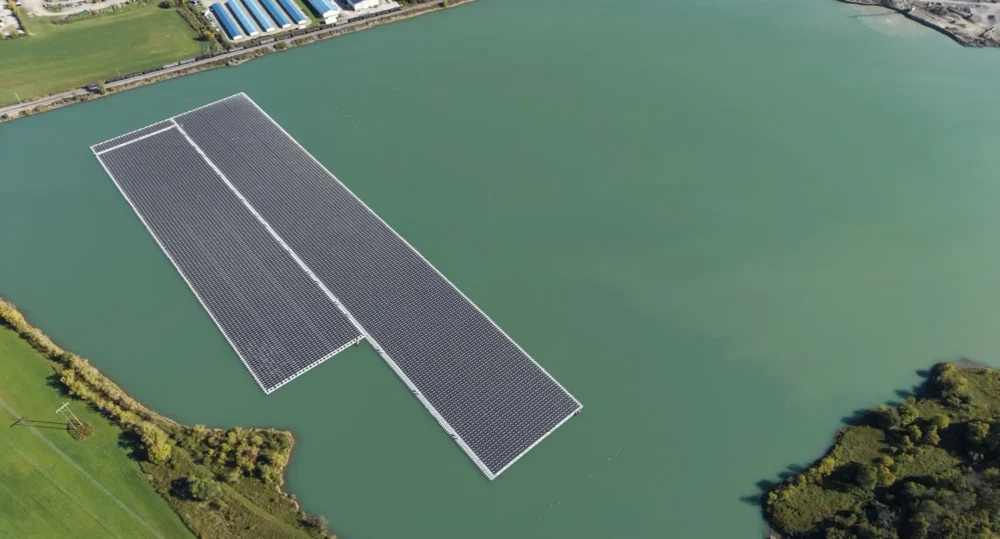
The floating architecture relies on a sophisticated mix of international and domestic technology. The system incorporates Alps Solar PV modules, specifically selected for their durability in high-moisture environments. These are supported by Profloating’s modular float technology, which provides the necessary buoyancy and stability. To ensure the entire array remains secure despite wind and changing water levels in the active quarry, the project employs Hazelett Marine’s specialized elastic mooring systems. Unlike traditional chain or cable anchors, elastic moorings can expand and contract, maintaining constant tension and preventing the solar "islands" from drifting or colliding.
Project Timeline and Phased Development
The development of Crown City Solar follows a rapid timeline, moving from site identification to active construction in less than two years. Third Pillar Power identified the Polkville Crushed Stone Facility as a prime candidate for floating solar in early 2024. The site offered a unique combination of a large, underutilized water surface and existing industrial infrastructure, which simplified the interconnection process with the local power grid.
The project is structured into three equal phases of 7.5 MW-dc each:
- Crown City Solar 1: Currently under construction, this phase is expected to reach mechanical completion in December 2026. Commercial operation and the first delivery of power to the grid are slated for February 2027.
- Crown City Solar 2: Construction is proceeding concurrently with the first phase. It is scheduled to begin commercial operation in October 2027.
- Crown City Solar 3: The final phase of the complex is also targeted for an October 2027 start date, bringing the total site capacity to 22.5 MW-dc.
The speed of the project’s progression is attributed to a collaborative effort between Third Pillar Power, the Town of Cortlandville, and Cortland County officials. Local stakeholders have viewed the project as a way to diversify the region’s tax base while supporting New York State’s aggressive renewable energy mandates. Furthermore, the acquisition of Suit-Kote by Colas USA—a subsidiary of the global infrastructure giant Colas—in October 2026 provided additional corporate backing and stability for the long-term operation of the site.
Economic and Environmental Impact
Crown City Solar is designed as a community solar project, a model that allows local residents to benefit from renewable energy without having to install panels on their own properties. Upon completion, the complex will serve approximately 1,500 subscribers within the region. These subscribers, which can include residential households, small businesses, and non-profit organizations, will receive credits on their electricity bills for the power generated by the floating array. This democratizes access to clean energy, particularly for renters or those with shaded roofs who are traditionally excluded from the solar market.
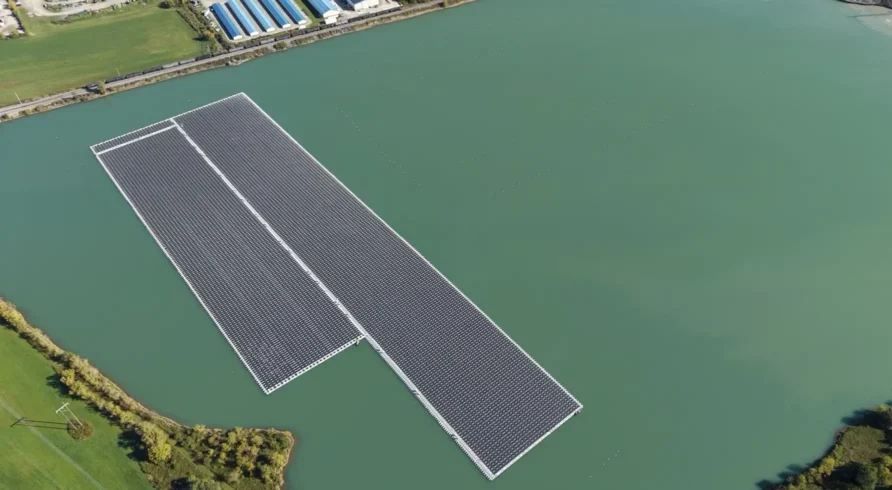
The environmental benefits of the project are substantial. By generating 22.5 MW of emissions-free electricity, the complex is projected to offset approximately 18,000 metric tons of carbon dioxide annually. Over the 25-to-30-year lifespan of the project, this equates to removing hundreds of thousands of tons of greenhouse gases from the atmosphere.
Beyond carbon reduction, floating solar offers unique ecological advantages. The presence of the panels on the water surface reduces evaporation, which is particularly beneficial for maintaining water levels in reservoirs and industrial pits. Additionally, the cooling effect of the water helps the solar panels operate more efficiently; photovoltaic cells typically lose efficiency as they heat up, so the natural heat sink provided by the quarry water can lead to higher energy yields compared to land-based systems.
Strategic Significance in the New York Energy Landscape
New York State is currently operating under the Climate Leadership and Community Protection Act (CLCPA), which mandates that 70% of the state’s electricity come from renewable sources by 2030, with a goal of a zero-emission power grid by 2040. To meet these targets, the state must rapidly scale up its solar capacity. However, large-scale solar development often faces opposition from agricultural communities concerned about the loss of tillable land.
Crown City Solar provides a blueprint for resolving this "land-use conflict." By utilizing "working industrial water bodies"—such as the flooded pits of active mines—developers can add significant capacity to the grid without competing with farmers for acreage. Jaimeet Gulati, CEO of Third Pillar Power, emphasized that every quarry and reservoir in the country already has an industrial or civic function. By adding a secondary layer of utility through solar generation, these sites become dual-purpose assets.
The project also highlights the growing expertise of specialized firms like D3Energy, which is serving as the engineering, procurement, and construction (EPC) contractor for Crown City Solar. With over a decade of experience in the floating solar sector, D3Energy’s involvement underscores the maturation of the industry. Stetson Tchividjian, Managing Director of D3Energy, noted that the magnitude of the Cortlandville project demonstrates the scalability of floating solar as a viable solution for the broader North American market.

Broader Implications for the Floating Solar Industry
The success of Crown City Solar is expected to trigger a wave of similar developments across the United States. While the U.S. has been slower to adopt floating solar than countries like China or Japan—where land is at a premium—the technological breakthroughs achieved in Cortlandville address many of the skepticism-driven barriers.
The ability to handle extreme snow loads and the innovation of floating electrical equipment prove that floating solar is not just a solution for tropical or temperate climates. It is a rugged, adaptable technology capable of operating in the harsh winters of the American Northeast and Midwest. As utilities and developers look for new ways to meet decarbonization goals, the vast network of man-made reservoirs, wastewater treatment ponds, and retired mining pits across the country represents a massive, untapped resource.
In conclusion, Crown City Solar stands as a testament to the potential of industrial reclamation. By transforming a gravel pit into a high-tech power plant, Third Pillar Power and its partners are providing a sustainable path forward for community-scale energy. As the three phases move toward their 2027 completion dates, the eyes of the renewable energy industry will remain fixed on Cortlandville, observing how this "Crown City" project sets a new standard for North American clean energy infrastructure.
