


Healthcare costs are presenting a significant and escalating challenge for American businesses, impacting profitability and strategic growth. The financial burden, once a considerable line item, is now described by experts as "crippling," driven by a consistent and dramatic increase in insurance premiums. Since 2001, the average annual premium for family healthcare coverage has surged from approximately $7,100 to nearly $27,000, more than quadrupling in just over two decades. Similarly, the cost of single coverage has more than tripled. This trend has reached a point where major corporations are allocating more resources to employee health benefits than to their core operational expenses. For instance, Starbucks now reportedly spends more on healthcare than on coffee beans, and automotive manufacturers have surpassed their spending on steel.
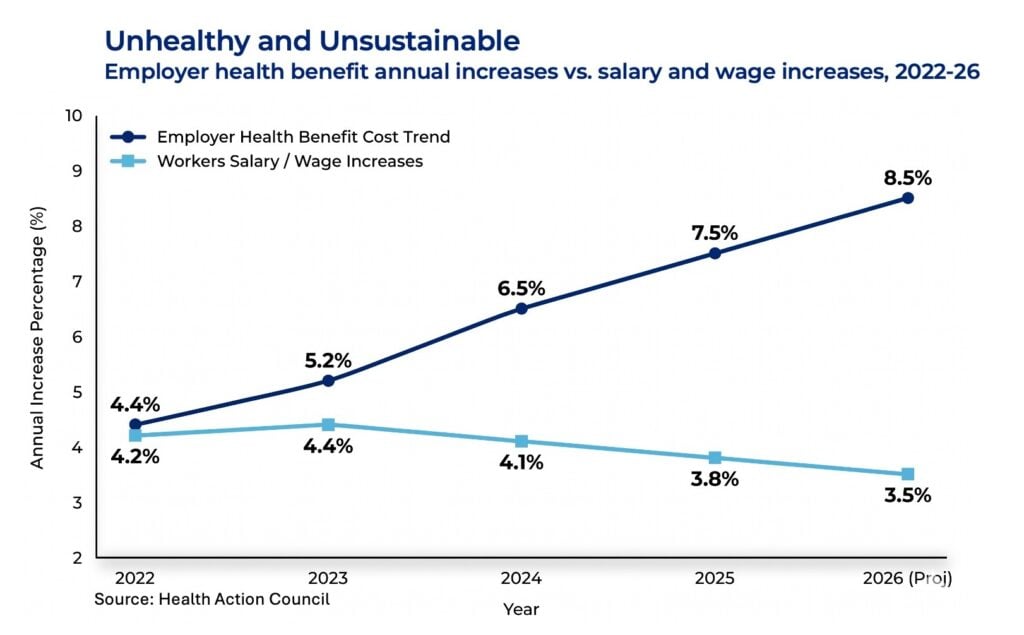
The situation is projected to worsen. Multiple employer surveys and reports from healthcare carriers indicate that healthcare spending is expected to increase by 8.5 percent to 9.5 percent in 2026. This anticipated surge represents the highest annual growth rate in approximately 15 years, underscoring the persistent and intensifying nature of this financial challenge. The escalating cost of healthcare directly influences critical business decisions, including wage growth potential, hiring capacity, pricing strategies, and ultimately, profit margins. For some organizations, the financial strain is so profound that it impedes their ability to invest in essential growth initiatives and long-term development.
Expert Guidance for Cost Containment
Patty Starr, President and CEO of the Health Action Council, a prominent nonprofit coalition representing 240 employers, union groups, and non-profit organizations, has dedicated years to understanding and addressing this complex issue. The Health Action Council is committed to improving employee health and implementing effective cost-control strategies. Through her extensive experience, Starr has identified the root causes of escalating healthcare expenditures and developed practical, actionable solutions for employers.
In a recent presentation hosted by Chief Executive, Starr outlined a comprehensive five-part action plan designed to empower businesses to regain control over their healthcare spending. This strategy focuses on practical, "do-able" steps that can significantly reduce the financial impact of healthcare costs, transforming what has become a "menacing line item" on profit and loss statements.
The Critical Blind Spot: Focusing on Variable Costs
Starr emphasizes that a fundamental misunderstanding of where healthcare spending truly lies is a primary impediment to effective cost control. Many organizations dedicate substantial resources and energy to managing fixed costs, such as administrative fees, stop-loss premiums, and broker or consultant fees. These costs are readily quantifiable, easily compared, and often provide a sense of immediate accomplishment when negotiated down.
However, Starr argues that these fixed costs represent only a fraction, typically 20 to 25 percent, of a company’s total healthcare expenditure. The vast majority, an estimated 75 to 80 percent, lies within the realm of variable costs. This category encompasses the true drivers of healthcare spending: actual claims incurred by employees, service model expenses, network access fees, payment integrity charges, medical rebates, and the increasingly significant cost of specialty pharmaceuticals. The critical issue, Starr notes, is that most organizations invest minimal effort in scrutinizing or managing these variable costs.
"We win the admin fee spreadsheet, but we really lose ultimately on our P&L," Starr stated, highlighting the disconnect between perceived cost savings and the actual financial impact on the business. This strategic misdirection means that while companies might achieve marginal savings on administrative overhead, they continue to bear the brunt of the escalating costs associated with actual healthcare utilization.
A Five-Point Strategy to Tackle Variable Healthcare Costs

To effectively combat the rising tide of healthcare expenses, Starr proposes a strategic five-point action plan, each component addressing a distinct area of variable cost.
1. Enhancing Visibility and Control Through Data Analytics
"You cannot manage what you cannot see or do not know," Starr asserted, underscoring the indispensable role of data in effective healthcare cost management. For self-insured employers, de-identified claims data should be the cornerstone of strategic planning, not merely a retrospective narrative presented during renewal negotiations. Even for fully insured employers with over 100 employees, carriers should be pressed to provide meaningful reports detailing conditions, utilization patterns, site-of-care choices, and geographical cost variations.
At a minimum, employers require access to medical and pharmacy claims data, eligibility information, employee location, details on high-cost claimants, site-of-care utilization, vendor performance metrics, and employee engagement results. This comprehensive data provides the necessary visibility to ask pertinent questions and identify areas for improvement. Starr advocates for a shift from an annual review of healthcare costs to a quarterly operating conversation. This cadence allows for proactive identification of trends, analysis of their underlying causes, development of targeted actions, assignment of ownership, and establishment of metrics to evaluate the effectiveness of interventions.
2. Proactive Management of Variable Cost Drivers
Starr uses the stark contrast between emergency room (ER) visits and urgent care centers as a prime example of a variable cost driver that can be managed. An average ER visit can cost approximately $2,700, while an urgent care visit for a similar clinical need typically costs around $150. Employees often seek care in ERs not due to recklessness, but because their health plan design fails to differentiate between these settings, and they lack clear guidance on more cost-effective alternatives.
"Variable cost control means influencing the decision before the claim is created," Starr explained. This involves a dual approach of structuring benefit plans to incentivize appropriate care-seeking behavior and implementing year-round employee education initiatives, rather than relying solely on a single annual open enrollment period. Furthermore, geographical variations in healthcare costs are a significant factor. Starr points out that many employers operate under the assumption of a single national patient population, neglecting the reality of diverse local markets. Provider networks, access to care, and even social determinants of health can vary significantly by region, leading to substantial differences in average allowed costs for the same diagnostic categories across different states and localities.
3. Steering Employees Toward Higher-Value Care
The disparity in outcomes and costs among healthcare providers presents another opportunity for cost optimization. Starr argues that when health plans treat all providers equally, employees have no incentive to seek out higher-value care. Strategies such as quality and cost tiering of providers, place-of-service tiering, reference-based pricing, designation of Centers of Excellence for specific procedures, and requiring pre-procedure second opinions can significantly impact spending. However, the effectiveness of these initiatives hinges on employees’ awareness and understanding of them.
"Would an employee know the better value choice before a claim?" Starr posed. "If the answer is no, the plan is relying on people to make sophisticated healthcare purchasing decisions at a moment when they’re either sick, stressed or already confused. Create a structure where the high value clinical choice becomes the easiest path for your employee." By simplifying the process and making the higher-value option the most convenient, employers can guide employees toward more cost-effective and potentially higher-quality care.
4. Treating Metabolic and Chronic Health Conditions as Financial Risks
Starr highlights the critical link between prevalent chronic health conditions and financial risk. Conditions such as obesity, diabetes, hypertension, and high cholesterol are not only measurable health indicators but also significant financial risk factors. Analysis by the Health Action Council has revealed that approximately 26 percent of member employees were diagnosed with obesity, and this group accounted for roughly 46 percent of total healthcare spending. Individuals with obesity incurred per-member costs more than double those without the condition. Furthermore, men with a metabolic condition were more than seven times as likely to experience a catastrophic health event compared to their counterparts without such conditions.
"If the organization waits until a stroke, a cardiac event, kidney complication or a complex diabetes admission occurs, an expensive claim path has already started," Starr cautioned. "The question to ask is, what are we doing to reduce the probability, severity and repeatability of catastrophic claims where early action can make a difference?" Proactive interventions aimed at managing and improving metabolic and chronic health can significantly mitigate the risk of costly acute events and long-term complications.
5. Governing Pharmacy Spend as a Supply Chain
The management of prescription drug costs, a rapidly growing component of healthcare expenditure, requires a strategic approach akin to supply chain management. Pharmacy expenses involve complex factors such as supplier economics, rebate negotiations, unit costs, utilization patterns, and critical safety considerations. Starr points out that the visible administrative fees charged by Pharmacy Benefit Managers (PBMs) represent only a fraction of the true cost. The more significant financial levers lie in rebate pass-throughs, spread pricing practices, the management of high-cost specialty drugs, the adoption of biosimil alternatives, the implementation of generic-first policies, and addressing the risks associated with polypharmacy.
Polypharmacy, where patients are prescribed multiple medications for various conditions by different prescribers, introduces significant risks, including increased side effects, reduced medication adherence, and a higher likelihood of avoidable ER visits and intensive care utilization. "The key question is, are we buying the lowest net cost and the safest regimen?" Starr asked. "Pharmacy is too large and too fast moving to be governed only through procurement at contract renewal." Continuous oversight and strategic management are essential to optimize pharmacy spend.
The Multiplier Effect of Governance
Starr emphasizes that the success of these five strategic plays is contingent upon robust governance. Without a structured oversight mechanism, individual initiatives risk becoming isolated HR projects that fail to align with overarching business objectives and deliver measurable outcomes.
Effective governance, Starr explains, involves establishing a quarterly steering committee comprised of representatives from finance, human resources, procurement, legal, and the organization’s broker or consultant. This committee should operate with a clear agenda focused on analyzing population health dashboards, evaluating vendor performance, monitoring member experience, and making timely strategic decisions. For self-insured employers, there is a legal imperative to implement strong governance, as ERISA mandates that fiduciaries act prudently and in the best interest of plan participants. This necessitates meticulous documentation of decision-making processes, vendor evaluations, and fee monitoring. The annual renewal process, therefore, should serve as a culmination of a year of active management, rather than the starting point for strategic planning.
The Next 90 Days: Immediate Actions for Cost Control
Starr’s most critical piece of advice is to avoid delaying action until the next renewal season. Businesses can initiate concrete steps immediately to begin addressing their variable healthcare costs.
-
Within 30 Days:
- Secure Data Access: Ensure access to comprehensive claims, eligibility, and vendor performance data. For fully insured plans, demand detailed reporting from carriers.
- Establish a Steering Committee: Convene key stakeholders from finance, HR, legal, and procurement to initiate regular reviews.
- Review Vendor Contracts: Begin a preliminary assessment of all vendor contracts, focusing on fees, performance guarantees, and data access provisions.
- Identify High-Cost Claimants: Begin the process of identifying individuals with high healthcare utilization to understand the drivers of these costs.
-
Within 60 Days:
- Analyze Data for Trends: Conduct initial analysis of secured data to identify patterns in utilization, cost drivers, and potential areas for intervention.
- Evaluate Site-of-Care Utilization: Assess where employees are seeking care for common conditions and identify opportunities to steer them toward more cost-effective settings.
- Review Pharmacy Spend: Begin analyzing pharmacy data, focusing on specialty drug utilization, generic fill rates, and rebate transparency.
- Communicate with Employees: Launch initial communication efforts to raise employee awareness about the importance of cost-effective healthcare choices.
-
Within 90 Days:
- Develop Targeted Interventions: Based on data analysis, begin implementing specific interventions, such as promoting centers of excellence, enhancing chronic disease management programs, or refining pharmacy benefit designs.
- Refine Vendor Performance: Conduct formal vendor performance reviews and begin negotiations for improved service or pricing based on data.
- Plan for Employee Education: Develop a comprehensive, year-round employee education strategy that goes beyond open enrollment.
- Integrate Healthcare into Business Strategy: Begin to formally integrate healthcare cost management into the broader business strategy and financial planning processes.
Throughout these efforts, Starr stresses the importance of maintaining focus on the overarching goal: "What variable costs are we controlling?" This singular focus prevents initiatives from fragmenting into a series of disconnected benefit projects and ensures a direct connection between actions taken, spending, and measurable outcomes.
By implementing these strategies, or even a significant portion of them, businesses can realistically expect to bend the cost curve of their healthcare expenditures over the next year. As Starr aptly concludes, "Employers are not passengers in the healthcare system. You are purchasers, fiduciaries, workplace strategists and economic actors. Control is about governing a major business expense with discipline." This disciplined approach, she asserts, is not only necessary but also entirely achievable.
