

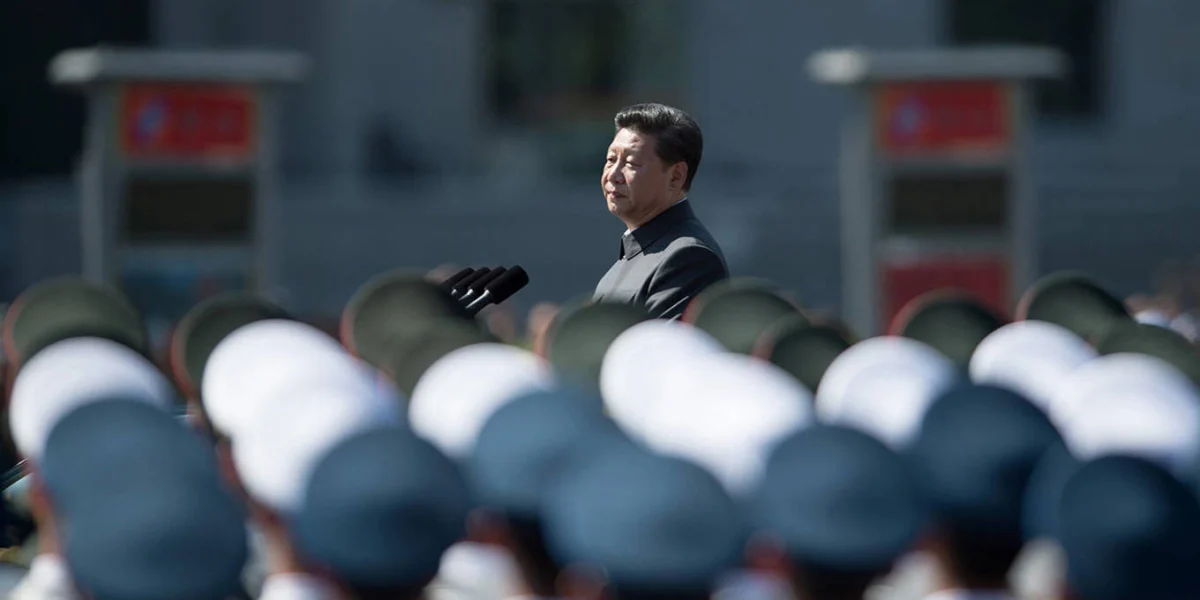
Under Xi Jinping, China is moving steadily away from the pragmatic authoritarianism of the reform era toward the restoration of Mao-style totalitarianism. Two recent books argue that Xi’s political ascent was no historical accident, but a structural feature of China’s political system.
LONDON—The lead-up to US President Donald Trump’s two-day summit with his Chinese counterpart, Xi Jinping, reflected the prevailing assumption within his administration that China can be treated as another rising power willing to negotiate pragmatic deals with the incumbent global hegemon. This perception, however, has increasingly proven to be a miscalculation, as China, under the firm leadership of Xi Jinping, embarks on a distinct trajectory, one that appears to be moving away from the Deng Xiaoping-era pragmatism and towards a reassertion of centralized, ideologically driven control reminiscent of the Mao Zedong era. This significant shift is not merely a stylistic change but a fundamental reorientation of China’s domestic and foreign policy, with profound implications for the global order.
The notion that China would readily engage in transactional diplomacy, akin to how previous rising powers have integrated into the existing international system, has been challenged by Xi’s consolidation of power and his ideological pronouncements. This paradigm shift has been further illuminated by the recent analyses presented in two influential books, which posit that Xi’s ascendance to the apex of power was not a serendipitous event but rather an emergent property of China’s evolving political architecture. These scholarly works suggest that the very structures and dynamics within the Chinese Communist Party (CCP) have created the conditions for a leader like Xi to emerge and steer the nation towards a more ideologically rigid and authoritarian path.
The Legacy of Reform and the Rise of Xi Jinping
For decades following Mao Zedong’s death in 1976, China pursued a path of economic reform and opening up, largely spearheaded by Deng Xiaoping. This era was characterized by a pragmatic approach to governance, prioritizing economic development and stability over strict ideological adherence. The CCP maintained its monopoly on power, but the focus was on delivering tangible improvements in living standards, fostering a degree of collective prosperity. This pragmatic authoritarianism allowed for experimentation, a degree of market liberalization, and a more outward-looking foreign policy, albeit one that remained cautiously integrated into the global system.
Xi Jinping, who assumed leadership of the CCP in 2012 and the presidency of China in 2013, has systematically dismantled many of the tacit understandings and institutional restraints that characterized the reform era. His tenure has been marked by an unprecedented centralization of power, a renewed emphasis on Marxist-Leninist ideology, and a crackdown on dissent and perceived threats to party control. This includes extensive anti-corruption campaigns, which, while popular, have also served to eliminate potential rivals and solidify Xi’s authority. Furthermore, the promotion of "Xi Jinping Thought on Socialism with Chinese Characteristics for a New Era" as a guiding ideology, enshrined in the Party constitution, signals a significant ideological reinforcement.
Structural Underpinnings of Xi’s Power
The argument presented in the aforementioned books is that Xi’s rise is intrinsically linked to the structural dynamics of the CCP itself. One perspective suggests that as China’s economic power grew, so did the internal pressures within the Party to reassert ideological control and nationalistic pride. The perceived successes of the reform era, while impressive in economic terms, also generated social inequalities and fostered a degree of intellectual and political pluralism that the Party leadership, particularly under Xi, viewed as destabilizing.
Another contributing factor, as explored in these analyses, could be the inherent limitations of a system that, while appearing meritocratic at certain levels, ultimately relies on a hierarchical power structure susceptible to the ambitions of a dominant leader. The absence of robust institutional checks and balances, coupled with a culture that historically emphasizes deference to authority, creates fertile ground for a strongman to consolidate power. Xi’s ability to orchestrate constitutional changes to remove presidential term limits in 2018 further underscores the structural malleability of China’s political system, allowing for indefinite rule by a paramount leader.
The Return of Totalitarian Control: Evidence and Analysis
The shift towards what can be described as Mao-style totalitarianism is evident in several key areas:
- Ideological Indoctrination: There has been a significant resurgence of ideological campaigns, emphasizing loyalty to the Party and its leader. This includes mandatory political study sessions for officials and a pervasive presence of propaganda across media and educational institutions. The concept of "rectification" – a term historically associated with ideological purges under Mao – has re-emerged in Party discourse.
- Suppression of Dissent: The space for civil society, independent media, and critical voices has been drastically curtailed. The crackdown on human rights lawyers, activists, and ethnic minorities, particularly in Xinjiang, exemplifies the state’s willingness to employ coercive measures to enforce conformity. The use of advanced surveillance technologies further enhances the state’s capacity for monitoring and control.
- Economic Re-centralization: While China’s economy remains largely market-oriented, there are increasing signs of state intervention and the prioritization of state-owned enterprises. The "common prosperity" agenda, while framed as addressing inequality, also implies a greater role for the state in directing economic activity and redistributing wealth, potentially at the expense of private enterprise dynamism.
- Nationalism and Assertive Foreign Policy: Xi has fostered a potent sense of nationalism, often framed in opposition to perceived Western hegemony. This has translated into a more assertive foreign policy, characterized by the Belt and Road Initiative, increased military modernization, and a more confrontational stance in international disputes, such as those in the South China Sea and concerning Taiwan.
Supporting Data and Chronological Markers
The trajectory towards this new era can be traced through several key events and data points:
- 2012: Xi Jinping becomes General Secretary of the CCP and Chairman of the Central Military Commission.
- 2013: Xi launches the Belt and Road Initiative (BRI), a massive infrastructure and investment project aimed at enhancing China’s global connectivity and influence.
- 2014-2017: A significant increase in arrests and detentions of human rights lawyers and activists. The "#MeToo" movement in China also faced severe suppression.
- 2017: "Xi Jinping Thought on Socialism with Chinese Characteristics for a New Era" is formally enshrined in the CCP constitution at the 19th Party Congress.
- 2018: China’s National People’s Congress votes to remove presidential term limits, allowing Xi to potentially rule indefinitely.
- 2019-2020: Pro-democracy protests in Hong Kong are met with increasing force, leading to the imposition of the National Security Law in 2020, which significantly eroded the city’s autonomy.
- 2020 onwards: The COVID-19 pandemic response, while initially hailed for its effectiveness, also led to stringent lockdowns and heightened state control. Simultaneously, the crackdown on Uyghurs in Xinjiang intensifies, with international condemnation and accusations of genocide and forced labor.
- Recent Economic Indicators: While China’s GDP growth remains robust, reports from institutions like the World Bank and the International Monetary Fund (IMF) have highlighted growing challenges related to debt, demographic shifts, and the impact of geopolitical tensions on its export-oriented economy. For instance, in early 2024, the IMF projected China’s GDP growth to moderate in the coming years, citing structural headwinds.
Reactions and Inferences from Related Parties
The international community’s reaction to China’s evolving political landscape has been varied and, at times, contradictory.
- United States: The Trump administration’s initial approach, as noted, was predicated on a belief in transactional diplomacy. However, as the nature of Xi’s leadership became clearer, US policy under both Trump and his successor, Joe Biden, has shifted towards increased strategic competition, focusing on economic decoupling in critical sectors, technological rivalry, and bolstering alliances in the Indo-Pacific region. Statements from US officials frequently highlight concerns about China’s human rights record, its economic practices, and its growing military assertiveness.
- European Union: European nations have adopted a more nuanced approach, often characterized by the "EU-China: A strategic outlook" document, which identifies China as a partner, an economic competitor, and a systemic rival. While seeking economic engagement, the EU has also expressed concerns about human rights, unfair trade practices, and China’s geopolitical ambitions. Leaders in Brussels have increasingly called for greater strategic autonomy and a more united European stance towards Beijing.
- Neighboring Asian Countries: Countries in China’s immediate neighborhood, particularly those with territorial disputes or historical sensitivities, often find themselves in a delicate balancing act. While many rely on China for trade and investment, they also harbor concerns about its growing regional influence and military power. Reactions range from cautious engagement to a strengthening of defense ties with countries like the United States and Japan.
Broader Impact and Implications
The shift towards a more Mao-style totalitarianism under Xi Jinping has profound implications for both China and the global order:
- Increased Geopolitical Instability: A more assertive and ideologically driven China is likely to lead to greater friction with existing global powers and a more challenging international environment. Disputes over trade, technology, and territorial claims are likely to intensify.
- Economic Realignment: The emphasis on state control and national security may lead to further decoupling of Western economies from China, particularly in sensitive technological sectors. This could result in a more fragmented global economy with regional trading blocs.
- Human Rights Concerns: The continued suppression of dissent and the systematic human rights abuses, particularly in Xinjiang, are likely to remain a significant point of contention and a stain on China’s international image.
- Internal Challenges for China: While Xi has consolidated power, the long-term sustainability of this model remains a subject of debate. Economic growth may face headwinds, and the suppression of diverse viewpoints could stifle innovation and societal resilience. The CCP’s emphasis on ideological purity could also lead to policy rigidity, making it harder to adapt to unforeseen challenges.
In conclusion, the era of pragmatic authoritarianism in China appears to be drawing to a close, replaced by a more ideologically charged and centralized model under Xi Jinping. The analyses offered by recent scholarly works provide a critical lens through which to understand this transformation, suggesting it is not a deviation but a structural outcome of China’s political system. As China continues its trajectory, the world will be closely watching to understand the full extent of its impact on global politics, economics, and human rights. The assumption of China as simply another rising power willing to play by established rules is increasingly being replaced by the recognition of a nation actively seeking to reshape the international order according to its own vision.
