

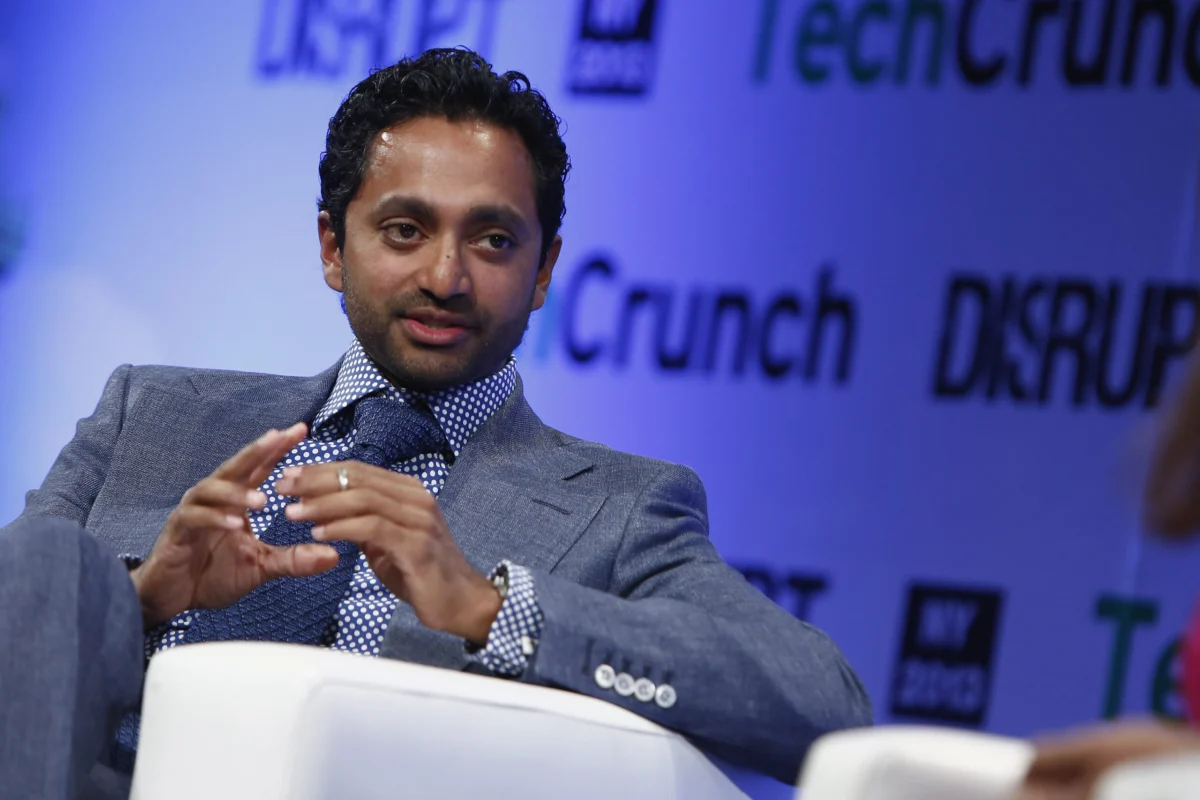
The landscape of enterprise software development underwent a significant shift on Monday as 8090 Labs, an artificial intelligence startup focused on the corporate coding sector, announced the successful closure of a $135 million Series A funding round. The investment, led by Salesforce Ventures, marks a pivotal moment for the company, which was founded in early 2024 by veteran technologist and venture capitalist Chamath Palihapitiya. In a move that signals a departure from his recent focus on investment and media, Palihapitiya also confirmed he would assume the role of Chief Executive Officer, transitioning from his previous position as a board member to lead the company’s daily operations.
The funding round attracted a high-profile syndicate of investors, reflecting both the perceived potential of the technology and Palihapitiya’s deep ties within the Silicon Valley ecosystem. Participants included WndrCo, the investment firm co-founded by Jeffrey Katzenberg; Craft Ventures, led by David Sacks; and a notable "All-In" podcast contingent featuring David Friedberg’s The Production Board and Jason Calacanis’s Launch. The round was further bolstered by prominent individual investors, including Nikesh Arora, CEO of Palo Alto Networks, and Adam D’Angelo, CEO of Quora and a member of the OpenAI board.
The Evolution of 8090 Labs and the Software Factory
Founded in January 2024, 8090 Labs entered a crowded field of AI-assisted development tools but sought to distinguish itself by targeting the specific, often rigid requirements of large-scale corporate environments. While consumer-facing AI coding tools have gained popularity for rapid prototyping and "vibe-coding"—a term referring to the creation of software based on high-level natural language prompts without rigorous architectural oversight—8090 Labs has focused on what it calls the "Software Factory."
The Software Factory is designed as an AI coding agent specifically for corporate programming teams. Its primary objective is to move beyond the generation of simple code snippets and instead assist in the creation of production-quality software. For enterprise clients, this distinction is critical. Production-quality software must adhere to strict security protocols, maintain scalability, and integrate seamlessly with existing legacy systems. 8090 Labs promises a suite of controls that are often missing from general-purpose AI models, including comprehensive audit trails, compliance monitoring, and automated testing frameworks that ensure generated code meets the internal standards of a Fortune 500 company.
The $135 million injection is expected to be utilized primarily for engineering talent acquisition and the expansion of the company’s infrastructure. As AI agents require significant compute resources and specialized data sets to maintain accuracy in complex coding environments, the capital provides 8090 Labs with the runway needed to compete with both established giants and well-funded startups in the generative AI space.
A Strategic Return to Operations
For Chamath Palihapitiya, the transition to the CEO role at 8090 Labs represents a significant career milestone. Known widely for his early role as a senior executive at Facebook (now Meta) and his later success with the venture firm Social Capital, Palihapitiya has spent the last decade primarily as an investor and a vocal commentator on technology and macroeconomics. His "SPAC King" era and the subsequent popularity of the "All-In" podcast solidified his status as a central figure in the tech world’s public discourse.
In a statement shared on the social media platform X, Palihapitiya drew parallels between the current advancements in artificial intelligence and the early days of the social media revolution. He noted that since leaving Facebook, he had been waiting for a technological shift significant enough to warrant a return to a full-time operating role.
"I am convinced that what we are building now is even more important [than social media], so there was no decision to make except to be all in," Palihapitiya wrote. This "all in" sentiment is echoed by the participation of his fellow podcast hosts, suggesting a unified front among some of the industry’s most influential voices regarding the future of AI-driven enterprise productivity.

The Enterprise AI Market and Competitive Landscape
The investment by Salesforce Ventures is particularly telling of the current market dynamics. Salesforce has been aggressive in integrating AI across its platform, recently launching its own "Agentforce" initiative. By leading the round for 8090 Labs, Salesforce Ventures is placing a strategic bet on a specialized tool that could potentially integrate with or enhance the broader Salesforce ecosystem, which serves millions of developers and corporate users.
The AI coding sector is currently one of the most competitive niches within the broader artificial intelligence industry. 8090 Labs enters a market where it must compete with:
- GitHub Copilot (Microsoft): The current market leader, which has integrated deeply into the developer workflow through Visual Studio Code.
- Cursor and Replit: Startups that have gained significant traction among individual developers and small teams for their intuitive AI-first integrated development environments (IDEs).
- Cognition (Devin): The creators of what was marketed as the first "AI software engineer," which raised significant capital at a high valuation earlier in the year.
- Poolside and Magic: Other well-funded ventures aiming to build large language models specifically optimized for code.
The competitive advantage 8090 Labs aims to leverage is its focus on the "unsexy" but essential aspects of enterprise software: governance and reliability. Large corporations are often hesitant to adopt AI tools that lack transparency or that might introduce vulnerabilities into their proprietary codebases. By building "auditability" into the core of the Software Factory, 8090 Labs is addressing the primary friction point for AI adoption in regulated industries such as finance, healthcare, and aerospace.
Chronology of Development
The journey of 8090 Labs from its inception to this Series A milestone follows a timeline of rapid development:
- January 2024: 8090 Labs is incorporated. The company begins operating in stealth mode, focusing on building a foundational model capable of understanding complex enterprise architectures.
- Late 2024 – Early 2025: The company conducts private beta testing with a select group of corporate partners. Feedback from these sessions leads to the development of the "Software Factory" concept, moving away from a simple chatbot interface toward a structured agentic workflow.
- June 2025: Initial rumors of a significant capital raise begin to circulate in Silicon Valley as Palihapitiya begins to scale back his other commitments.
- June 29, 2026: The company officially announces its $135 million Series A and the appointment of Palihapitiya as CEO.
Implications for the Future of Software Engineering
The rise of 8090 Labs and its peers suggests a fundamental change in the role of the human software engineer. Industry analysts suggest that the focus is shifting from syntax and manual coding to system architecture and oversight. In this new paradigm, the "Software Factory" acts as the assembly line, while the human developer acts as the plant manager, ensuring that the output aligns with business goals and safety standards.
Furthermore, the participation of investors like Nikesh Arora of Palo Alto Networks suggests that security will be the next major frontier for AI coding. If an AI can write code, it must also be able to secure it. The integration of security-first principles into the coding agent itself could drastically reduce the time-to-market for new corporate applications, which is currently often delayed by lengthy security review cycles.
As the tech industry watches Palihapitiya’s return to the helm of a startup, the success of 8090 Labs will likely be viewed as a bellwether for the broader "AI agent" economy. If 8090 Labs can successfully penetrate the enterprise market and deliver on its promise of production-quality code with full auditability, it may validate the thesis that the next generation of multi-billion dollar software companies will not be platforms, but rather highly specialized, autonomous agents.
The company has not yet released a public timeline for a broader rollout of the Software Factory, but with $135 million in the bank and a high-profile CEO at the lead, the industry expectation is for a rapid expansion of its customer base throughout the remainder of 2026 and into 2027. For now, 8090 Labs stands as a testament to the ongoing "re-platforming" of the enterprise, where AI is no longer a peripheral tool but the core engine of production.
