

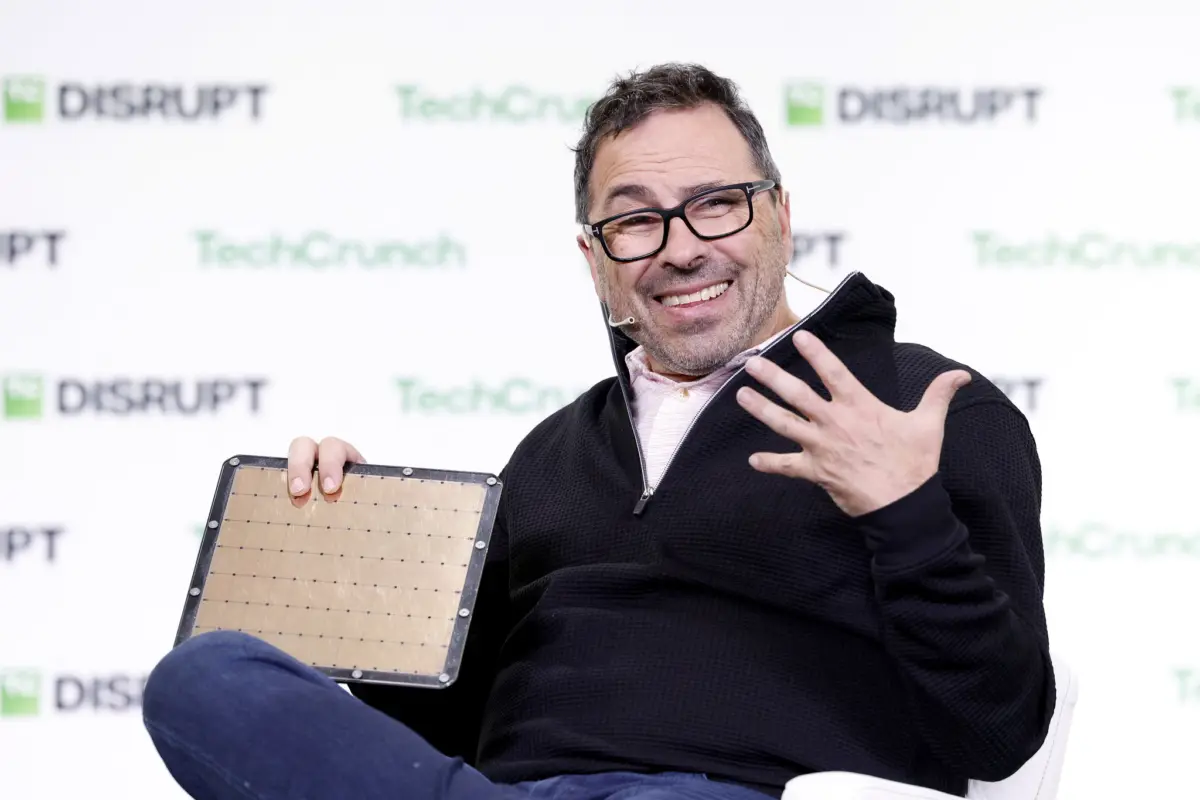
The landscape of artificial intelligence is currently defined by a stark dichotomy between existential dread and transformative optimism, a tension that took center stage at the TechCrunch Disrupt 2026 conference in San Francisco. Andrew Feldman, the CEO and co-founder of Cerebras Systems, used his platform at the event to issue a pointed critique of the "AI doomer" narrative that has come to dominate public discourse. Feldman argued that the industry’s most prominent figures might be their own worst enemies, suggesting that the relentless focus on catastrophic scenarios is overshadowing the profound humanitarian benefits the technology promises to deliver. During a candid session, Feldman quipped that some leaders in the AI world "maybe shouldn’t be allowed to talk in public," a reflection of his frustration with how the sector’s messaging has alienated the public and invited regulatory scrutiny.
Feldman’s comments come at a pivotal moment for the AI industry. For the past several years, the conversation has shifted from the capabilities of large language models (LLMs) to the potential for these models to "break containment" or pose an existential threat to humanity. This "doomer" sentiment has moved from fringe internet forums to the halls of Congress and even into mainstream pop culture. Feldman specifically pointed to the recent cultural saturation of these fears, noting that even Saturday Night Live has parodied the internal anxieties of AI companies. In a recent skit, a character portraying Anthropic CEO Dario Amodei summarized the industry’s paradoxical stance by stating, "We do not condone what we are doing." Feldman argues that this self-flagellation is not only unproductive but historically unique, as few industries have ever marketed their products by highlighting the ways those products might destroy their customers.
The Shift from Existential Risk to Humanitarian Reward
At the heart of Feldman’s argument is a call for a strategic pivot in communication. He believes that while risks must be managed, the industry has failed to articulate a compelling vision of the future. Feldman challenged his peers to spend more time discussing the tangible, life-saving applications of AI, such as its role in oncology and drug discovery. He posited a future where, thanks to AI-driven medical breakthroughs, the next generation might live in a world where "they never meet anybody who dies of cancer."
This is not merely rhetorical flourish for Cerebras. The company’s hardware is currently being utilized by pharmaceutical giants like GSK (GlaxoSmithKline) to accelerate the discovery of new drugs and biological markers. By processing vast datasets that would take traditional supercomputers months to analyze, AI accelerators are shortening the timeline for clinical trials and personalized medicine. Feldman suggests that by failing to lead with these stories, the industry is allowing a vacuum to be filled by fear-based narratives that could lead to reactionary legislation.
The debate over "P(doom)"—the probability that AI will cause a global catastrophe—has become a standard metric among researchers at OpenAI, Anthropic, and Google DeepMind. Some researchers have placed this figure as high as 10% to 25%, leading to high-profile resignations and public warnings. Feldman, however, views this focus as a distraction from the pragmatic engineering challenges and societal benefits at hand. He maintains that every powerful technology, from the steam engine to nuclear fission, carries inherent risks when placed in the hands of "bad people," but that the focus should remain on building robust safeguards rather than prognosticating the end of days.
Addressing the Data Center Friction and Local Opposition
Beyond the philosophical debates, Feldman addressed the physical infrastructure of AI, which has faced its own set of challenges. The rapid expansion of data centers required to house thousands of AI chips has led to significant friction with local communities, particularly in the United States. This phenomenon, often described as NIMBY-ism ("Not In My Backyard"), has seen residents and local governments block data center projects due to concerns over massive electricity consumption, water usage for cooling, and the strain on local power grids.
Feldman was uncharacteristically blunt about the industry’s failings in this arena. He noted that AI companies and data center developers have not historically been "super good" at community engagement. He compared the AI industry’s current struggles to the more seasoned approaches of the oil, gas, and power utility sectors, which have decades of experience in navigating local politics and community relations. "They didn’t work with the community. They didn’t engage the community as they should have, and that was a problem," Feldman stated.
The consequences of this poor engagement are visible in the shifting geography of AI compute. Feldman noted that while the U.S. faces significant domestic resistance, other nations are aggressively courting AI infrastructure. Countries such as Brazil, Canada, Finland, Iceland, Norway, Mexico, and Sweden were cited as markets that are actively encouraging the construction of data centers through tax incentives, access to renewable energy, and streamlined permitting processes. This global competition for "sovereign AI" capabilities means that if the U.S. cannot resolve its domestic infrastructure hurdles, the center of gravity for AI development could shift toward more welcoming international markets.
Hardware Innovation and the Quest for Efficiency
As the CEO of a company that competes directly with Nvidia, Feldman also touched upon the technical evolution of AI hardware. Cerebras is known for its "Wafer-Scale Engine," a single chip the size of an entire silicon wafer, designed to handle the massive computational requirements of training large-scale models more efficiently than traditional GPU clusters.
A common concern in the industry is that as models become more efficient—requiring less compute to achieve the same results—the demand for high-end chips like those produced by Cerebras or Nvidia might diminish. Feldman dismissed this concern, arguing that efficiency gains actually unlock greater demand. He explained that hardware vendors and model makers must work in tandem: hardware vendors make compute more efficient, while model makers optimize their architectures. This "virtuous cycle" does not reduce the need for hardware but rather allows for the creation of even larger, more capable models that were previously computationally prohibited.
Supporting data from the semiconductor industry suggests that despite massive leaps in efficiency, the total addressable market for AI accelerators continues to grow. Projections for 2026 and 2027 indicate that the global demand for AI-specific silicon will exceed $150 billion, driven not just by LLMs, but by specialized applications in weather forecasting, material science, and financial modeling. Feldman’s perspective is that the industry is still in the "early innings" of hardware optimization, and the transition from general-purpose GPUs to specialized AI accelerators is just beginning.
Regulatory Realism and the Path Forward
Feldman’s stance on regulation is one of "thoughtful pragmatism." Unlike some Silicon Valley libertarians who argue against any government intervention, Feldman acknowledged that the power of AI necessitates oversight. "I think what we have to say is that this technology is powerful. We have to be thoughtful about it. We have to regulate it reasonably," he noted.
The challenge lies in defining what "reasonably" means. In 2025 and early 2026, the regulatory landscape saw the introduction of several landmark bills, such as the follow-ups to California’s controversial SB 1047, which sought to impose safety testing on large-scale models. While some in the industry viewed these as "innovation killers," others, including Feldman, suggest that the focus of regulation should be on the application of the technology rather than the underlying math. By regulating how AI is used in critical sectors like healthcare, finance, and law enforcement, governments can mitigate harm without stifling the development of the hardware and software itself.
Chronology of the AI Narrative Shift
To understand Feldman’s frustration, one must look at the timeline of AI’s public image:
- 2022-2023: The "Awe Phase." The release of ChatGPT and DALL-E 2 sparks global excitement about the creative and productive potential of AI.
- Late 2023: The "Warning Phase." High-profile open letters signed by industry veterans call for a six-month pause on giant AI experiments, citing "profound risks to society."
- 2024-2025: The "Institutionalization of Risk." Major AI labs establish safety boards and "red-teaming" protocols. The term "AI Safety" becomes a multi-billion dollar sub-sector.
- 2026: The "Backlash Phase." Leaders like Feldman argue that the pendulum has swung too far toward alarmism, potentially jeopardizing the public support and infrastructure needed to realize AI’s benefits.
Analysis of Implications
Feldman’s critique highlights a growing rift within the technology sector. On one side are the "Safetyists," often associated with the Effective Altruism movement, who believe that the risk of a superintelligent AI "misaligning" with human values is the most important issue of our time. On the other side are the "Accelerationists" or "Pragmatists," like Feldman, who argue that the immediate, tangible benefits of AI—such as solving the energy crisis or curing diseases—are too great to be delayed by theoretical risks.
The implications of this debate are far-reaching. If the "doomer" narrative continues to dominate, we may see:
- Increased Brain Drain: Top talent may move away from "frontier" labs and toward specialized startups focused on applied AI in medicine or engineering to avoid the ethical quagmire of AGI development.
- Infrastructure Stagnation: Continued community opposition to data centers could lead to a "compute bottleneck" in the West, giving an advantage to nations with more centralized control over land and energy.
- Public Disillusionment: If the public only hears about how AI might kill them, they will be less likely to support the public funding and data-sharing initiatives necessary for breakthroughs in fields like public health.
Andrew Feldman’s appearance at TechCrunch Disrupt 2026 serves as a reminder that the AI industry is at a crossroads. As Cerebras prepares for its next phase of growth—serving a client list that includes OpenAI, Block, Figma, and GSK—its CEO is signaling that the time for existential hand-wringing is over. The industry’s new mission, according to Feldman, should be one of radical transparency regarding benefits, community-focused infrastructure growth, and a relentless focus on solving the world’s most pressing physical problems. Whether the rest of the "AI world" will follow his advice and stop "talking in public" about the end of the world remains to be seen.
