

The simmering tensions between the United States and Iran escalated dramatically on September 3, when Iranian missiles and drones struck targets in Kuwait. This action followed just two days after American aircraft conducted a series of retaliatory strikes on roughly a hundred positions along the Hormuz coast and across western Iran, including a tragic incident that killed five people at a wedding party in Sirik. The confrontation has since evolved into a sustained period of aggression, with US forces reportedly targeting Iranian oil tankers and Iran, in turn, increasing its targeting of commercial shipping in and around the strategically vital Strait of Hormuz. This volatile situation has sent ripples through global energy markets, with Brent crude oil currently trading around $97 a barrel, reflecting profound instability.
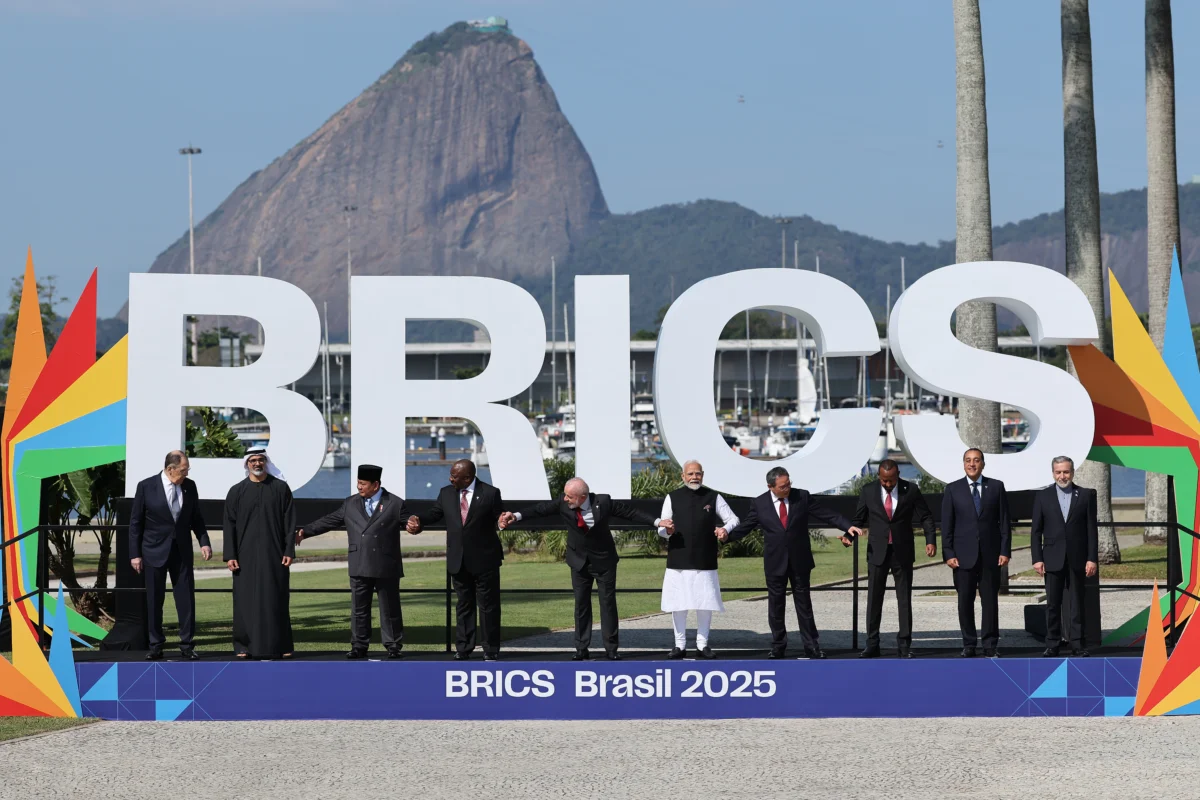
Against this backdrop of heightened military and economic pressure, the global diplomatic spotlight shifts to New Delhi, where Iranian President Masoud Pezeshkian is scheduled to arrive on September 12 for the much-anticipated BRICS summit. He will be joined by other significant world leaders, including Chinese President Xi Jinping and Russian President Vladimir Putin, alongside at least eight of the eleven BRICS heads of state and government. Notably, the United Arab Emirates, a nation that has endured six months under Iranian fire, will also have its representatives in the same hall, underscoring the complex and often contradictory alliances at play within the expanding bloc.
Western Skepticism vs. BRICS’s Emerging Diplomatic Footprint
Western observers have largely dismissed the upcoming BRICS summit as little more than a "photo opportunity," a gathering of disparate nations too broad in their interests to forge any meaningful consensus. However, this interpretation overlooks a critical, inconvenient truth that has defined the past six months of this conflict: every single ceasefire produced during this period of intense hostilities was brokered not in Washington, but by BRICS members and their strategic partners. This record suggests that the bloc, despite its internal complexities, is emerging as a significant, albeit unconventional, force in global conflict resolution, offering an alternative diplomatic architecture to traditional Western-led initiatives.
A Chronology of BRICS-Led Mediation Efforts
The diplomatic sequence preceding the New Delhi summit reveals a pattern of persistent, if ultimately fragile, engagement by BRICS nations and their allies:
- March 31: Beijing and Islamabad jointly issued a comprehensive five-point initiative. This proposal called for an immediate cessation of hostilities and the crucial reopening of the Strait of Hormuz, recognizing its indispensable role in global commerce and energy supply.
- A Week Later: Iran, under significant international pressure and facing mounting economic costs, accepted a two-week truce, providing a brief respite from the escalating conflict.
- April 11: Building on this fragile truce, direct American and Iranian delegations convened in Islamabad. These talks represented the highest-level contact between the warring parties since the conflict began. The delicate negotiations were skillfully mediated by Pakistan’s then-Prime Minister Shehbaz Sharif, with his army chief, Asim Munir, undertaking two critical shuttle diplomacy missions to Tehran to bridge divides and foster understanding.
- June 17: The culmination of these intensive diplomatic efforts was the signing of the Islamabad Memorandum. This landmark agreement was signed electronically by then-US President Donald Trump at Versailles and President Pezeshkian in Tehran, signifying a rare moment of direct, if indirect, engagement. The memorandum was a complex document, comprising fourteen distinct points. Key provisions included a commitment to sixty days of toll-free passage through the Strait of Hormuz, a pledge to lift the naval blockade within 30 days, and an ambitious plan for at least $300 billion in reconstruction and economic development for the region. The agreement was supported by a coalition of regional partners, including Qatar, Oman, Turkiye, Saudi Arabia, and Egypt, each playing a role in carrying pieces of the intricate diplomatic puzzle.
- August 17: Despite its initial promise, the Islamabad Memorandum ultimately expired. The primary reason for its collapse stemmed from differing interpretations of Articles 1 and 5 by the two sides, and the inability of any mediator to compel a common, agreeable text.
While the document itself failed to achieve lasting peace, the underlying diplomatic machinery that constructed it proved remarkably effective. This apparatus, which facilitated direct communication and negotiated terms between sworn adversaries, is the only such mechanism produced by this protracted conflict. A significant portion of its architects and operators will be converging inside one building in Delhi on September 12, highlighting the potential for renewed efforts.
China’s Complex and Pivotal Role
China’s contribution to these mediation efforts, often met with a dismissive shrug, warrants closer examination. Beijing’s economic ties to the region are profound and multifaceted. China purchases more than 80 percent of Iran’s exported crude oil, making it Iran’s single largest economic lifeline. Simultaneously, China is a major importer from the Gulf states that Iran has been shelling, with its Gulf imports experiencing a significant 25 percent year-on-year drop in March due to the instability. No other major global power finds itself losing money on both sides of this conflict simultaneously. This unique economic exposure is precisely what made China’s proposals "legible" in Tehran and "tolerable" in Abu Dhabi, providing a compelling incentive for Beijing to seek de-escalation.
However, China’s role is far from pristine. Chinese firms have been implicated in supplying Iran with dual-use components, radar and navigation equipment, and even a commercial reconnaissance satellite, with Washington alleging an even longer list of prohibited items, which Beijing denies. Furthermore, China has maintained a conspicuous silence regarding the Kuwaiti and Bahraini civilians killed and Qatari civilians injured by Iranian missiles. This silence has come at a tangible cost to its standing in the Gulf, a cost that the affected states have undoubtedly noticed. The argument for China’s utility as a mediator is not predicated on its moral rectitude, but rather on its pragmatic positioning: a mediator with significant commercial interests on all sides and no vested interest in regime change is arguably more effective and "usable" than one without such balanced stakes. In this context, opportunism that leads to a signed ceasefire, however temporary, often outperforms conviction that yields no tangible results.
The United States’ Unwavering Stance and Regional Burden
Washington’s current strategy appears resolute and uncompromising. President Trump has articulated a preference for "near-total control" of the Strait of Hormuz, rejecting any agreement that would dilute American dominance. This stance comes at a considerable cost, both militarily and politically. The United States has reportedly expended nearly 80 percent of its THAAD interceptors and virtually all of its ATACMS and Precision Strike Missiles in the region, indicating a high rate of matériel consumption. Six months into the conflict, this represents a strategy of attrition without a clear terminal point, and the states bearing the brunt of this attrition are not American.
Kuwait, for instance, has endured strikes on its international airport, vital refineries, and military bases since the very first day of the war, underscoring its direct exposure. Oman has been forced to draw and maintain compromise shipping lanes to ensure some degree of maritime safety. Qatar, despite suffering direct hits itself, has diligently kept diplomatic channels open, demonstrating a commitment to de-escalation that transcends its own immediate suffering. These nations are not mere spectators to be arranged around a Chinese or Russian diplomatic argument. Any text emerging from the Delhi summit that fails to acknowledge their agency, their sacrifices, and their unique perspectives is destined to fail, much like previous attempts.
The Economic Front: De-dollarization and BRICS Financial Innovations
The economic dimension of the BRICS summit represents a "war by other means." Iran’s economy is reeling under immense pressure, with inflation running close to 70 percent and the International Monetary Fund forecasting a contraction exceeding five percent this year. While military actions have certainly contributed to this decline, exclusion from the dollar-denominated global payment infrastructure has inflicted even greater damage, a tactic previously employed against Russia, Venezuela, and Afghanistan.
This economic exclusion is now actively repricing itself in the global marketplace. China’s Cross-Border Interbank Payment System (CIPS) recently posted a single-day record of 1.22 trillion yuan, equivalent to approximately $178.5 billion, with March average daily volumes surging 50 percent above February’s figures. Standard Chartered’s chief economist for Greater China attributed this surge, particularly in oil settlements, as a likely catalyst stemming from the conflict. India, as the chair of the BRICS summit, is actively championing initiatives to link members’ fast-payment systems, such as India’s UPI and Brazil’s Pix, alongside collaborative work on central bank digital currencies (CBDCs). Sanjay Malhotra, who heads India’s central bank, shrewdly frames these efforts as "cost reduction rather than confrontation," a statement that is both accurate in its economic rationale and politically astute.
It is crucial to be honest about the scale of these efforts. The yuan still accounts for less than three percent of global payments processed through SWIFT, in stark contrast to the dollar’s dominant 51 percent share. Furthermore, CIPS has 1,791 participating institutions compared to SWIFT’s formidable network of 11,000. No immediate displacement of the dollar is anticipated this decade. However, what has unequivocally shifted is the demand curve. Governments from Jakarta to Pretoria have observed firsthand how a country can be subjected to military strikes in the midst of live nuclear talks while simultaneously being cut off from the financial rails that would allow it to sell its oil to willing buyers. For these nations, the debate is no longer whether an alternative appeals; they are actively pricing the costs and risks associated with over-reliance on a single, weaponized currency system.
India’s Dilemma and the Pursuit of Resilience
India’s own recent experience further underscores this point. In February, New Delhi faced a punitive 50 percent tariff wall imposed by Washington. Under this significant bilateral pressure, India reluctantly agreed to cease its purchases of Russian crude oil, leading Washington to reduce the tariff rate to a still-substantial 18 percent. This incident vividly illustrates how bilateral pressure can be highly effective when applied to a single country. The only truly robust counter to such economic arithmetic is the development of shared, resilient infrastructure. Prime Minister Narendra Modi, chairing the BRICS summit under the banner of "building for resilience," understands the imperative to demonstrate that the bloc can deliver tangible alternatives that are impervious to unilateral tariff actions.
Internal Divisions and the Delhi Imperative
The path to BRICS unity is not without its internal hurdles. When the foreign ministers of the BRICS nations met in May, they failed to issue a joint statement. This diplomatic impasse arose because Iran’s Foreign Minister Abbas Araghchi insisted that the bloc explicitly name American and Israeli aggression in the statement, a demand that the United Arab Emirates, having endured Iranian missile attacks, understandably refused to sign. This contrasts sharply with the Shanghai Cooperation Organisation (SCO) summit in Bishkek on September 1, where a declaration condemning the strikes on Iran passed unanimously. Bishkek was relatively easy because no member state in the room found itself on the receiving end of Iranian aggression. Delhi’s challenge is precisely its strength: the diverse and sometimes conflicting interests within the room make any consensus hard-won, but also profoundly valuable.
Therefore, the bar for the Delhi summit must be set realistically but ambitiously. A concrete navigation understanding, initialed by Iran alongside the UAE and Oman, would do more to alleviate war-risk premiums for global shipping than another month of strikes on strategic locations like Larak Island. Furthermore, resurrecting the reconstruction money from the defunct Islamabad Memorandum and having it carried forward by a grouping representing a formidable 40 percent of global output at purchasing power parity would be far harder for Western powers to dismiss as mere Kremlin messaging than the same offer originating solely from Moscow. Finally, a clearly dated timetable for the linkage of member states’ payment systems would send a powerful message to the Global South: that a viable alternative financial architecture is actively under construction, not merely under abstract discussion.
Washington has unequivocally stated its terms for the Strait of Hormuz: its own conditions, indefinitely. The Delhi BRICS summit now represents the pivotal moment where everyone else gets their turn to formulate and present their answer, challenging the prevailing geopolitical order with a vision of multilateralism and alternative pathways to stability and economic resilience.
The views expressed in this article are the author’s own and do not necessarily reflect Al Jazeera’s editorial stance.
