

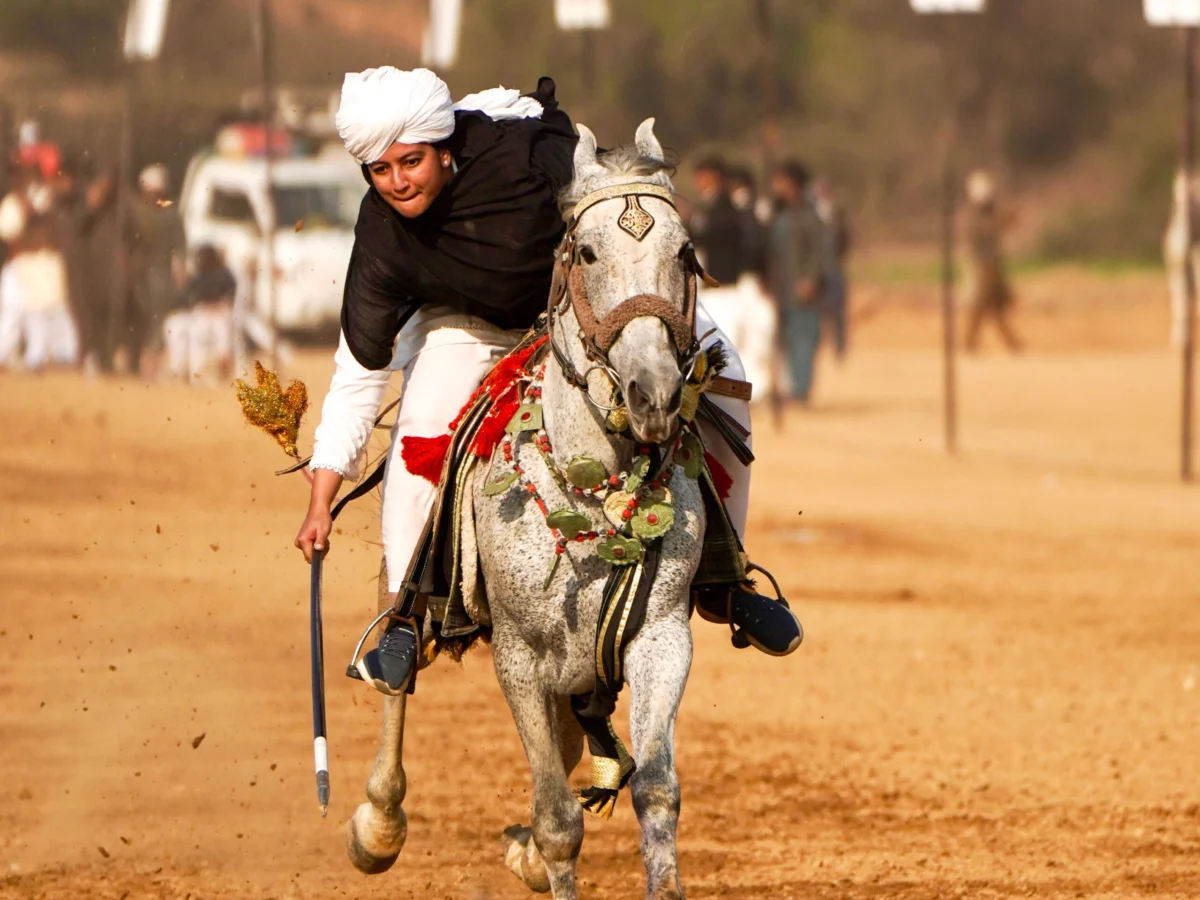
Rawalpindi, Pakistan – On a brisk January morning, Anum Shakoor, 30, charges across a sun-baked field on the outskirts of Rawalpindi, her black shawl billowing like a banner of defiance. Gripping a 1.8-meter (6ft) lance, she leans into the gallop, eyes fixed on a small wooden peg buried in the dry earth. Having already claimed her first target, the second looms ahead. Her horse thunders across the ground, kicking up a dramatic cloud of dust, a visual testament to the power and speed of the ancient sport of neza baazi, or tent pegging. A few meters from her objective, Shakoor lowers the lance, steadying her aim with practiced precision, bracing for the impact that signifies a successful strike. Yet, the lance misses by a mere 2.5 centimeters (1 inch). A collective gasp ripples through the packed bleachers, followed by headshakes and averted gazes from many of the thousands of predominantly male onlookers. Shakoor exhales, slowing her horse to a walk, the vast, windswept fields of northern Punjab province stretching around her. The scene is a microcosm of the formidable challenges and nascent triumphs faced by women breaking into one of Pakistan’s most deeply entrenched male-dominated sports.
The Ancient Roots of Neza Baazi: A Cultural Pillar
Tent pegging, known locally as neza baazi, is more than just a sport; it is a profound cultural institution in Pakistan, particularly in the Punjab province. Its origins are steeped in military history, dating back centuries when cavalrymen would demonstrate their prowess by galloping at speed to dislodge enemy tent pegs, causing their camps to collapse. Over time, this martial exercise evolved into a ceremonial sport, a thrilling display of horsemanship, precision, and courage. The mela, a carnival-like competition, is the traditional setting for these events, often held in rural areas or on the outskirts of garrison cities like Rawalpindi. These gatherings are vibrant spectacles, attracting thousands of spectators, many adorned in traditional turbans, carrying forward a legacy passed down through generations of riders.

The atmosphere at a mela is immersive and sensory. The rhythmic beat of the dhol (drums) intertwines with the piercing melodies of the shehnai (oboe), traditionally associated with weddings and celebrations, filling the crisp winter air. Bustling stalls line the fields, selling steaming cups of cardamom tea and an array of fried fritters, creating a festive, communal ambiance. Before the competition commences, riders parade their horses, many adorned in embroidered velvet gowns, their manes intricately braided, brass bells jingling softly at their necks. These horses, often highly prized and meticulously cared for, are central to the spectacle, embodying both grace and raw power. The sport is a significant social event, a gathering point for local political and feudal elites, who often wear honorary turbans, symbolizing their status and connection to this heritage. For generations, this world has been almost exclusively male, a bastion of masculine pride and tradition.
Pioneers on Horseback: The Rise of Women in Tent Pegging
The entry of women into this overwhelmingly male arena represents a seismic shift, challenging deeply ingrained societal norms and expectations. Anum Shakoor is not alone in this endeavor. She leads Bint-e-Zahra Club, established in 2025, Pakistan’s first exclusively female tent-pegging club. The club comprises three other riders: Eshal Ibrahim and Noor un Nisa Malik, both 16, and Sehrish Awan, a 32-year-old mother of two, making her debut at a mela. Shakoor’s motivation for forming the club stemmed from a "frustrating realization" that female riders were relegated to practicing and competing only within mixed clubs. "We wanted to give women riders a stage for training so they can form a community," she explains, highlighting the need for a dedicated, supportive environment.
The presence of Bint-e-Zahra’s members at the Rawalpindi mela is a spectacle in itself. As they prepare for their runs, photographers, vloggers, and local spectators rush to capture the rare sight, surrounding them from all sides. Eshal Ibrahim, for instance, is always accompanied by her mother, Fatima Adeel, who maintains a vigilant eye over her teenage daughter amidst the throng of men. "I cannot even take pictures of her in the crowd," Adeel states, underscoring the protective measures required. "I am in charge of her. I cannot leave a teenage girl alone in a sea of men." Shakoor echoes this sentiment, emphasizing the need for encouragement and respect for any woman entering the sport. "Our society cannot bear a woman’s lead in any field," she notes, succinctly capturing the prevailing patriarchal attitudes.

Ayesha Khan: Breaking National and International Barriers
Several kilometers away, Ayesha Khan, 22, represents another formidable force in the movement. Galloping on Sawa, the horse she has ridden since the age of eight, Khan embodies a lifelong dedication to equestrianism. At 17, encouraged by her father, she tried out for the women’s national team. A year later, she became the sole woman selected for Pakistan’s under-21 mixed-gender team, competing in South Africa against a team comprising four girls and one boy. "I was hit with the realization of how tent pegging is conditioned to appear masculine in Pakistan," Khan recounts. "But my father and brothers taught me riding when I was five. I used to be the only child riding a horse between adults." Her passion for riding, she admits, is an "addiction."
Khan’s ascent was swift. In 2022, she joined the women’s team and quickly became its captain, leading them to Jordan where they competed against 13 countries and proudly secured third place. This landmark international participation, however, proved to be an isolated event. "Yet that was the only trip that the Pakistani women’s team competed in internationally. Before that trip, never. After that, never again," Khan reveals, exposing the systemic neglect of female athletes. The International Tent Pegging Federation’s open international competition in Jordan in 2024, despite being open to women, saw Pakistan send an all-male team, a reflection of the prevailing assumption that only men would participate. "In Pakistan, we don’t have the concept of a player," Khan tells Al Jazeera. "We have the concept of male and female. Unless there is a women-only event, our federation exclusively sends male teams." Undeterred, at 20, Khan achieved another milestone: she became the first Pakistani woman to compete against and defeat 70 male riders at a mela. Today, she captains Pakistan’s only all-women tent-pegging team, continuing her trailblazing efforts.
A Timeline of Progress and Setbacks for Women in Neza Baazi:

- Pre-2015: Tent pegging in Pakistan is almost exclusively a male domain, with virtually no organized female participation.
- 2015: Samiullah Barsa, a US national of Pakistani origin, witnesses women compete in tent pegging for the first time at a mela in Kot Fateh Khan. This event was organized by Malik Ata, often called "Baba-e neza baazi" (the father of tent pegging), who invited the Australian women’s tent-pegging team, planting the seeds for female involvement in Pakistan.
- 2021: The Equestrian Federation of Pakistan, founded by Malik Ata, sponsors six young girls, including Ayesha Khan, to train under a South African coach, marking an official, albeit limited, investment in female riders.
- 2022: Ayesha Khan joins and captains the Pakistani women’s tent-pegging team, leading them to a third-place finish in an international competition in Jordan, competing against 13 other nations. This marks the only international appearance for the Pakistani women’s team to date.
- 2023: Ayesha Khan is the sole female member of Pakistan’s Under-21 mixed-gender team at the World Tent Pegging Championship in South Africa, further highlighting the gender disparity.
- 2024: The International Tent Pegging Federation organizes an open international competition in Jordan. Pakistan sends a men-only team, despite the event being open to women, illustrating institutional biases. Ayesha Khan becomes the first Pakistani woman to compete against and defeat 70 male riders at a mela.
- 2025: Anum Shakoor forms Bint-e-Zahra Club, Pakistan’s first female-only tent-pegging club, aiming to provide a dedicated platform for women riders.
- Present (January): Anum Shakoor and her Bint-e-Zahra team compete at a mela near Rawalpindi, garnering significant attention as they challenge traditional norms. Shakoor later makes it to the final seven in the team captains’ round at a mela in Jathli, Rawalpindi, a significant achievement as the sole woman among male captains.
Catalysts for Change: Malik Ata and International Influence
The event near Rawalpindi where Shakoor competed was organized by Samiullah Barsa, a 27-year-old Pakistani-American, as part of his wedding celebrations – a testament to the sport’s cultural significance, even for diaspora communities. Barsa, whose family emigrated from Gujrat, Punjab, to Ohio in the 1980s and now hosts annual melas attracting thousands, recalls the pivotal moment in 2015 when he first witnessed women compete. This was at a mela in Kot Fateh Khan, Attock district, the ancestral home of Malik Ata.
Malik Ata, a politician from an influential feudal family, was a legendary equestrian revered as "Baba-e neza baazi." His grand melas drew hundreds of teams from across Pakistan. It was Ata who invited the Australian women’s tent-pegging team to compete, a groundbreaking move that "set the stage for Pakistani women to embrace the sport," as Barsa notes. In 2021, the Equestrian Federation of Pakistan, established by Ata, further facilitated progress by sponsoring six girls to train under a South African coach, a group that included Ayesha Khan. Both Khan and Barsa credit Ata for laying the foundational roots for female participation in Pakistani tent pegging, recognizing his foresight in challenging conventional boundaries.
Barsa advocates for separate competitions for men and women, citing examples from football and cricket. "When female teams lose against male teams, they lose hope and don’t come forward," he argues, emphasizing that separate categories would foster greater female participation and confidence. This perspective highlights a practical approach to nurturing women’s involvement in sports where physical differences or historical dominance might otherwise create insurmountable barriers.

The Hurdles: Societal Pressure, Financial Constraints, and Institutional Bias
Despite the pioneering efforts, the path for women in tent pegging remains arduous, fraught with societal, financial, and structural obstacles. Anum Shakoor articulates the immense social pressure on girls and women to conform to patriarchal roles. "My mother has told me multiple times that I have to get married. But since I am part of such a manly sport, she worries how will I get good proposals," she shares. "My sister did so too, but I never gave up. My brother stood up for me and told my mother that I am excelling in my passion. He asked her to let me live my life." This internal family struggle reflects the broader societal conflict between individual aspirations and traditional expectations.
Ayesha Khan, being younger, faces less immediate pressure regarding marriage, but she recounts relatives whispering to her mother: "It is probably just a phase. She should focus on her studies." These subtle, yet persistent, attempts to redirect women away from sports and towards conventional paths are common. Furthermore, practical challenges abound. Khan meticulously researches mela organizers, inquiring about separate enclosures, restrooms, and prayer spaces for women, which are often non-existent or inadequate in male-centric event venues. The absence of such basic facilities underscores the lack of consideration for female participants, making multi-day events particularly challenging.
The financial barrier is perhaps the most significant. "Not everyone has the privilege of owning a horse, especially women, who are already restricted by society," notes Eshal Ibrahim. The cost of maintaining a horse in Pakistan is substantial: monthly feed alone averages 30,000 to 35,000 Pakistani rupees ($107 to $125), nearly equivalent to the monthly minimum wage in Punjab. Caretaker fees and rental charges can more than double this amount. A sporting horse itself costs approximately $1,500. "It’s a class thing. Everything related to horses is," Khan states, highlighting how economic disparities compound gender inequality in access to the sport. Shakoor, who managed to buy her horse by saving from her salary as a microfinance network manager, embodies the immense dedication required. "You can’t put a price on passion," she asserts, prioritizing her horse’s well-being over her own. This high cost forces women like Shakoor to miss events due to inability to afford transport and lodging for their horses across cities, further limiting their competitive opportunities and exposure. Her team, Bint-e-Zahra, spent over 100,000 rupees ($358) just for Barsa’s event, covering transport, feed, and lodging for five horses. The rule requiring riders to bring their own horses to national trials inherently excludes many aspiring athletes.

The Digital Arena: Social Media and Shifting Perceptions
Despite the formidable obstacles, social media has emerged as a powerful tool for these female riders. Videos featuring women performing neza baazi have garnered millions of views on platforms like Instagram and TikTok, often surpassing their male counterparts in engagement. Khan and Zoya Mir, the vice-captain of the national tent pegging team, manage joint accounts under "Equestrians In Green," showcasing their sporting victories. These videos, often set to trendy music and paired with captions that explicitly challenge the stereotypical association of horsemanship with men, depict women picking up pegs mid-gallop or emerging dramatically from dust clouds, dressed in their club’s gear. This digital visibility not only inspires other women but also forces a broader public reckoning with the evolving landscape of the sport.
However, this increased visibility also attracts backlash. Khan recounts a viral video of women riders wearing turbans at a mela that provoked strong criticism from veteran male riders who claimed "women were polluting the sport." The turban, a traditional symbol of male social position and a defining element of a horse rider’s identity in neza baazi, takes on added significance. For some, women wearing it is perceived as a direct challenge to a space long associated with male authority and tradition. Yet, the women at the Rawalpindi mela wear their turbans with pride – Sehrish Awan tying hers over a red niqab, while Anum Shakoor pulls hers low, as taught by her mentor, Chaudry Nazakat Hussain, who also encouraged her to create Bint-e-Zahra. This act of wearing the turban is not just about protection or tradition; it is a powerful statement of their rightful place in the sport.
Broader Implications and the Path Forward

The struggles and successes of women in Pakistani tent pegging reflect a broader national narrative about gender equality in sports and society. The lack of institutional support, particularly from sports federations, is a recurring theme. While women have proven their capabilities on the international stage, the consistent failure to send female teams to open competitions signifies a deep-seated bias. This perpetuates a cycle where women have fewer opportunities, less exposure, and struggle to secure the necessary financial backing and infrastructure.
The courage demonstrated by these riders goes beyond the physical demands of the sport. It is a social courage, a willingness to defy generations of expectations and challenge a patriarchal order. Anum Shakoor’s journey to the captains’ round at a mela in Jathli, where she was the only woman among seven finalists, epitomizes this bravery. Despite not securing a top position, her inclusion was a victory in itself, especially given the random assignment of horses in that round, which emphasizes a rider’s skill over their mount. "A sportsman is known for their skill, not their horse," she says, highlighting a core principle of fair competition.
The growing interest among young girls, despite the formidable challenges, offers a glimmer of hope. Many girls reach out to Ayesha Khan, eager to pursue tent pegging, only to be hindered by a lack of family support or financial means. This underscores the need for comprehensive initiatives that address not only institutional biases but also provide grassroots support, training, and funding for aspiring female riders. Sponsorships, dedicated women’s facilities, and proactive efforts from sports bodies are crucial to transform this nascent movement into a sustainable wave of change.
Ultimately, the lessons learned from neza baazi extend far beyond the dusty fields of Punjab. "This is a sport of the brave. If you don’t have the heart for it, it’s not for you," Shakoor asserts. "Passion and dedication have no gender… We don’t want to prove we are better than men. We only want equal respect." Their fight is not merely for trophies or recognition; it is a demand for equitable participation, for the right to pursue their passions, and for the fundamental respect that every athlete, regardless of gender, deserves. The thundering hooves of these women riders are not just an echo of ancient traditions; they are the sound of a new chapter being written in Pakistan’s sporting history.
