

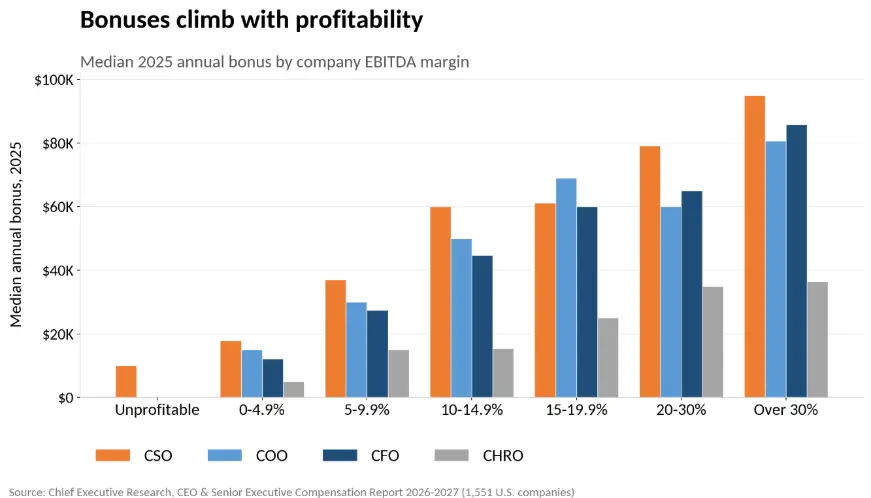
A recent compensation study by Chief Executive Group Research, analyzing data from 1,551 U.S. private companies, has illuminated a significant trend: annual bonuses for senior leaders in profitable companies are rising sharply. However, this surge in payouts is prompting a critical re-evaluation for CEOs and boards. The core question is no longer simply whether bonuses are increasing with profitability, but whether these incentive programs are effectively rewarding the specific contributions that drive sustainable, long-term success, or merely acknowledging positive financial outcomes after the fact.
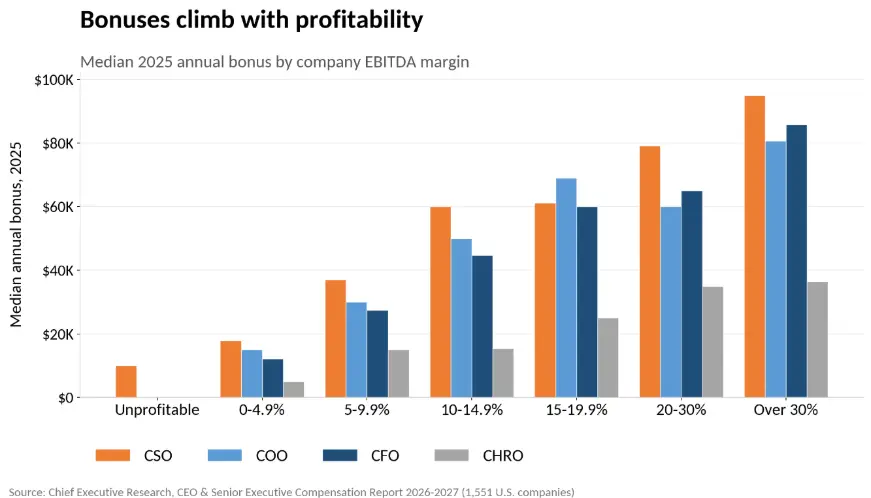
The research indicates a strong correlation between a company’s profitability and the bonuses received by its executive team. For instance, in 2025, companies that reported being unprofitable saw median bonuses of virtually zero for Chief Financial Officers (CFOs), Chief Operating Officers (COOs), and Chief Human Resources Officers (CHROs). In stark contrast, at companies achieving EBITDA margins exceeding 30 percent, median bonuses for these roles jumped to $85,842 for CFOs, $80,625 for COOs, and $36,503 for CHROs. This disparity underscores a fundamental principle: financial success directly translates into greater variable compensation for the C-suite.
This trend extends to sales leadership as well. Chief Sales Officers (CSOs) at unprofitable companies received a median bonus of a mere $10,103. However, in companies with EBITDA margins above 30 percent, this figure soared to $95,000. Similarly, revenue growth plays a pivotal role. Companies reporting flat revenue in 2025 offered median CFO bonuses of $20,000. This figure increased to $36,500 for companies experiencing revenue growth between 10 and 19.9 percent, and further climbed to $59,000 for those achieving growth of 20 percent or more. For CHROs, the pattern is also evident, with median bonuses rising from $6,450 for flat revenue companies to $20,000 for those growing 10-19.9 percent, and $30,000 for companies with over 20 percent growth.
The Nuance of Performance Measurement
While the direct link between profitability and bonus payouts is clear and intuitively appealing, the Chief Executive Group Research findings raise a more complex issue. The study suggests that a heavy reliance on company-wide financial metrics, such as EBITDA margins and revenue growth, may inadvertently obscure or undervalue the specific contributions of individual executives.
Consider a scenario where a COO diligently works to reduce production costs, enhance product quality, and expedite delivery times. If, during the same period, overall customer demand experiences a significant downturn, the company’s top-line revenue or profit margins might suffer despite the COO’s operational successes. In such a case, if the COO’s bonus is predominantly tied to these aggregate financial targets, their performance may not be adequately recognized.
The converse is also possible. A company might achieve exceptional profit targets due to favorable market conditions or unforeseen external factors, even if certain executives fail to meet their individual performance objectives. This highlights the potential for incentive programs to reward outcomes that were not solely driven by executive action, or conversely, to under-reward significant individual efforts that were hampered by broader market forces.
The research emphasizes the need for a more nuanced approach to executive compensation, one that acknowledges the distinct roles and responsibilities within the C-suite. A CFO’s performance, for instance, might be more accurately assessed through metrics such as improvements in working capital, strategic capital allocation, the cost of financing, and the robustness of financial controls. For a COO, key performance indicators could include productivity gains, operational efficiency, quality improvements, and the successful execution of strategic initiatives.
Similarly, a CHRO’s success might be measured by their ability to retain critical talent, develop strong leadership pipelines, enhance workforce productivity, and address skill gaps within the organization. Sales leaders, on the other hand, are typically accountable for driving revenue growth, ensuring customer retention, maintaining pricing discipline, and delivering profitable business.
While periods of strong revenue growth often create the financial capacity to reward executives generously, this growth itself is a reflection of collective decision-making and execution across the entire company. The challenge for CEOs lies in discerning and incentivizing the individual contributions that underpin this overall success, rather than solely rewarding the aggregate financial outcomes.
Balancing Short-Term Wins with Long-Term Vision
Another critical dimension highlighted by the study is the potential disconnect between annual bonus structures and the strategic imperatives of long-term value creation. Annual bonuses are inherently designed to reward near-term achievements. However, many of the decisions that yield the most substantial and lasting value for a company require a focus that extends beyond the current fiscal year.
Investments in cutting-edge technology, comprehensive leadership development programs, expansion of operational capacity, or the strategic entry into new markets often necessitate upfront expenditures that can temporarily depress short-term earnings. While these investments are crucial for building a resilient and competitive enterprise for the future, an incentive system that rigidly prioritizes annual profit targets may offer executives little financial motivation to pursue them.
This is where the strategic implementation of long-term incentives becomes paramount. Equity-based awards, multi-year performance plans, and long-term cash incentives can effectively align executive compensation with outcomes that materialize over extended periods. However, the effectiveness of these programs hinges not only on their potential rewards but also on their structure and clarity.
Executives need to have a clear understanding of the objectives they are working towards, the precise metrics by which their success will be measured, and the tangible benefits they stand to gain if the company achieves its long-term goals. A long-term incentive plan with ambiguous targets or an uncertain payoff mechanism is unlikely to significantly influence the strategic decisions made by executives in the present.
A Call for Strategic Compensation Review
For CEOs and boards undertaking reviews of executive compensation, the most pertinent question is not merely whether bonuses are rising in lockstep with profitability, as the Chief Executive Group Research suggests they generally are. The more profound inquiry is whether these bonuses are truly incentivizing and rewarding the individual and collective contributions that are essential for sustaining high performance over the long haul. This necessitates looking beyond the sheer magnitude of the payouts.
The Chief Executive Group Research report, which draws upon data from 1,551 U.S. private companies, offers a detailed analysis of compensation benchmarks across various company sizes, industries, and ownership structures. This comprehensive data provides a valuable resource for companies seeking to benchmark their own executive compensation strategies against industry peers. The report underscores that while there is no universally applicable compensation formula, a fundamental distinction exists between simply increasing executive pay because the company performed well, and designing compensation structures that actively encourage and drive superior company performance.
The implications of this distinction are far-reaching. A compensation plan that rewards executives solely for achieving profit targets, without adequately recognizing their strategic contributions to operational efficiency, innovation, talent development, or market positioning, risks creating a culture that prioritizes short-term financial gains over sustainable growth. This can lead to a neglect of critical long-term investments, potentially hindering the company’s competitive edge in the future.
Conversely, a well-designed compensation program that incorporates a blend of short-term and long-term incentives, and that utilizes a balanced scorecard of metrics to evaluate executive performance, can foster a more holistic and strategic approach to business management. This can empower executives to make decisions that benefit the company not only in the current year but also for years to come.
The ongoing evolution of the business landscape, marked by rapid technological advancements, shifting market dynamics, and increasing global competition, demands that executive compensation strategies remain agile and forward-looking. As private companies navigate these complexities, a rigorous and strategic approach to executive pay will be a critical determinant of their ability to attract, retain, and motivate the leadership talent necessary for sustained success. The Chief Executive Group Research’s findings serve as a timely reminder for CEOs to critically assess whether their incentive programs are truly aligned with their organization’s overarching strategic objectives and its long-term vision for growth and prosperity. The ultimate goal of executive compensation should be to cultivate a leadership team that is not only rewarded for past achievements but is also intrinsically motivated to drive future value creation.
