

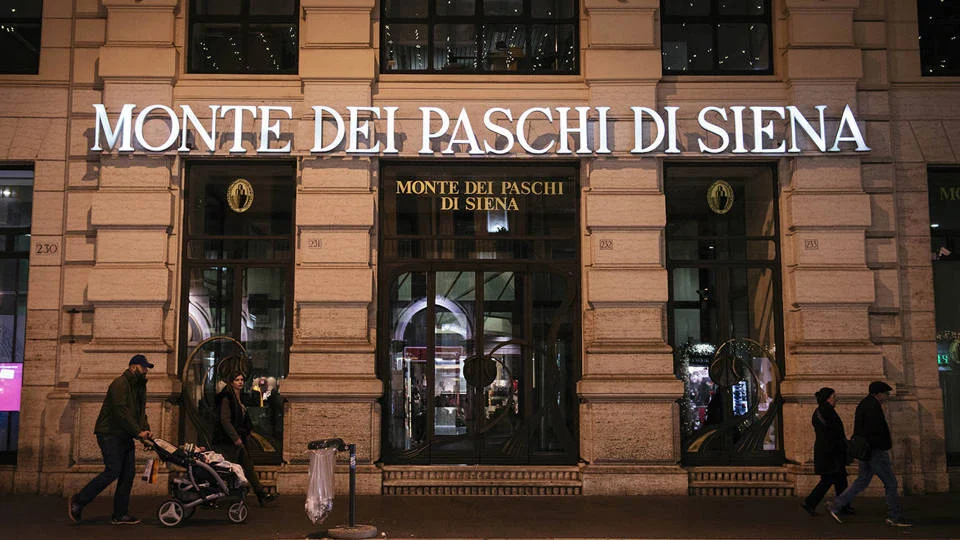
BOLOGNA – In a dramatic move to repel an unsolicited takeover bid, Banca Monte dei Paschi di Siena (MPS), Italy’s third-largest bank, has unveiled ambitious counter-offers for two other prominent Italian financial institutions, Banco BPM and Banca Generali. This strategic maneuver, approved by the MPS board after an extensive seven-hour deliberation on August 20, 2026, signals a high-stakes battle for control within the Italian banking landscape and underscores broader concerns about the fragmentation of European finance. The proposed share-exchange offers, collectively valued at approximately €34 billion, alongside a €4 billion distribution to its own shareholders, represent a significant defensive posture against the €30.6 billion ($35.7 billion) acquisition proposal from Intesa Sanpaolo, Italy’s largest bank.
The Genesis of the Conflict: A Historic Bank Under Siege
The origins of this unfolding financial drama are deeply rooted in the complex history of Banca Monte dei Paschi di Siena. Founded in 1472, it is the world’s oldest operating bank, a venerable institution that has weathered centuries of economic and political upheaval. However, its modern history has been marked by significant financial distress. In 2017, the Italian state was compelled to intervene with a substantial taxpayer-funded bailout to prevent the bank’s collapse, injecting €5.4 billion and acquiring a significant stake. This intervention, while stabilizing MPS, also placed it under increased scrutiny and ultimately led to a European Commission mandate for its eventual privatization.
The current crisis was precipitated by Intesa Sanpaolo’s unsolicited bid, a move that, if successful, would consolidate a significant portion of the Italian banking sector under its umbrella. Intesa Sanpaolo, a well-capitalized and dominant player, has been actively seeking expansion opportunities. Its offer for MPS was reportedly viewed as a strategic move to gain access to MPS’s substantial customer base and branch network, particularly in regions where Intesa Sanpaolo sought to strengthen its presence.
A Defensive Strategy Unfolds: The Counter-Bid Tactic
The board of MPS, facing what it perceived as an existential threat, opted for a bold, albeit high-risk, counter-offensive. Instead of passively evaluating Intesa Sanpaolo’s offer, MPS leadership decided to proactively reshape the competitive landscape. The rationale behind the counter-bids for Banco BPM and Banca Generali is multi-faceted. By proposing to acquire these entities, MPS aims to:
- Increase its own valuation and market capitalization: A larger, more diversified entity would theoretically be more attractive to shareholders and less vulnerable to hostile takeovers.
- Create a more formidable competitor: The integration of Banco BPM, another significant Italian bank, and Banca Generali, a leading independent wealth management firm, would create a larger, more diversified financial group, potentially rivaling Intesa Sanpaolo in certain segments.
- Dilute Intesa Sanpaolo’s offer: The issuance of new shares to fund these acquisitions would dilute the ownership stake of existing MPS shareholders, making Intesa Sanpaolo’s bid less appealing in terms of control and per-share value.
- Signal independence and strategic vision: The move demonstrates MPS’s intention to chart its own course rather than be absorbed.
The proposed acquisition of Banco BPM, the fourth-largest Italian banking group, would create a significant industrial merger, combining two substantial retail banking networks. Banca Generali, known for its expertise in wealth management and financial advisory services, would add a crucial revenue stream and a different customer demographic to the combined entity.
Timeline of Events: A Rapid Escalation
The events leading up to MPS’s counter-bid unfolded with remarkable speed:
- Early August 2026: Reports begin to surface of Intesa Sanpaolo exploring a potential takeover of Banca Monte dei Paschi di Siena.
- Mid-August 2026: Intesa Sanpaolo formally submits its €30.6 billion ($35.7 billion) takeover bid for MPS. This offer is presented as a friendly proposal, but its unsolicited nature signals a potentially aggressive approach.
- August 20, 2026: Banca Monte dei Paschi di Siena’s board convenes for an extended session. After seven hours of deliberations, the board announces its decision to launch counter-bids for Banco BPM and Banca Generali. The total value of these offers is estimated at approximately €34 billion, with an additional €4 billion earmarked for distribution to MPS shareholders.
- Late August 2026 onwards: The market reacts to the news, with analysts scrutinizing the financial viability and strategic logic of MPS’s aggressive defense. Regulatory bodies and shareholders of all involved institutions begin to assess the implications.
Supporting Data and Market Context
The Italian banking sector is characterized by a high degree of fragmentation, with numerous regional and smaller banks operating alongside a few dominant national players. This structure has historically been a subject of debate, with some arguing for consolidation to improve efficiency and competitiveness, while others emphasize the importance of local banking relationships.
- Market Share: Intesa Sanpaolo is the largest bank in Italy by assets, followed by UniCredit. MPS, prior to this maneuver, was the third-largest. Banco BPM ranks fourth. Banca Generali is a leader in its niche of wealth management.
- Profitability and Capitalization: Italian banks have historically faced challenges with profitability and non-performing loans (NPLs). While the situation has improved in recent years, the sector remains sensitive to economic downturns. Intesa Sanpaolo is generally considered to be well-capitalized and profitable, providing it with the financial muscle for such an acquisition. MPS, having undergone a state bailout, has been under pressure to improve its financial standing and operations.
- European Banking Union: The European Union has been working towards a more integrated banking sector through the Banking Union, which includes a Single Supervisory Mechanism (SSM) and a Single Resolution Mechanism (SRM). However, national influences and distinct national banking systems persist, creating complexities for cross-border mergers and acquisitions.
Potential Implications and Expert Analysis
The ramifications of MPS’s aggressive counter-bid are far-reaching and could significantly alter the Italian and potentially the broader European financial landscape.
For Banca Monte dei Paschi di Siena:
- Increased Risk: The success of MPS’s strategy hinges on its ability to finance these acquisitions and integrate the target banks effectively. This carries substantial financial and operational risks, especially for a bank still recovering from past difficulties and reliant on state support.
- Potential for a Stronger Independent Entity: If successful, MPS could emerge as a more robust and diversified banking group, better positioned to compete and potentially reduce its reliance on state intervention.
- Shareholder Value: The €4 billion distribution to shareholders could be seen as an attempt to retain their support, but the long-term value creation will depend on the success of the proposed mergers.
For Intesa Sanpaolo:
- Setback to Expansion Plans: The counter-bid directly thwarts Intesa Sanpaolo’s immediate expansion strategy. It may force them to re-evaluate their approach to acquiring MPS.
- Competitive Response: Intesa Sanpaolo may decide to increase its offer, engage in a bidding war, or pursue alternative acquisition targets. The bank’s management will need to carefully weigh the costs and benefits of such actions.
For Banco BPM and Banca Generali:
- Shift in Ownership: The potential acquisition by MPS represents a significant change in ownership and strategic direction for these banks. Their management and boards will need to assess the proposals carefully.
- Market Reaction: The share prices of Banco BPM and Banca Generali are likely to be highly volatile as the situation develops.
The Broader Call for a European Financing Channel
The current episode involving Banca Monte dei Paschi di Siena, Intesa Sanpaolo, Banco BPM, and Banca Generali serves as a potent illustration of the challenges facing European finance. The fragmented nature of national banking systems, coupled with differing regulatory environments and historical legacies, often hinders the development of truly integrated European capital markets.
The author of the original piece, Lucrezia Reichlin, argues that policymakers should shift their focus. Instead of prioritizing the reduction of government influence over national banking systems, which can sometimes lead to the very nationalistic defensive maneuvers witnessed here, the emphasis should be on building a robust and unified European financing channel. Such a channel would:
- Facilitate Cross-Border Investment: A more integrated financial system would make it easier for businesses to access capital across the EU, fostering economic growth and innovation.
- Enhance Competitiveness: A larger, more interconnected European financial market would be better equipped to compete on a global scale with financial centers in North America and Asia.
- Reduce Systemic Risk: A more diversified and less fragmented system could potentially be more resilient to shocks, as risks are spread more broadly rather than concentrated within national borders.
- Support Economic Convergence: A common financing channel could help to reduce economic disparities between member states by providing more equitable access to funding.
The intricate dance of acquisitions and counter-acquisitions within Italy highlights the enduring national character of its banking sector. While consolidation may occur, the underlying challenge remains: how to foster a truly European financial ecosystem that transcends national boundaries and supports the economic ambitions of the entire Union. The aggressive maneuvers by MPS, while a tactical response to an immediate threat, indirectly amplify the strategic imperative for a more cohesive and powerful European financial architecture. The coming months will reveal the success of MPS’s bold gambit and will undoubtedly contribute to the ongoing debate about the future of banking in Europe.
