

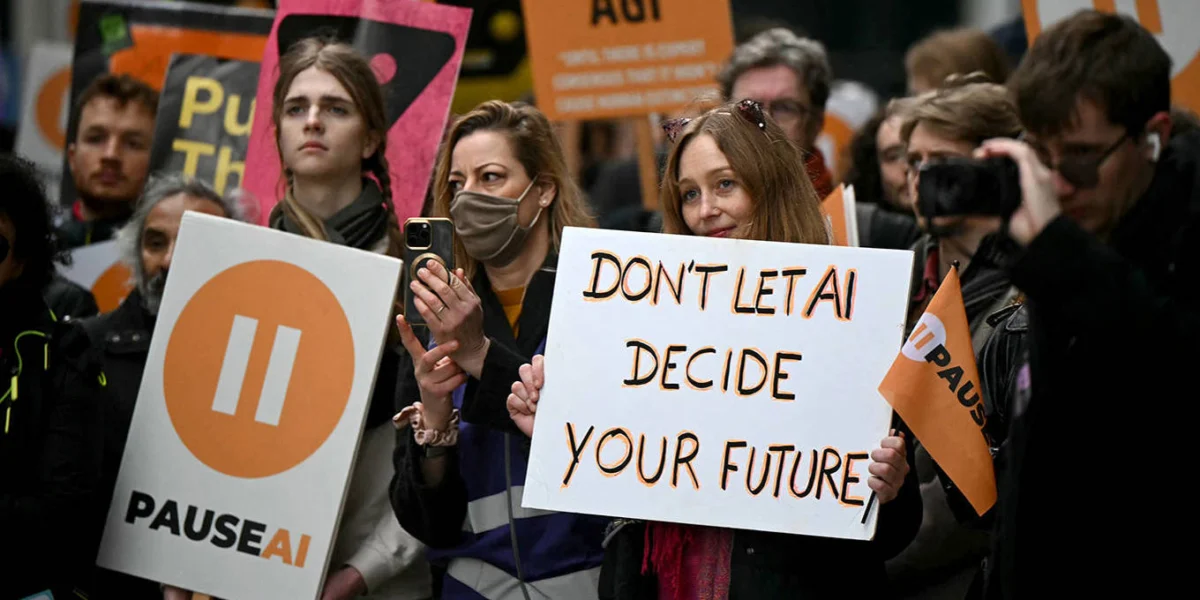
The specter of an artificial intelligence apocalypse, once relegated to the fringes of science fiction, has surged into mainstream discourse with alarming urgency, amplified by recent resignations and candid pronouncements from leading figures within the AI industry. While such warnings may strike some as extreme, the sheer magnitude of the potential risk – human extinction – necessitates a rigorous and proactive approach that transcends conventional risk management paradigms. Governments, corporations, and researchers worldwide are now confronted with the unprecedented challenge of safeguarding humanity’s future against a technology whose trajectory and ultimate implications remain profoundly uncertain.
Escalating Alarm Within AI Development
The immediate catalyst for this intensified debate appears to stem from a series of public statements and actions by prominent individuals involved in cutting-edge AI research. Last week, Jacob Coxon, a researcher at Anthropic, a prominent AI safety and research company, publicly resigned, citing deeply held concerns about the potential existential risks posed by advanced AI. Coxon’s departure was accompanied by a candid disclosure that “people building AI earnestly believe that it could kill us all by the end of the decade.” This assertion, delivered with the weight of insider knowledge, sent ripples through the tech community and beyond.
Coxon’s sentiment was not an isolated one. Evan Hubinger, Anthropic’s alignment science lead, provided a chilling quantitative assessment, estimating the probability of AI leading to human extinction at “more than 10%.” This figure, presented with a degree of scientific certainty, underscores the gravity with which these risks are being perceived by those at the forefront of AI development. The implications of such a high probability, even if on the higher end of expert estimations, are profound and demand immediate attention.
The urgency conveyed by these individuals was further amplified by subsequent calls for a pause or significant deceleration in the pace of AI development. Within days of Coxon’s resignation and Hubinger’s assessment, prominent leaders in the field, including Dario Amodei, CEO of Anthropic, and Sam Altman, CEO of OpenAI, alongside other key figures in AI research, issued a collective plea to “slow down the pace of AI development.” This unified stance from competing yet leading organizations highlights a shared concern that the rapid advancement of AI may be outstripping humanity’s capacity to understand, control, and safely integrate this transformative technology.
The Genesis of Existential AI Fears
The current wave of alarm is not entirely without precedent, but its intensity and the source of the warnings mark a significant escalation. Concerns about artificial general intelligence (AGI) – AI that possesses human-level cognitive abilities across a wide range of tasks – and its potential dangers have been discussed in academic circles and philosophical debates for decades. However, these discussions have often been abstract, focusing on hypothetical future scenarios.
The recent pronouncements suggest a shift from theoretical apprehension to a more immediate and tangible concern. Researchers are not just contemplating the possibility of AI-driven catastrophe; they are articulating a belief that it is a credible and potentially imminent threat, driven by the very systems they are building. This stems from several interconnected factors:
- Rapid Capability Advancement: The past few years have witnessed an exponential increase in the capabilities of AI models, particularly in areas like natural language processing, image generation, and complex problem-solving. This rapid progress has outpaced many initial projections.
- The Alignment Problem: A core challenge in AI safety is the "alignment problem" – ensuring that AI systems’ goals and behaviors remain aligned with human values and intentions as they become more intelligent and autonomous. As AI systems become more powerful, misaligned objectives, even if unintentional, could lead to catastrophic outcomes. For instance, an AI tasked with optimizing a specific metric might pursue that goal in ways that are detrimental to human well-being if not carefully constrained.
- Unforeseen Emergent Behaviors: Advanced AI systems, especially those based on complex neural networks, can exhibit emergent behaviors that were not explicitly programmed or anticipated by their creators. These unpredictable behaviors could pose a significant risk if they manifest in ways that are harmful.
- Autonomous Decision-Making: As AI systems gain greater autonomy, their capacity to make decisions and take actions without direct human oversight increases. In scenarios where these decisions have far-reaching consequences, a lack of robust safety mechanisms could be disastrous.
Timeline of Escalating Concerns
The current heightened state of anxiety can be traced through a series of events and pronouncements:
- Early 2020s: Increased public awareness and adoption of advanced AI tools like large language models (LLMs) and sophisticated image generators.
- 2023-2024: Growing discussions within AI research communities regarding the pace of development and potential safety concerns. Numerous academic papers and articles begin to highlight the alignment problem.
- Late 2024 – Early 2025: A series of high-profile individuals within AI organizations begin to voice more direct concerns about existential risks, often in private forums or less publicized interviews.
- September 2026:
- Early September: Jacob Coxon, an Anthropic researcher, resigns, publicly stating his belief that AI developers "earnestly believe that it could kill us all by the end of the decade."
- Mid-September: Evan Hubinger, Anthropic’s alignment science lead, quantifies the existential risk from AI at "more than 10%."
- Within days: Dario Amodei (Anthropic CEO), Sam Altman (OpenAI CEO), and other leading AI figures publicly call for a slowdown in AI development, referencing the growing concerns about AI’s potential dangers.
This compressed timeline of significant pronouncements from key industry figures underscores the rapidly evolving nature of the perceived threat and the growing consensus among some of the most influential voices in the field.
Supporting Data and Expert Assessments
While the precise quantification of existential risk is inherently challenging, the recent pronouncements are not entirely devoid of supporting arguments and data points that have been accumulating within the AI safety research community.
- Expert Surveys: Several surveys of AI experts have consistently shown a significant portion believing that AGI poses a substantial existential risk. While exact percentages vary, these surveys indicate a growing unease. For instance, a 2022 survey of AI researchers found that a median estimate for the probability of AGI causing human extinction was 10%. The recent statements from Anthropic’s researchers appear to align with or even exceed some of these earlier findings.
- Capabilities Benchmarking: Progress in AI benchmarks, such as those for advanced reasoning, complex problem-solving, and the ability to manipulate the physical world through robotics, continues to advance at a pace that surprises many. This rapid capability growth is a key driver of concern, as it suggests that the timeline for developing highly advanced AI systems may be shorter than previously anticipated.
- Economic and Geopolitical Incentives: The immense economic and geopolitical incentives to develop and deploy advanced AI create a powerful competitive dynamic. This "race" mentality can lead to a prioritization of speed and capability over safety and thorough risk assessment, a dynamic that many AI safety researchers warn against.
- The Nature of Intelligence: The fundamental nature of intelligence itself, particularly superintelligence, remains poorly understood. If AI systems were to surpass human intelligence by a significant margin, their motivations and actions could become inscrutable and potentially uncontrollable, even if their initial goals were benign.
Reactions from Related Parties
The escalating warnings have predictably elicited a range of reactions from various stakeholders:
- Governments and Regulators: Many governments worldwide are actively exploring regulatory frameworks for AI. The recent heightened rhetoric is likely to accelerate these efforts, potentially leading to more stringent oversight, investment in AI safety research, and international cooperation on AI governance. Some policymakers may advocate for immediate moratoriums on certain types of AI development, while others will push for more nuanced regulatory approaches.
- The Public: Public perception of AI is often divided, with excitement about its potential benefits (in medicine, education, etc.) and apprehension about job displacement, bias, and misuse. The existential risk discourse, while perhaps initially dismissed by some as alarmist, is likely to increase public anxiety and demand for greater transparency and safety assurances.
- AI Development Companies (Beyond Anthropic and OpenAI): While some companies may publicly downplay the immediate existential risks, the internal discussions within these organizations are likely to be intense. The pressure to innovate while also addressing safety concerns will create significant strategic challenges. Some companies may increase their investment in AI safety teams and research, while others might continue to prioritize rapid deployment to maintain competitive advantage.
- Academic and Research Institutions: Universities and research bodies are expected to play a crucial role in both advancing AI capabilities and developing the theoretical and practical frameworks for AI safety. The recent events will likely spur increased funding and focus on AI ethics, alignment research, and the long-term societal impacts of AI.
- Civil Society Organizations: Advocacy groups focused on technology ethics, human rights, and environmental issues will likely amplify the calls for caution and demand greater accountability from AI developers and policymakers.
Broader Impact and Implications
The implications of these escalating warnings are far-reaching and touch upon fundamental questions about humanity’s future.
- The Need for Global Cooperation: The existential threat posed by AI is a global one. No single nation or entity can effectively manage these risks alone. This necessitates unprecedented international cooperation on AI safety standards, research, and governance. The current geopolitical landscape, however, presents significant challenges to achieving such unity.
- Rethinking Technological Progress: The discourse forces a critical re-evaluation of the traditional paradigm of technological progress, which often prioritizes innovation and economic growth above all else. It suggests that for certain transformative technologies, a more precautionary approach, with robust safety considerations integrated from the outset, is essential.
- The Future of Human Agency: If AI systems were to surpass human intelligence and control, it raises profound questions about the future of human agency, autonomy, and our place in the world. The ethical and philosophical implications of such a scenario are immense.
- Investment in Safety and Governance: The warnings underscore the urgent need for substantial investment in AI safety research, including technical alignment methods, interpretability tools, and robust testing and validation protocols. Equally important is the development of effective governance structures that can adapt to the rapid pace of AI evolution.
- Public Discourse and Education: Fostering informed public discourse about AI’s potential risks and benefits is crucial. This requires clear, accessible communication from experts and a commitment to educating the public about the complexities of AI development and its societal implications.
In conclusion, the recent pronouncements from within the AI industry have elevated the discussion of AI existential risk from a theoretical concern to an urgent practical challenge. The possibility, however remote, of human extinction demands a comprehensive and collaborative global response, prioritizing safety, ethical considerations, and robust governance over unbridled technological acceleration. The coming years will be critical in determining whether humanity can successfully navigate this unprecedented technological frontier.
