

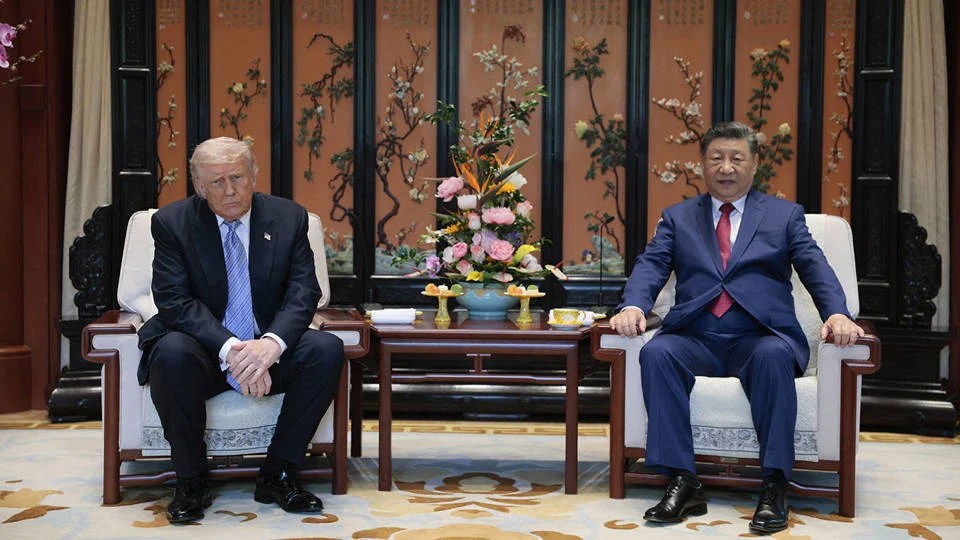
SINGAPORE – The recent summit between United States President Donald Trump and Chinese President Xi Jinping, carefully orchestrated to project an image of parity, offered a potential respite from the escalating global economic uncertainties that have plagued the international landscape for the past eighteen months. The optics of the meeting were meticulously crafted, with President Trump, the first US leader to visit mainland China in almost a decade, leading a delegation of American chief executives whose companies hold significant stakes in maintaining robust economic ties with the People’s Republic. The presence of luminaries such as Elon Musk of Tesla (accompanied by his son X), Tim Cook of Apple, Kelly Ortberg of Boeing, and Jensen Huang of Nvidia, underscored the commercial interdependence at play. This high-profile group was afforded a grand reception within the hallowed halls of the Great Hall of the People, a symbolic gesture designed to highlight the importance both nations place on their economic relationship.
The timing of this high-stakes encounter is particularly significant. The global economy has been navigating a complex web of geopolitical tensions and trade disputes, leading to a discernible increase in "tail risks" – events with a low probability but a high impact. These risks, ranging from outright trade wars to potential military escalations, have cast a long shadow over investment decisions, supply chain stability, and overall economic growth forecasts. The prospect of a sustained trade truce between the world’s two largest economies, coupled with any progress towards de-escalating tensions in the Strait of Hormuz, a critical chokepoint for global oil supplies, would undeniably inject a much-needed dose of predictability and stability into the international economic order.
Background to the Summit and Evolving US-China Relations
The summit did not occur in a vacuum. It followed a period of heightened friction between the United States and China, characterized by escalating tariffs, accusations of intellectual property theft, and a deepening strategic rivalry. Since the initial imposition of tariffs in 2018, the trade relationship between the two nations had become increasingly contentious. The United States, under President Trump’s "America First" policy, had sought to rebalance what it perceived as an unfavorable trade deficit with China, while also addressing concerns about China’s state-backed industrial policies and its growing technological influence. China, in turn, had retaliated with its own set of tariffs, leading to a tit-for-tat exchange that disrupted global trade flows and created significant uncertainty for businesses worldwide.
This trade war had tangible economic consequences. According to data from the International Monetary Fund (IMF), global economic growth projections were revised downwards in late 2025 and early 2026, with trade tensions cited as a primary contributing factor. The World Trade Organization (WTO) also reported a slowdown in global merchandise trade volume growth, directly linked to the imposition of protectionist measures by major economies. The uncertainty surrounding future trade policies had led many multinational corporations to re-evaluate their supply chains, some even considering diversification away from China to mitigate risks.
Beyond trade, geopolitical flashpoints had also contributed to the elevated level of global uncertainty. The Strait of Hormuz, a vital maritime passage through which approximately 30% of the world’s seaborne oil passes, had become a focal point of regional tensions. Incidents involving shipping in the Persian Gulf, often attributed to heightened US-Iran animosity, had sent ripples through global energy markets, leading to temporary spikes in oil prices and concerns about supply disruptions. Any de-escalation in this region, therefore, would have a direct and positive impact on global energy security and price stability.
A Carefully Staged Diplomatic Overture
The deliberate staging of the summit, emphasizing parity, suggests a mutual recognition of the detrimental effects of prolonged confrontation. The composition of the US delegation, replete with leaders of companies deeply embedded in the Chinese market, signaled a desire to protect and preserve existing commercial interests. For these American corporations, China represents not only a vast consumer market but also a crucial manufacturing and supply chain hub. The risks associated with a complete decoupling or further escalation of trade hostilities were, and remain, substantial for these businesses. Their participation underscored the economic stakes involved and the potential benefits of a more stable bilateral relationship.
The "grand welcome" in the Great Hall of the People was not merely ceremonial. It was a potent visual statement, aiming to project an image of strength and respect for both leaders on the global stage. For President Xi, hosting President Trump with such fanfare was an opportunity to showcase China’s growing economic prowess and its importance in the international arena. For President Trump, it was a chance to present a diplomatic achievement, potentially softening the narrative of ongoing trade conflict and demonstrating his administration’s ability to engage directly with China’s leadership.
Potential Ramifications of a Sustained Truce
If the summit yields a sustained Sino-American trade truce, the immediate impact would be a reduction in uncertainty for global businesses. This could translate into increased investment, a stabilization of supply chains, and a more predictable environment for international trade. Economists have long argued that trade uncertainty is a significant drag on economic growth, as it discourages long-term planning and capital expenditure. A de-escalation of trade tensions would therefore be a welcome development for the global economy.
Specifically, a truce could lead to:
- Reduced Tariffs and Trade Barriers: A rollback or at least a freeze on further tariff impositions would alleviate cost pressures for businesses and consumers. This could lead to lower prices for imported goods and a boost in consumer spending.
- Increased Business Confidence: A more predictable trade environment would likely lead to a significant uptick in business confidence. This could encourage companies to increase their capital investments, hire more workers, and expand their operations.
- Stabilized Supply Chains: Many companies have been grappling with the complexities of diversifying their supply chains away from China due to trade war fears. A truce would provide them with the stability needed to optimize their existing operations and potentially slow down or even reverse some of these costly diversification efforts.
- Renewed Global Trade Growth: The IMF and WTO have consistently pointed to trade friction as a major impediment to global trade growth. A Sino-American truce would likely be a catalyst for renewed growth in international commerce, benefiting economies worldwide.
The Significance of Reopening the Strait of Hormuz
The parallel discussion of reopening the Strait of Hormuz, while seemingly a separate issue, is intrinsically linked to the broader objective of reducing global tail risks. The Strait is a critical artery for global energy supplies, and any disruption there has immediate and far-reaching economic consequences. Elevated tensions in the Persian Gulf have historically led to volatile oil prices, impacting inflation, consumer spending, and industrial production across the globe.
A commitment to de-escalate tensions and ensure the free passage of vessels through the Strait would:
- Stabilize Energy Markets: Predictable oil flows would contribute to more stable energy prices, reducing inflationary pressures and providing greater certainty for energy-dependent industries.
- Enhance Global Energy Security: The security of energy supplies is paramount for economic stability. A de-escalation in the Strait of Hormuz would reassure global markets and ensure the continued flow of vital energy resources.
- Reduce Geopolitical Risk Premium: The ongoing tensions in the region have contributed to a geopolitical risk premium in oil prices. A reduction in these tensions would likely lead to a decrease in this premium, benefiting consumers and businesses alike.
Reactions and Anticipated Outcomes
While official statements from the summit would be crucial in assessing its concrete outcomes, the initial reactions from market participants and industry leaders would provide early indicators of its success. Analysts would be scrutinizing statements for any specific commitments regarding tariff reductions, dispute resolution mechanisms, and clear pathways for de-escalation in the Strait of Hormuz.
Inferred Reactions:
- Financial Markets: Global stock markets would likely react positively to news of a sustained trade truce and de-escalation in the Strait of Hormuz, as it would reduce perceived risks and improve the outlook for corporate earnings. Bond yields might also see some upward pressure as investor appetite for risk increases.
- Business Leaders: CEOs of multinational corporations with significant exposure to China and global energy markets would likely express cautious optimism, emphasizing the need for concrete follow-through on any agreements reached. They would be keen to understand the duration and scope of any truce.
- International Organizations: The IMF, World Bank, and WTO would likely welcome any steps towards greater global economic stability, reiterating their calls for open trade and multilateral cooperation. They would be keen to incorporate any positive developments into their revised economic forecasts.
- Regional Powers: Countries in the Middle East, heavily reliant on oil exports and sensitive to regional stability, would closely monitor developments concerning the Strait of Hormuz. Any signs of de-escalation would be viewed favorably.
Looking Ahead: The Path Forward
The summit between President Trump and President Xi, while potentially offering a much-needed reduction in tail risks, represents a crucial juncture rather than an end point. The sustainability of any trade truce and the long-term implications for global economic stability will depend on the follow-through and the commitment of both nations to de-escalation.
The challenges remain significant. Underlying structural issues in the US-China economic relationship, such as intellectual property rights, market access, and state subsidies, have not been fully resolved. Furthermore, geopolitical rivalries extend beyond trade and energy, encompassing technological competition, regional influence, and ideological differences.
However, the very act of engaging in high-level dialogue and the careful staging of the summit to emphasize parity signal a recognition of the shared interest in avoiding further escalation. For the global economy, which has been navigating a period of heightened uncertainty and vulnerability, the prospect of a sustained Sino-American trade truce and a more stable environment in the Strait of Hormuz offers a welcome opportunity to regain momentum and foster a more predictable and prosperous future. The coming weeks and months will be critical in determining whether this summit marks a genuine turning point or merely a temporary pause in ongoing global economic and geopolitical flux. The world economy, for now, can afford to breathe a cautious sigh of relief, hoping that the carefully crafted optics of this meeting translate into tangible and lasting stability.
