

In the heart of Munich, a city often characterized by its tidy, light-filled apartments and rigorous adherence to Bavarian architectural norms, a transformative residential project has emerged that challenges the traditional German domestic aesthetic. Designed by the renowned studio Holzrausch for film producer Cornelia Popp and her husband, this town house represents a radical departure from conventional floor-plan-first architecture. Instead, the project was born from a series of cinematic vignettes and atmospheric sketches, resulting in a home that functions less like a standard dwelling and more like a carefully curated film set. The collaboration has produced a space that prioritizes mood, materiality, and an evocative "club atmosphere" over the typical pursuit of maximum natural brightness.

A Visual Script for Living: The Conceptual Genesis
The design process for the Munich town house did not begin with the structural constraints of the existing 1990s-era building. Rather, Cornelia Popp and her husband approached the design team at Holzrausch with a collection of images and narrative scenes. Given Popp’s professional background in film production, the couple found that expressing their desires through visual storytelling was the most intuitive method for communicating their vision.
The primary inspiration for the home was a specific, imagined scene: a 1970s-era evening in South America, where the interior is defined by the warmth of dark wood and the distant glow of city lights. This narrative served as the "script" for the renovation. According to Popp, the goal was to create a sanctuary that felt entirely removed from its Central European surroundings. By focusing on the interplay of shadow and texture, the designers sought to evoke a sense of intimacy and seclusion that is rarely found in the urban German landscape.

The Architectural Gorge: A Study in Spatial Transition
One of the most defining features of the home is the entrance, which serves as a psychological and physical threshold between the outside world and the private sanctuary within. Upon entering, visitors find themselves in a small, dark vestibule that leads to a narrow, steep staircase. Sven Petzold, a lead designer at Holzrausch, describes this staircase as a "gorge."
Unlike traditional staircases that aim to connect levels seamlessly, this design was intended to separate them deliberately. The "gorge" is clad in dark materials and illuminated by strategic, low-level lighting. This creates a sense of compression that heightens the experience of "descending" into another world. Popp notes that the transition is exciting every time the door closes, effectively shutting out the noise and aesthetic of the surrounding Munich streets.

This dramatic use of space is a hallmark of the Holzrausch philosophy, which emphasizes the physical and emotional impact of architectural transitions. By treating the staircase as a narrative device, the designers ensure that the act of moving through the house is a deliberate, sensory experience.
The Architecture of Shadow: Reimagining Light and Darkness
In a notable rejection of modern architectural trends that favor floor-to-ceiling glass and "sun-drenched" interiors, the Munich town house embraces darkness. The ceilings and walls are finished in deep, dark tones, and light sources are placed with clinical precision to create pockets of warmth rather than uniform brightness.

Sven Petzold explains that the goal was not to maximize light, but to curate an atmosphere. Designing with dark surfaces requires a higher level of precision than working with white walls, as the textures, proportions, and reflections become the primary drivers of the room’s character. Every shadow is intentional, and every highlight is designed to direct the eye toward specific architectural details or pieces of furniture.
While the owners admit to moments of doubt during the construction—specifically questioning if the dark-paneled ceilings were too daring—the final result justifies the risk. The darkness serves to focus the space, making the rooms feel more intimate and private. It also provides a high-contrast backdrop for the couple’s collection of design pieces, including original 1920s furniture by Pierre Chareau, produced in hammered metal and walnut.

Materiality and Craftsmanship: A Palette of Contrast
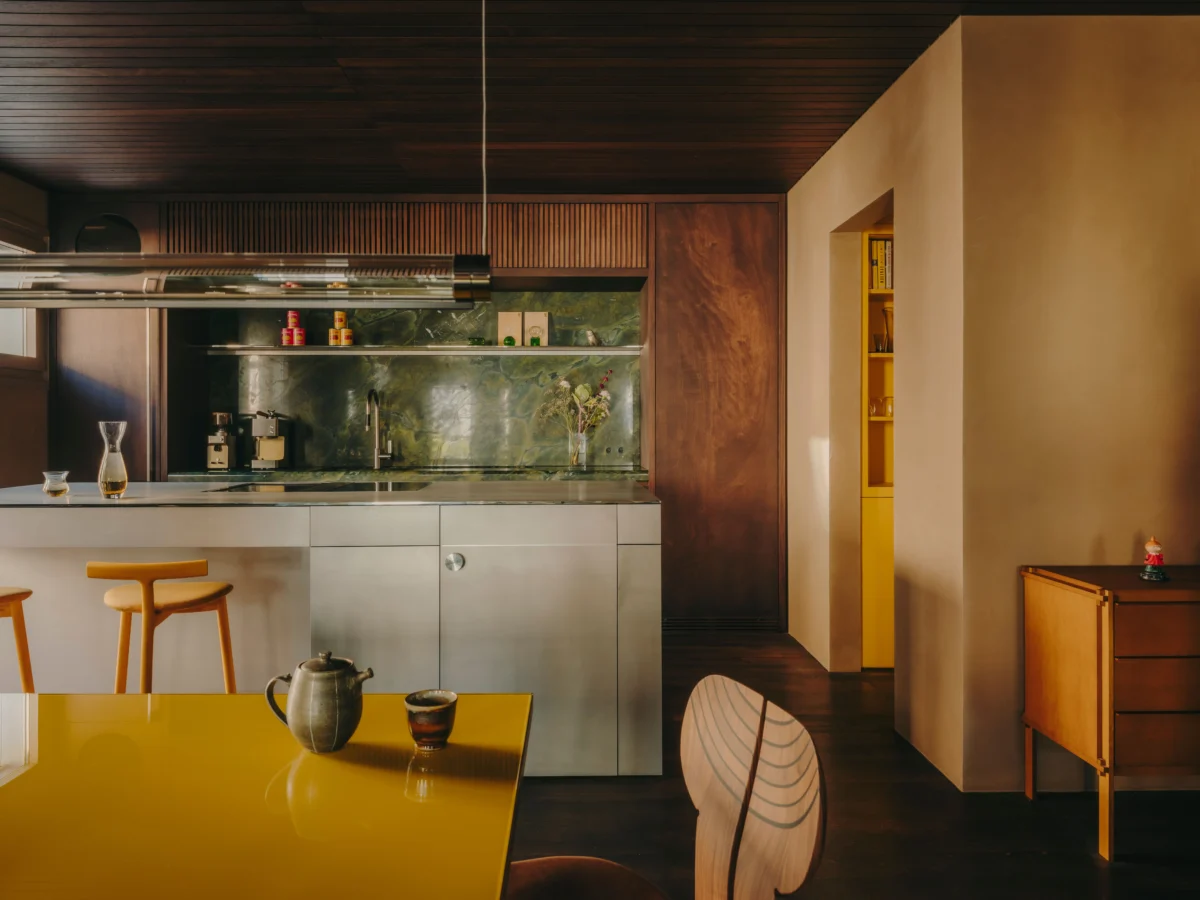
The tactile nature of the home is achieved through a sophisticated mix of organic and industrial materials. The dominant woods used throughout the residence are Okoumé—an African hardwood known for its consistent grain and warm tones—and smoked oak. These woods provide the "warmth" central to the 1970s South American theme.
To prevent the dark wood from feeling heavy or oppressive, Holzrausch introduced a variety of "cool" surfaces to create depth and reflection:

- Vitoria Regia Quartzite: A striking natural stone with green and grey veining that adds an organic, tropical feel to the kitchen and bathrooms.
- Wachenzeller Limestone: Used for its smooth, matte finish and durability.
- Stainless Steel: Predominantly featured in the kitchen, providing a sharp, industrial contrast to the surrounding wood.
- Colored Glass: Used in shower enclosures and partitions to refract light and add a layer of visual complexity.
The kitchen, in particular, showcases a successful compromise between the homeowners’ differing tastes. While Popp initially envisioned green marble for the kitchen unit, her husband preferred stainless steel. The resulting design features a sleek stainless steel island that reflects the room’s minimal lighting, paired with vibrant yellow cabinetry in the pantry and backsplash. This "sunny yellow" niche acts as a filter, making the light in the kitchen feel dense and warm, contrasting with the more somber tones of the living area.
The Living Area: A Biophilic "Club Atmosphere"
The heart of the home is the double-height living area, which Petzold describes as having a "club atmosphere." This term refers to the sense of intensity and privacy found in exclusive lounges—spaces that do not reveal themselves all at once. The room features custom-built shelving in Okoumé with an integrated ladder, housing an extensive library that adds to the room’s sense of history and intellectual weight.

Lush tropical plants are strategically placed throughout the living room and on the mezzanine levels. These are not merely decorative; they are essential to the "South American" vibe, providing a biophilic element that softens the hard lines of the custom cabinetry. The plants also create a natural transition between the different levels of the house, their green leaves catching the carefully placed spotlights to create shifting shadows on the dark wood walls.
The furniture selection, sourced by interior designer Stephanie Thatenhorst, complements this aesthetic. Pieces like the Romy lounge chair by Haymann Editions and Africa chairs by Tacchini bring a mid-century modern sensibility to the space, bridging the gap between the 1920s modernist roots of Chareau and the 1970s cinematic inspiration.

Contextualizing the Project: Munich’s Architectural Evolution
To understand the significance of this project, one must look at the broader context of Munich’s urban development. Much of the city’s residential architecture from the 1990s—the era of the town house’s original construction—is characterized by brick facades and white, square windows. These buildings were designed for efficiency and a specific type of German "Gemütlichkeit" (coziness) that often leaned toward the bright and the functional.
The Holzrausch renovation deliberately minimizes these existing architectural elements. By focusing inward and creating a self-contained world, the project critiques the "standard" urban lifestyle. It suggests that a home in a dense city can be a place of radical escape, provided the designers are willing to ignore conventional rules about light and transparency.

Furthermore, the project reflects a growing trend in high-end European design: the shift toward "story-driven" interiors. As global aesthetics become more homogenized through social media, wealthy homeowners are increasingly seeking bespoke environments that reflect their personal histories, professional backgrounds, and specific cultural interests.
Broader Implications for Modern Interior Design
The Munich town house serves as a case study for several emerging themes in contemporary interior design:

- The Narrative Turn: The use of filmic "scenes" rather than floor plans suggests a more emotional, less clinical approach to residential design.
- The Return of Dark Wood: After a decade of "Scandinavian minimalism" dominated by light woods like ash and birch, there is a clear return to the gravitas of oak, walnut, and exotic hardwoods.
- Atmospheric Lighting: The project reinforces the idea that lighting should be used to create zones of interest and mood, rather than simply illuminating a room for utility.
- Material Sincerity: The heavy use of stone, steel, and solid wood highlights a demand for "physical" materiality in an increasingly digital world.
In the end, Cornelia Popp’s home is a testament to the power of a clear vision. By staying true to the "1970s South American film" concept, the couple and Holzrausch have created a residence that is entirely unique. It is a quiet place free of distractions, a "club" without the smoke, and a piece of the Southern Hemisphere tucked away in the heart of Bavaria. As Petzold notes, the success of the project lay in the precision of the execution—a necessity when one chooses to live in the shadows.
