

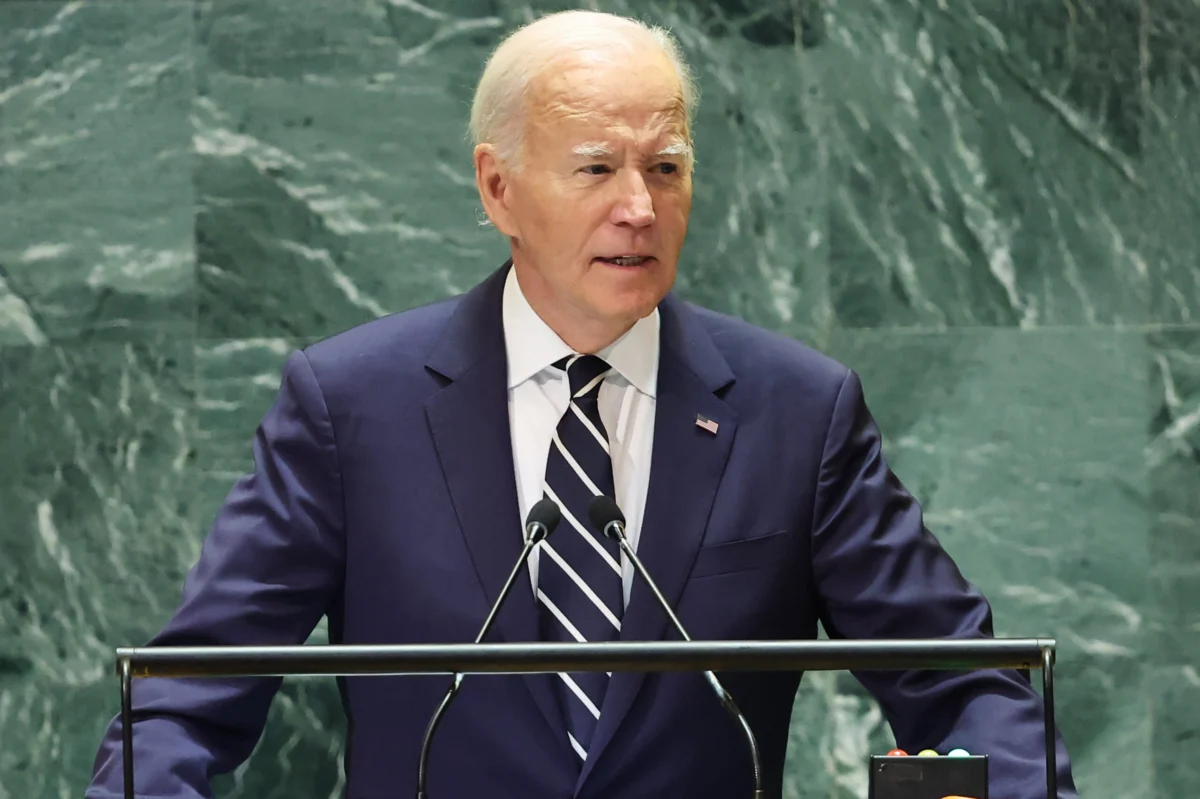
President Joe Biden delivered his final address to the United Nations General Assembly on Tuesday, marking a pivotal moment in his half-century of public service as he sought to reconcile his administration’s diplomatic aspirations with the volatile reality of global conflicts. Speaking before an audience of world leaders at the UN headquarters in New York, Biden offered a defense of his "America is back" foreign policy doctrine while acknowledging the grim humanitarian crises currently unfolding in the Middle East, Ukraine, and Sudan. The speech served as both a valedictory summary of his international legacy and a sobering assessment of the "crisis and uncertainty" that have defined his tenure since 2021.
As Biden prepares to leave the White House in four months, his remarks were framed by the duality of hope and despair. "I know many look at the world today and see difficulties and react with despair," Biden told the assembly. "But maybe because of all I’ve seen and all we have done together over the decades, I have hope." This sentiment of optimism, however, was tested by the immediate geopolitical backdrop, characterized by the most significant land war in Europe since World War II and a Middle East teetering on the edge of a regional conflagration.
A Record of Alliances and the Defense of Ukraine
A central pillar of Biden’s address was the ongoing defense of Ukraine against Russian aggression. Since the full-scale invasion in February 2022, the Biden administration has spearheaded an international coalition to provide military, economic, and humanitarian support to Kyiv. Biden used the UN platform to reaffirm that the United States and its allies "cannot let up" or "grow weary" in their support.
The President highlighted the revitalization and expansion of NATO as a key achievement of his presidency, specifically noting the accession of Finland and Sweden to the alliance. He framed the conflict not merely as a regional dispute but as an existential struggle for the principles of the U.N. Charter, which protects the sovereignty and territorial integrity of all nations. Biden credited Vice President Kamala Harris for her role in the diplomatic effort, noting that they both understood the invasion was "an assault on everything this institution was supposed to stand for."
Despite the President’s resolve, the speech comes at a time of domestic political friction regarding continued aid. Since the start of the conflict, the U.S. has authorized over $175 billion in aid to Ukraine, yet a vocal segment of the Republican party has signaled increasing resistance to further funding. Biden’s insistence that "we will not let up… until Ukraine wins a just and durable peace" was a direct message to both the Kremlin and his domestic opposition.
Escalation in the Middle East and the Pursuit of a Two-State Solution
The address occurred amid a sharp escalation in hostilities between Israel and Hezbollah, following nearly a year of intense military operations in Gaza. Biden addressed the humanitarian catastrophe in Gaza, where tens of thousands of Palestinians have been killed or wounded following the Hamas terrorist attacks of October 7, 2023. He reiterated his administration’s commitment to a three-phase ceasefire and hostage deal, urging all parties to "finalize its terms."
"Now is the time for the parties to finalize its terms, bring the hostages home, to secure security for Israel and Gaza free from Hamas’ grip, ease the suffering in Gaza, and end this war," Biden stated. He also expanded his critique to include the West Bank, calling for an end to the rise in violence against innocent Palestinians.
Biden’s vision for the region remains anchored in a two-state solution—a goal that has remained elusive despite decades of U.S. mediation. He described a future where Israel enjoys full recognition and normalized relations with its neighbors, while Palestinians live in security, dignity, and self-determination in a state of their own. However, with the Middle East currently facing the threat of an all-out regional war involving Lebanon and Iran-backed proxies, critics argue that the administration’s "red lines" have been frequently tested without significant de-escalation.
Addressing the "Forgotten War" in Sudan and Global AI Governance
Beyond the high-profile conflicts in Europe and the Levant, Biden drew attention to the civil war in Sudan, often referred to by humanitarian organizations as a "forgotten war." The conflict between the Sudanese Armed Forces (SAF) and the Rapid Support Forces (RSF) has displaced over 10 million people and pushed parts of the country into famine. Biden emphasized the need for the international community to address the humanitarian crisis and uphold global norms regarding civilian protection.

The President also touched upon the future of technology, specifically the governance of artificial intelligence. The administration has been active in outlining global AI principles, seeking to balance the technology’s transformative potential with the risks of misinformation, surveillance, and autonomous weaponry. Biden’s focus on AI at the UNGA reflects a broader effort to establish international standards before the technology outpaces regulatory frameworks.
A Chronology of Diplomatic Engagements
The UNGA address was the centerpiece of a high-intensity week of diplomacy for the President. The following timeline illustrates the administration’s efforts to solidify partnerships in the Indo-Pacific and the Middle East during the final months of the term:
- September 21: Biden hosted a "Quad" summit in Wilmington, Delaware, with the leaders of Australia, India, and Japan. The meeting focused on maritime security in the South China Sea and competition with China.
- September 23: Biden met with United Arab Emirates President Mohamed bin Zayed Al Nahyan in Washington to discuss regional stability and economic cooperation.
- September 24: The President delivered his final address to the UN General Assembly and hosted a summit on the international effort to combat synthetic drug trafficking, specifically targeting fentanyl.
- September 25: Biden is scheduled to meet with President Tô Lâm of Vietnam to further the "Comprehensive Strategic Partnership" established in 2023.
- September 26: Biden will host Ukrainian President Volodymyr Zelenskyy at the White House to discuss Kyiv’s "victory plan" and the continued flow of military assistance.
The Domestic Transition and the "New Generation of Leadership"
In a rare moment of personal reflection on the international stage, Biden addressed his decision to withdraw from the 2024 presidential race. In July, Biden announced he would not seek re-election, endorsing Vice President Kamala Harris as his successor. He used his platform at the UN to deliver a message to other global leaders about the nature of power.
"As much as I love the job, I love my country more. I decided, after 50 years of public service, it’s time for a new generation of leadership to take my nation forward," Biden said. "My fellow leaders, let us never forget: Some things are more important than staying in power."
This statement was widely interpreted as a contrast to both domestic political challengers and authoritarian leaders abroad. It also underscored the unique position of this year’s UNGA, where foreign diplomats are simultaneously engaging with the current administration and the campaigns of the two major-party nominees, Harris and former President Donald Trump.
Analysis: The Biden Legacy and Global Implications
Biden’s final UNGA speech highlights the complexities of a "lame-duck" presidency in an era of global instability. While the President can claim successes in strengthening alliances like NATO and AUKUS, the unresolved nature of the wars in Ukraine and Gaza leaves his foreign policy legacy in a state of flux.
The "Biden Doctrine" has been characterized by a return to multilateralism and the strengthening of democratic coalitions against autocracy. However, the effectiveness of these coalitions is under scrutiny as the "Global South" expresses increasing frustration with what it perceives as a double standard in the application of international law—specifically comparing the West’s response to Russia’s invasion of Ukraine with its support for Israel’s actions in Gaza.
Furthermore, the "shadow presidency" of the 2024 election was palpable throughout the week. World leaders, including President Zelenskyy and UAE President Mohamed bin Zayed, held separate meetings with Kamala Harris, while Donald Trump is expected to meet with leaders from India, Poland, and Ukraine. This dual-track diplomacy indicates that the international community is already hedging its bets, recognizing that the trajectory of U.S. foreign policy could shift dramatically depending on the outcome of the November election.
As Biden concludes his final major international summit, his message was clear: the world stands at an "inflection point." Whether the institutions he has championed—the UN, NATO, and the G7—can withstand the current pressures of nationalism and conflict remains the defining question of his post-presidency era. For now, Biden’s hope remains a rhetorical anchor in a world increasingly defined by its divisions.
