

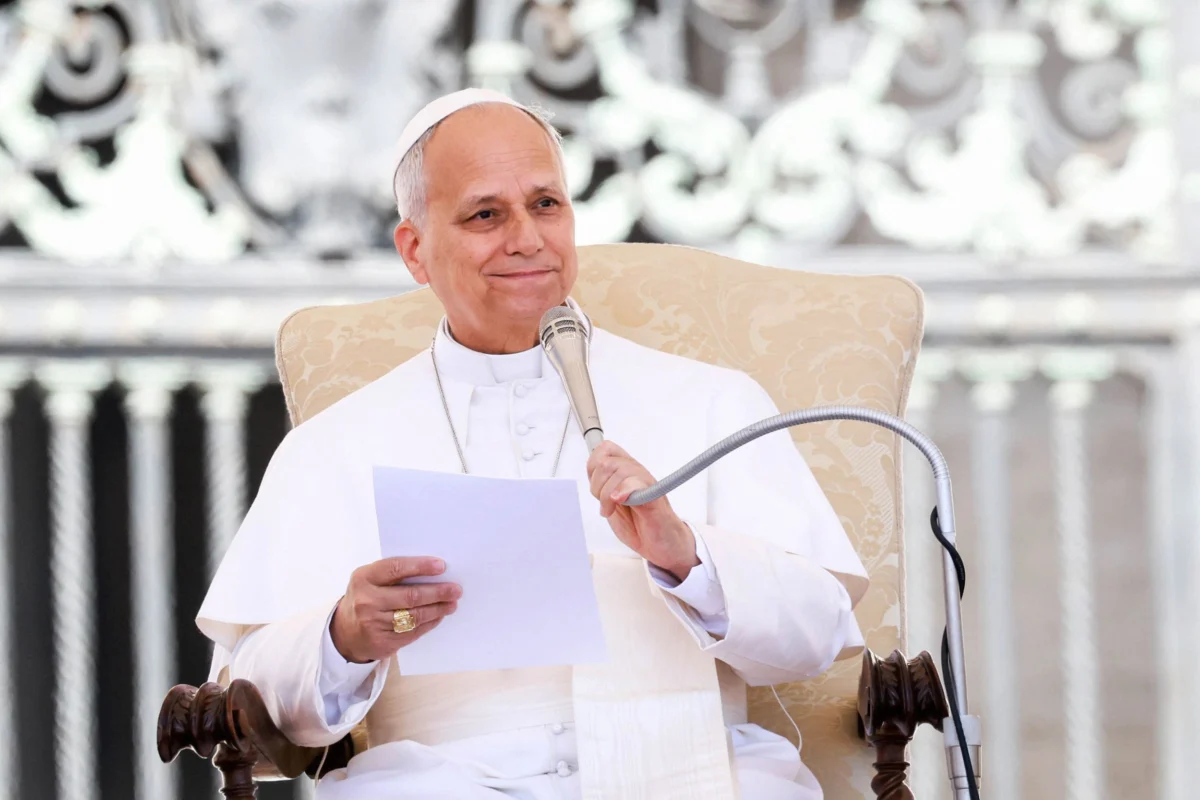
The Vatican released the first encyclical of Pope Leo XIV on Monday, a sweeping spiritual and ethical treatise titled Magnifica humanitas, which addresses the moral challenges posed by the rapid advancement of artificial intelligence and the concentration of power within the global technology sector. While the document follows the traditional format of citing scripture, saints, and previous pontiffs, it has garnered significant international attention for its explicit reference to J.R.R. Tolkien, the Catholic author of The Lord of the Rings. By invoking the wisdom of Tolkien’s literary world, the Pope has positioned the Catholic Church in direct opposition to the "technocratic paradigm" championed by Silicon Valley’s most influential billionaires, signaling a new era of Vatican skepticism regarding the digital age.
The encyclical, whose title translates to "Magnificent Humanity," serves as a foundational document for Leo XIV’s papacy. In it, the Pope warns of a growing societal tendency to reduce human beings to "mere cogs in a system driven toward ever greater efficiency." Drawing a historical parallel to the Industrial Revolution, Leo XIV echoes the concerns of his namesake, Pope Leo XIII, whose 1891 encyclical Rerum Novarum defended the rights and dignity of workers during a period of massive technological and economic upheaval. Magnifica humanitas suggests that the current AI revolution represents a similar, if not more profound, threat to the essence of the human person and the integrity of creation.
Historical Context and the Technocratic Paradigm
The philosophical core of Magnifica humanitas builds upon the work of Pope Francis, particularly his 2015 encyclical Laudato si’, which first introduced the concept of the "technocratic paradigm." This paradigm describes a worldview in which technology is not merely a tool but a dominant ideology that seeks to control and manipulate nature and humanity for the sake of profit and power. Pope Leo XIV expands this critique, arguing that the pursuit of Artificial General Intelligence (AGI) by private corporations often ignores the common good in favor of "limitless profit and cultural dominance."
The Pope’s decision to cite J.R.R. Tolkien is seen by many scholars as a strategic move to reclaim the author’s legacy. Tolkien, a devout Catholic whose work was deeply influenced by his faith, has recently been co-opted by prominent figures in the technology sector, most notably Peter Thiel and Elon Musk. These tech leaders have frequently used Tolkien’s imagery to brand their ventures, a practice the Vatican appears to view as a fundamental misinterpretation of the author’s anti-authoritarian and pro-environmental themes.
A Chronology of Modern AI and the Vatican’s Response
The release of Magnifica humanitas follows a decade of increasing engagement between the Holy See and the technology industry.
- 2015: Pope Francis releases Laudato si’, criticizing the "technocratic paradigm."
- 2019: The Vatican hosts the "Ethics of AI" conference, leading to the "Rome Call for AI Ethics," signed by companies like Microsoft and IBM.
- 2023: The emergence of generative AI leads to global concerns over misinformation and labor displacement, prompting the Vatican to issue further warnings.
- 2025: Following his election, Pope Leo XIV announces that his first encyclical will focus on the "sanctity of the human person in the digital era."
- May 15, 2026: Magnifica humanitas is officially promulgated, citing Tolkien and calling for a "human-centered" approach to technology.
This timeline illustrates a steady progression from general environmental and social concern to a specific, urgent critique of the AI industry’s current trajectory. The Pope’s focus on AI in his first year reflects the urgency with which the Church views the potential for algorithmic bias, the erosion of privacy, and the dehumanization of labor.
The Battle for Middle-earth: Reclaiming Tolkien from Silicon Valley
One of the most striking sections of the encyclical is the Pope’s use of a quote from Gandalf, the wizard in The Lord of the Rings: "It is not our part to master all the tides of the world, but to do what is in us for the succour of those years wherein we are set, uprooting the evil in the fields that we know, so that those who live after may have clean earth to till."
This passage is used to emphasize personal and collective responsibility in the face of systemic "dark forces." It stands in sharp contrast to the way Tolkien’s work has been utilized by Peter Thiel, the co-founder of Palantir Technologies. Thiel named his data analytics firm after the "palantiri," the seeing-stones in Tolkien’s mythology that were used by the corrupted wizard Saruman and the dark lord Sauron for surveillance and manipulation. Furthermore, Thiel has reportedly referred to his venture capital firm, the Founders Fund, as "the precious"—the same term used by the character Gollum to describe the One Ring, an object of ultimate, corrupting power.
Similarly, Elon Musk has recently used Tolkien’s work to support far-right political narratives. In a post on the social media platform X, Musk suggested that The Lord of the Rings could be read as a parable for anti-immigration policies, comparing the protection of the Shire to the "hard men of Gondor" guarding borders. Literary critics and Tolkien scholars have widely panned this interpretation, noting that Tolkien’s work consistently warns against the dangers of militarization and the industrial destruction of the environment.
Pope Leo XIV’s encyclical suggests that these interpretations are not merely literary disagreements but represent a dangerous embrace of the very "will to power" that Tolkien sought to condemn. By quoting Gandalf’s call for stewardship and humility, the Pope challenges the notion that technology should be used to achieve omniscience or authoritarian control.
Supporting Data: The Impact of the Technocratic Paradigm
The Pope’s concerns are supported by a growing body of data regarding the social and environmental costs of the AI boom. According to reports from the International Labour Organization (ILO), the integration of AI in various sectors could impact up to 40% of jobs globally, with the potential to exacerbate inequality if not managed with a focus on worker dignity.
Furthermore, the environmental footprint of AI is a significant point of contention. The energy consumption required to train large-scale AI models has skyrocketed, with some estimates suggesting that the carbon footprint of training a single large language model is equivalent to the lifetime emissions of five average cars. This "ravaging of the environment" for the sake of digital efficiency is a direct violation of the principles of "integral ecology" laid out by both Francis and Leo XIV.
The encyclical also alludes to the human cost of policies supported by tech-aligned administrations. References to the "bulldozing" of international aid agencies and the resulting preventable deaths highlight the real-world consequences of a paradigm that prioritizes "efficiency" and "disruption" over the preservation of human life.
Official Responses and Global Implications
The Vatican has not officially commented on whether the encyclical was intended as a direct rebuke to Musk and Thiel, though the choice of citations has led many observers to conclude that the message was intentional. As of the time of publication, neither Peter Thiel nor Elon Musk has issued a formal response to the encyclical.
Within the Catholic community, reactions have been largely positive. Progressive Catholic groups have praised the Pope for his clear-eyed critique of corporate power, while conservative scholars have noted the importance of reclaiming Tolkien from secular and political misappropriation. Dr. Maria Rossi, a theologian at the Pontifical Gregorian University, stated, "Pope Leo XIV is reminding us that technology must serve humanity, not the other way around. By using Tolkien, he is speaking a language that resonates with the modern world while remaining rooted in Catholic tradition."
The broader impact of Magnifica humanitas may be felt in the realm of international policy. The Vatican holds permanent observer status at the United Nations and has been active in discussions regarding AI regulation. This encyclical provides a moral framework that Catholic lawmakers and international bodies can use to advocate for stricter ethical standards in AI development.
Conclusion: A Call for Clean Earth
Magnifica humanitas concludes with a plea for a "new humanism" that resists the temptations of the technocratic paradigm. Pope Leo XIV argues that the true measure of progress is not the sophistication of our machines, but the degree to which we care for the "least among us" and the environment we inhabit.
By framing the struggle against the dark side of AI as a task for every person—to "uproot the evil in the fields that we know"—the Pope provides a hopeful, yet serious, roadmap for the future. The encyclical serves as a reminder that while the "tides of the world" may be vast and complex, the responsibility to act with justice and mercy remains firmly within human hands. In the face of a digital age that threatens to reduce the world to data and objects of exploitation, Leo XIV’s first papal letter is a defiant celebration of the "magnificent humanity" that remains the Church’s central concern.
