

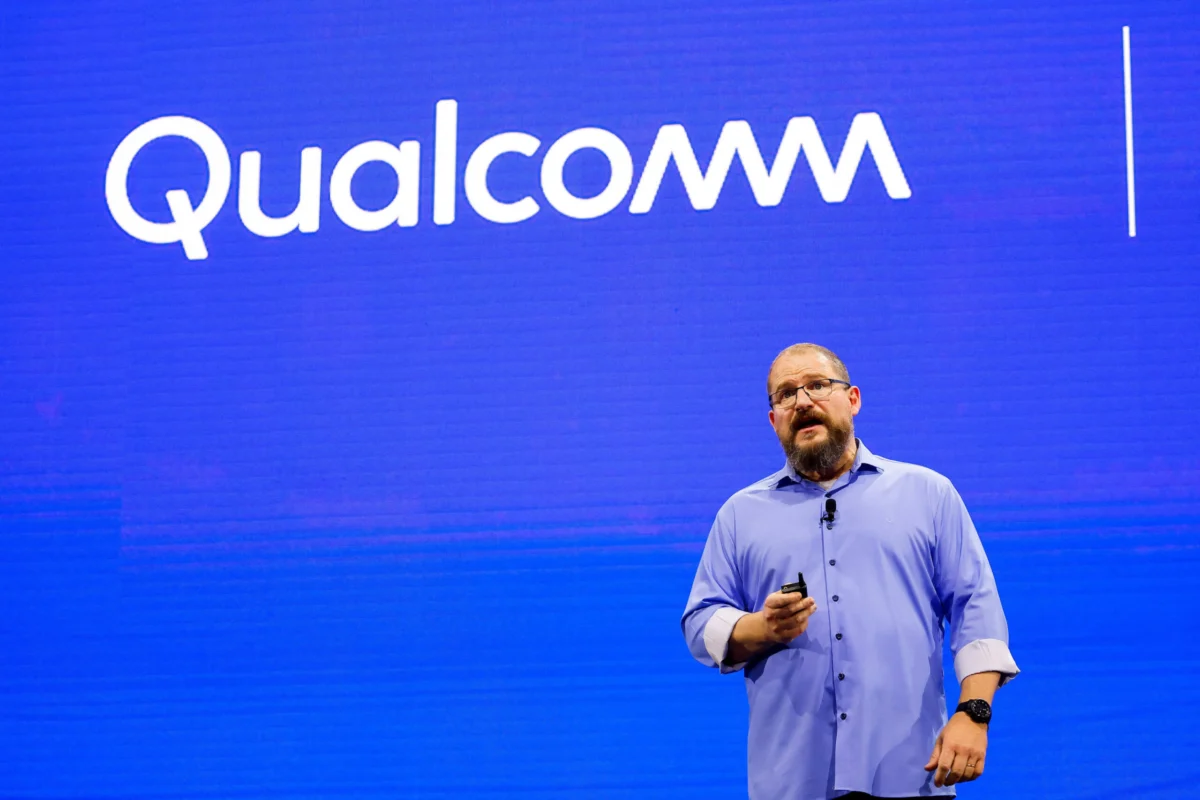
The global semiconductor landscape is witnessing a seismic shift as Qualcomm Incorporated (NASDAQ: QCOM) cements its position not merely as a smartphone chip provider, but as a central architect of the "physical AI" era. On Friday, Qualcomm shares surged by 12%, marking a historic milestone for the San Diego-based company. This single-day leap is part of a broader, more aggressive rally that has seen the stock climb 75% over the past month, propelling the company’s valuation to record levels. Wall Street’s renewed enthusiasm stems from a growing realization that Qualcomm’s reach now extends far beyond the mobile handsets that defined its previous decade of growth, encompassing automotive systems, personal computing, and the burgeoning field of edge-based artificial intelligence.
While industry giants like Nvidia have dominated the initial wave of the AI boom through massive data center GPUs used to train large language models (LLMs), Qualcomm is successfully carving out a dominant niche in "inference at the edge." This strategy focuses on running AI models directly on local devices—such as smartphones, laptops, and vehicles—rather than relying exclusively on the cloud. This shift is increasingly viewed by analysts as the next critical frontier in the AI revolution, as it addresses concerns regarding latency, privacy, and energy consumption.
The Evolution of Mobile Dominance into AI Ubiquity
For years, Qualcomm has been the undisputed leader in the premium smartphone market, providing the Snapdragon processors that power the vast majority of high-end Android devices. However, as the smartphone market matured, investors initially feared the company’s growth might plateau. Those fears have been largely dispelled by Qualcomm’s aggressive pivot toward integrated AI capabilities.
The company’s recent performance reflects a strategic bet made by CEO Cristiano Amon: that every connected device will eventually require on-board AI processing. This "connected device revolution" is now bearing fruit. According to Ivan Feinseth, an analyst at Tigress Financial Partners, Qualcomm is returning to its "former glory" by leading this transition. Feinseth, who maintains a "buy" rating on the stock, noted that the investment community is finally "waking up to the fact" that Qualcomm’s intellectual property is indispensable for the next generation of consumer electronics.
A significant catalyst for this sentiment is the reported partnership between Qualcomm and OpenAI. The collaboration aims to develop a specialized AI chip designed to power a new category of handheld devices. Unlike traditional smartphones, these devices are expected to be built around "AI agents"—autonomous software entities capable of performing complex tasks across various applications. Feinseth described the prospect as a "phone that will be an AI-based operating system that will do everything," suggesting a fundamental redesign of the user experience that moves away from app-centric interfaces toward intent-based interactions.
The Automotive Transformation: From Semiconductors to Software-Defined Vehicles
One of the most robust pillars of Qualcomm’s diversification strategy is its automotive division. On Thursday, the company announced an expanded partnership with Stellantis, the global automotive powerhouse behind brands such as Jeep, Ram, Dodge, Fiat, Chrysler, Alfa Romeo, and Maserati. Under the agreement, Stellantis will utilize Qualcomm’s Snapdragon Digital Chassis to provide unified compute power across its entire vehicle lineup.
This technology will manage everything from the digital cockpit and in-car infotainment to advanced driver assistance systems (ADAS) and connectivity. Ned Curic, head of product development at Stellantis, emphasized during the company’s investor day that this partnership would allow customers to enjoy a "smooth, immersive, and safe auto-drive experience" with various driving modes tailored for both urban and highway environments.
The financial impact of these deals is already evident. In its most recent quarterly earnings report, Qualcomm revealed that its automotive revenue jumped 38% year-over-year, reaching $1.3 billion. The company disclosed that more than 1 million vehicles are currently operating autonomous or semi-autonomous systems powered by Qualcomm processors. By securing long-term design wins with other major manufacturers including Bosch, Volkswagen, Hyundai, and BMW, Qualcomm has built an automotive pipeline that promises steady, high-margin revenue for years to come.
A New Frontier in the Data Center: Challenging Nvidia’s Hegemony
While Qualcomm’s strength has traditionally been in low-power mobile chips, the company is now making a bold entry into the data center market—the traditional stronghold of Nvidia and AMD. The excitement surrounding Friday’s stock performance was fueled in part by details regarding Qualcomm’s upcoming AI200 and AI250 chips.

These products are custom AI accelerators, designed to be more programmable and energy-efficient than the standard graphics processing units (GPUs) currently used for AI workloads. Qualcomm plans to offer these chips in a full "rack-scale" system, a move that puts them in direct competition with Nvidia’s upcoming "Vera Rubin" architecture and AMD’s "Helios" systems.
CEO Cristiano Amon recently confirmed that Qualcomm expects to begin shipping these data center chips to a "large hyperscaler" within the current calendar year. This move is significant because it suggests that the world’s largest cloud providers (such as Microsoft, Amazon, or Google) are looking for alternatives to Nvidia’s expensive and power-hungry hardware. If Qualcomm can prove that its Arm-based architecture can handle high-performance AI inference in the data center as efficiently as it does on mobile devices, it could unlock a massive new revenue stream.
The Shift in the PC Landscape: Windows on Arm
Qualcomm is also at the forefront of a major shift in the personal computer industry. For decades, the PC market has been dominated by the x86 architecture championed by Intel and AMD. However, the rise of "Windows on Arm"—powered by Qualcomm’s Snapdragon X Elite and X Plus processors—is challenging this status quo.
Microsoft’s recent unveiling of "Copilot+ PCs" features Qualcomm’s silicon as the launch platform. These devices offer a combination of long battery life and high-performance AI processing (measured in NPU TOPS, or Tera Operations Per Second) that currently exceeds the capabilities of traditional x86 processors. By providing an energy-efficient alternative for Microsoft’s Surface line and devices from other major OEMs, Qualcomm is positioning itself to capture a significant portion of the laptop market, particularly as enterprises look to upgrade hardware to support local AI features.
Chronology of Recent Events and Future Milestones
The current surge in Qualcomm’s valuation is the result of a series of strategic announcements and market shifts over the past year:
- Late 2023: Qualcomm announces the Snapdragon X Elite, signaling its intent to dominate the high-end Windows PC market.
- April 2024: During its quarterly earnings call, Qualcomm reports a 38% surge in automotive revenue and confirms plans to ship data center chips to a major hyperscaler.
- April 27, 2024: Reports emerge regarding a strategic partnership with OpenAI for a next-generation AI agent device.
- May 16, 2024: Stellantis confirms the adoption of Snapdragon processors across its global brand portfolio during its annual investor day.
- May 17, 2024: Qualcomm stock surges 12% to reach an all-time high, capping a 75% gain over a 30-day period.
- June 2, 2025: CEO Cristiano Amon is scheduled to deliver a keynote address at Computex in Taipei, Taiwan, where further details on the AI200 series and PC partnerships are expected.
- June 24, 2025: Qualcomm will host its 2025 Investor Day, providing updated long-term financial targets and a roadmap for its data center and edge AI initiatives.
Market Analysis and Broader Implications
The meteoric rise of Qualcomm’s stock reflects a broader market rotation. While the first phase of the AI trade was characterized by "buying the pickaxes" (Nvidia’s GPUs for training), the second phase is focused on "the edge" (Qualcomm’s chips for deployment). Investors are betting that as AI models become more efficient, the bulk of AI activity will move from centralized cloud servers to the devices in people’s pockets, cars, and offices.
Qualcomm’s advantage lies in its mastery of power efficiency. AI processing is notoriously energy-intensive; in a mobile or automotive environment, managing heat and battery life is as important as raw computing power. Qualcomm’s experience in optimizing high-performance silicon for the strict thermal constraints of a smartphone gives it a significant head start over traditional server-chip manufacturers.
Furthermore, the company’s diversification reduces its reliance on the volatile consumer smartphone cycle. By expanding into automotive and data centers, Qualcomm has created a more resilient business model with multiple growth engines. The 75% gain in the past month suggests that the market is no longer valuing Qualcomm as a "modem company," but as a diversified semiconductor powerhouse essential to the infrastructure of the 21st century.
As Cristiano Amon prepares for his upcoming keynote at Computex, the industry will be watching closely for signs of new "hyperscaler" partnerships and technical benchmarks for the AI200 series. If Qualcomm can successfully execute its entry into the data center while maintaining its lead in mobile and automotive AI, its recent record-high stock price may only be the beginning of a new era of market leadership.
