

On May 14, the High Court of Madhya Pradesh issued a landmark ruling regarding the centuries-old Kamal Maula mosque in the city of Dhar, declaring the site to be a temple dedicated to a Hindu goddess. Within forty-eight hours of the judicial pronouncement, the site was transformed by the presence of saffron flags—symbols synonymous with Hindu nationalist movements—as supporters gathered to conduct rituals and document the occasion for social media. This development at the Kamal Maula mosque, also known as the Bhojshala complex, is not an isolated legal dispute; rather, it represents the latest flashpoint in a decades-long movement to reclaim religious sites across the country.
For years, activists aligned with Hindutva ideology have asserted that various medieval-era mosques were constructed atop demolished Hindu temples. These claims have gained significant momentum and legal traction following the ascent of Prime Minister Narendra Modi and the Bharatiya Janata Party (BJP) in 2014. While India remains a constitutionally secular republic, the growing influence of Hindutva—a right-wing political and nationalist ideology—has fundamentally altered the nation’s social and political landscape, sparking a global debate over the future of pluralism in the world’s most populous democracy.
Defining Hindutva: Essence, Identity, and Ideology
To understand the current political climate in India, one must distinguish between Hinduism, the ancient and diverse religion, and Hindutva, the political ideology. The term "Hindutva" literally translates to "Hindu-ness" or "Hindu essence." It was popularized in the early 20th century to define Indian national identity through the lens of Hindu cultural values.
Etymologically, the word "Hindu" is derived from "Sindhu," the Sanskrit name for the Indus River. Historical usage by Persians and later Greeks transformed the "S" to an "H," using the term to describe the inhabitants of the land beyond the river. By adding the Sanskrit suffix "-tva," ideologues created a term that signifies a collective identity rather than just a religious practice. Proponents of Hindutva argue that India is not merely a collection of citizens under a social contract, but a sacred civilizational entity whose "true" identity is rooted in Hindu heritage.
Unlike the secular framework established by India’s founding fathers, which envisions a state neutral toward all religions, Hindutva advocates for a "Hindu Rashtra" (Hindu Nation). In this vision, Hinduism would serve as the foundational state religion, and the cultural life of the nation would be dictated by Hindu norms and history.
The Genesis of a Movement: From Colonial Resistance to Sectarian Identity
The roots of Hindu nationalism lie in the late 19th and early 20th centuries, emerging partly as a reaction to British colonial rule. Early thinkers sought to revitalize Hindu society to resist both Western cultural hegemony and what they perceived as the growing influence of other religious groups.

The ideological blueprint for the movement was formalized by Vinayak Damodar Savarkar in his 1923 pamphlet, Essentials of Hindutva. Savarkar, a complex and controversial figure in Indian history, proposed that an Indian is someone who considers India to be both their "Pitribhu" (Fatherland) and "Punyabhu" (Holy Land). This definition created an inherent distinction between Hindus, Sikhs, Jains, and Buddhists—whose religions originated within the Indian subcontinent—and Muslims and Christians, whose primary holy sites (such as Mecca and Jerusalem) are located abroad.
This distinction remains a cornerstone of Hindutva thought. Critics argue that this framework effectively categorizes India’s 200 million Muslims and nearly 30 million Christians as "outsiders" or "secondary citizens," despite their centuries-long presence in the country. During the British Raj, these ideological divisions contributed to rising sectarian tensions, which eventually culminated in the 1947 Partition of India and the creation of Pakistan as a Muslim state—a trauma that continues to inform Hindutva rhetoric today.
The Institutional Backbone: The RSS and the Sangh Parivar
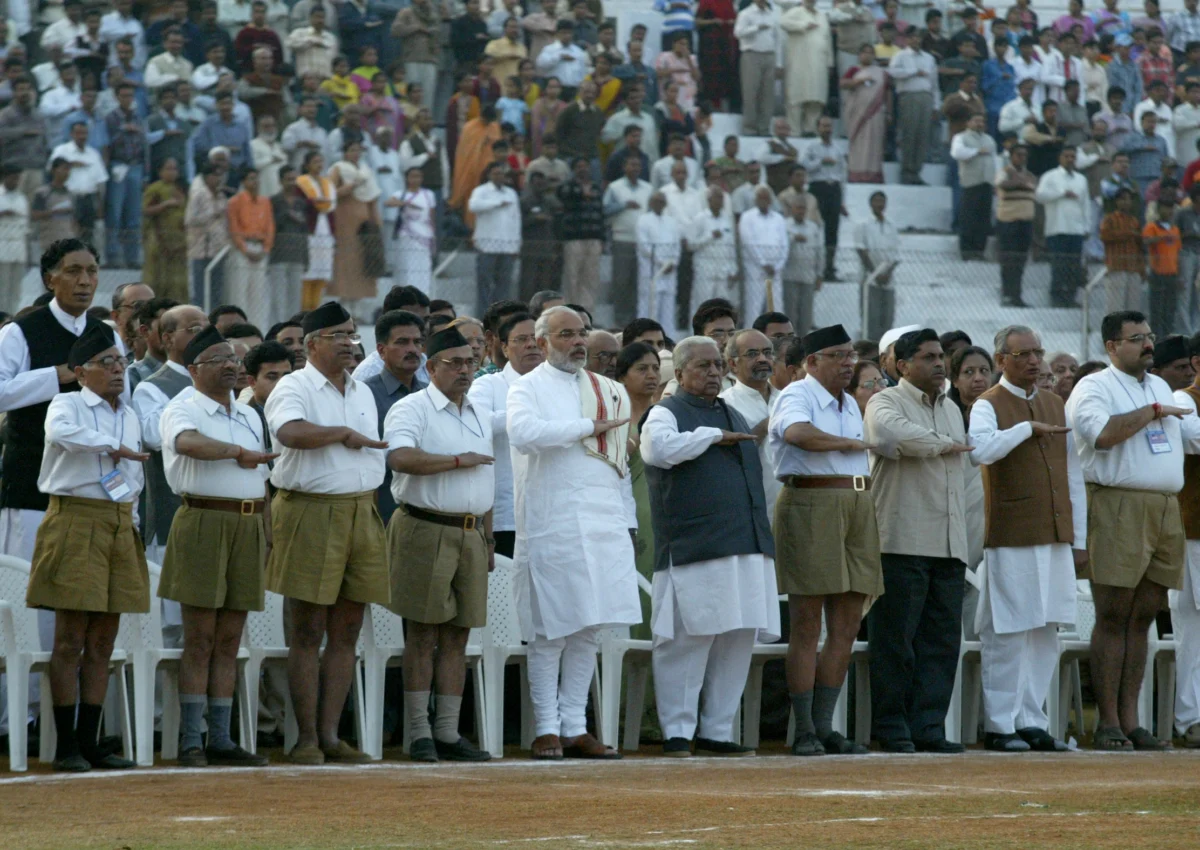
In 1925, shortly after Savarkar’s ideological manifesto, Keshav Baliram Hedgewar founded the Rashtriya Swayamsevak Sangh (RSS), or the National Volunteer Organization. The RSS was designed to be a paramilitary, cultural organization dedicated to "strengthening" the Hindu community through discipline and physical training.
Over the decades, the RSS has grown into the "mothership" of a vast network of organizations known as the Sangh Parivar (the Family of Organizations). This network includes:
- The Vishva Hindu Parishad (VHP): Focused on religious and social causes.
- The Bajrang Dal: The militant youth wing often involved in grassroots activism.
- The Bharatiya Mazdoor Sangh: A powerful trade union.
- The Akhil Bharatiya Vidyarthi Parishad (ABVP): One of the largest student organizations in the world.
The RSS has historically faced scrutiny for its methods and ideology. Some of its early leaders expressed admiration for European fascist movements of the 1930s, particularly their emphasis on racial and cultural purity. The organization faced its greatest crisis in 1948 following the assassination of Mahatma Gandhi. The assassin, Nathuram Godse, was a former member of the RSS who believed Gandhi was too conciliatory toward Muslims. Although the RSS was banned for a period and Savarkar was tried (and eventually acquitted) in connection with the conspiracy, the movement survived and pivoted toward direct political participation.
The Political Ascent: From the Fringes to the Center of Power
The political arm of the Hindutva movement began with the Bharatiya Jana Sangh in 1951, which eventually evolved into the Bharatiya Janata Party (BJP) in 1980. For several years, the BJP remained a marginal force in Indian politics, struggling to compete with the dominant, secular Congress Party.
The turning point occurred in the late 1980s and early 1990s with the "Ram Janmabhoomi" movement. The BJP and its affiliates campaigned for the construction of a temple dedicated to Lord Ram in Ayodhya, on the site of the 16th-century Babri Mosque. In 1992, a mob of activists demolished the mosque, triggering nationwide communal riots that left thousands dead. This event catapulted the BJP to national prominence, allowing it to lead short-lived coalition governments in the late 1990s.

However, it was the 2014 general election that signaled a paradigm shift. Under the leadership of Narendra Modi, the former Chief Minister of Gujarat, the BJP secured an absolute majority. Modi’s rise was fueled by a "cocktail" of Hindutva nationalism and a promise of economic development. In 2019, he was re-elected with an even larger mandate, solidifying the movement’s control over the state apparatus.
Legislative Milestones and Social Policy under the BJP
Since 2014, the Hindutva ideology has moved from the realm of political rhetoric into the halls of legislation. Several key policy decisions reflect the core tenets of the movement:
- Abrogation of Article 370 (2019): The government revoked the special autonomous status of Jammu and Kashmir, India’s only Muslim-majority state, integrating it fully into the federal structure. Proponents saw this as a victory for national unity; critics viewed it as an attempt to alter the region’s demography.
- The Citizenship Amendment Act (CAA): Passed in 2019 and implemented in 2024, this law provides a path to citizenship for persecuted minorities from neighboring countries—specifically excluding Muslims. When combined with the proposed National Register of Citizens (NRC), many fear it could be used to disenfranchise Indian Muslims.
- Anti-Conversion and "Love Jihad" Laws: Several BJP-ruled states have enacted strict laws regulating religious conversion and interfaith marriages. These laws are often framed as a defense against "Love Jihad," a conspiracy theory alleging that Muslim men trick Hindu women into marriage to convert them.
- Cow Protection Legislation: The cow is a sacred symbol in Hinduism. Under BJP rule, many states have tightened restrictions on the sale and slaughter of cattle. This has been accompanied by the rise of "cow vigilantes," groups that have been implicated in the lynching of Muslims and Dalits suspected of transporting beef.
Chronology of Key Events in the Hindutva Movement
- 1923: Vinayak Savarkar publishes Essentials of Hindutva.
- 1925: Formation of the Rashtriya Swayamsevak Sangh (RSS).
- 1948: Assassination of Mahatma Gandhi; RSS briefly banned.
- 1980: Formation of the Bharatiya Janata Party (BJP).
- 1992: Demolition of the Babri Mosque in Ayodhya.
- 2002: Gujarat riots occur while Narendra Modi is Chief Minister.
- 2014: BJP wins a landslide victory; Narendra Modi becomes Prime Minister.
- 2019: Re-election of the BJP; Abrogation of Article 370; Passing of the CAA.
- 2024: Inauguration of the Ram Temple in Ayodhya; Implementation of the CAA; Madhya Pradesh High Court ruling on the Kamal Maula mosque.
Implications for Indian Pluralism and Global Perception
The ongoing transformation of India has drawn varied reactions. Supporters of the Hindutva movement argue that it represents a "decolonization" of the Indian mind, allowing the country to embrace its true heritage after centuries of foreign rule. They point to the construction of the Ram Temple in Ayodhya as a symbol of national pride and historical justice.
Conversely, critics and human rights organizations express alarm at what they describe as the "erosion of democratic norms." They argue that the focus on majoritarian identity undermines the protections guaranteed to minorities under the Indian Constitution. Reports from international bodies often highlight the increasing frequency of hate speech and the marginalization of dissenting voices within academia and the media.
The case of the Kamal Maula mosque in Dhar serves as a microcosm of this broader struggle. As the judiciary increasingly entertains petitions to survey and "reclaim" religious sites, the legal precedent set by the 1991 Places of Worship Act—which sought to freeze the status of religious sites as they existed at the time of independence—appears increasingly fragile.
As India continues its ascent as a global economic and geopolitical power, the internal debate over its identity remains unresolved. The rise of Hindutva has successfully shifted the "Overton Window" of Indian politics, making what were once fringe ideas the new national consensus. Whether this shift will lead to a more unified national identity or further deepen the sectarian fault lines of the subcontinent remains the defining question of modern India.
