

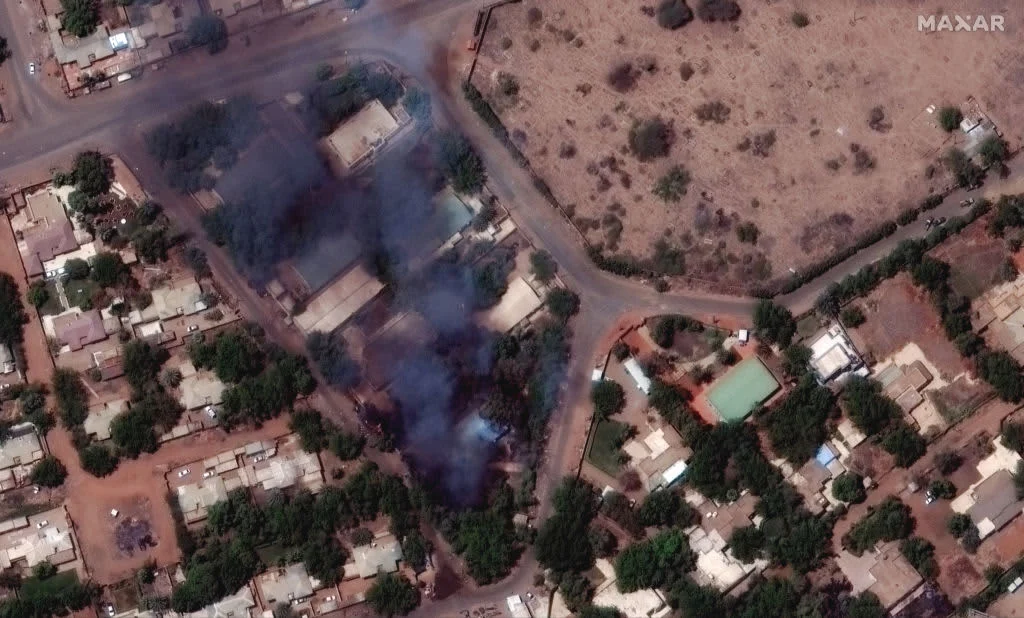
Heavy gunfire and artillery shells shattered a fragile 24-hour truce in Sudan on Tuesday, shortly after the agreement was scheduled to take effect under intense international pressure to pause a conflict that has rapidly descended into a humanitarian catastrophe. Despite the 6:00 p.m. local time (1600 GMT) deadline brokered by the United States to allow for the evacuation of civilians and the delivery of essential supplies, witnesses in the capital, Khartoum, reported that the sounds of war did not cease. Instead, the night sky was illuminated by the flash of explosions, and the roar of fighter jets continued to echo over the metropolitan area, signaling a complete breakdown of the diplomatic effort to halt the bloodshed between the country’s two most powerful military factions.
The conflict, which pits the Sudanese Armed Forces (SAF), led by General Abdel Fattah al-Burhan, against the paramilitary Rapid Support Forces (RSF), commanded by General Mohamed Hamdan Dagalo—widely known as Hemedti—has entered its fourth day of high-intensity urban warfare. The failure of the ceasefire underscores the depth of the animosity between the two leaders, who were once allies in a 2021 military coup but are now locked in a zero-sum struggle for control over Africa’s third-largest nation. United Nations spokesman Stephane Dujarric confirmed the grim reality from New York, stating that the organization had received no indications of a functional halt in hostilities.
Immediate Aftermath of the Failed Truce
Minutes after the ceasefire was meant to begin, live broadcasts from Arab news channels operating in Khartoum were punctuated by the staccato of heavy machine-gun fire and the dull thud of tank rounds. A Reuters correspondent on the ground reported that tanks began firing shortly after the deadline, while residents in the sister city of Omdurman, located across the Nile, described hearing the unmistakable whistle of air strikes. The RSF issued a statement via social media blaming the regular army for the violations, while the SAF countered with claims that the paramilitary group had failed to honor the agreement.
The collapse of the truce has left millions of residents trapped in a city that is fast becoming a graveyard. Satellite imagery provided by Maxar Technologies has captured the extent of the devastation, showing plumes of black smoke rising from the Khartoum International Airport and destroyed fuel depots. In several neighborhoods, military patrols were seen navigating streets littered with debris and burnt-out vehicles. The violence has not been contained to the capital; reports of heavy fighting have emerged from the western Darfur region and several northern cities, suggesting a nationwide escalation that the international community is struggling to contain.
The Humanitarian Catastrophe and Attacks on Aid Workers
The United Nations has warned that the situation in Sudan has reached a breaking point, characterized by the near-total collapse of the healthcare system in the conflict zones. According to the World Health Organization (WHO), at least 185 people have been killed and over 1,800 wounded since the fighting erupted on April 15, though the actual death toll is believed to be significantly higher as many bodies remain in the streets, uncollected due to the ongoing shelling.
Beyond the direct casualties of war, the targeting of humanitarian infrastructure has sparked global outrage. U.N. aid chief Martin Griffiths reported that relief workers are being subjected to targeted attacks, including reports of sexual violence and the looting of U.N. offices in South Darfur. The World Food Programme (WFP) was forced to suspend its operations across the country after three of its employees were killed in the line of duty last Saturday. Furthermore, the European Union’s ambassador to Sudan was assaulted in his own home, and a U.S. diplomatic convoy was fired upon despite being clearly marked with diplomatic plates and American flags. U.S. Secretary of State Antony Blinken described the attack on the convoy as "reckless" and confirmed that while all personnel were safe, the incident highlighted the total disregard for international law by the warring factions.
Chronology of the Crisis: From Transition to Civil War
To understand the current violence, one must look back at the volatile political landscape of Sudan following the 2019 popular uprising that ended the 30-year rule of Islamist autocrat Omar al-Bashir.
- April 2019: Mass protests lead to the ouster of Bashir. A fragile power-sharing agreement is established between civilian leaders and the military.
- October 2021: General Burhan and General Dagalo join forces to lead a military coup, dissolving the civilian government and stalling the democratic transition.
- December 2022: Under international pressure, the military signs a "framework agreement" to return the country to civilian rule, but key details regarding security sector reform remain unresolved.
- Early April 2023: Tensions peak over the timeline for integrating the RSF into the regular army. The SAF demands a two-year integration period, while the RSF insists on a ten-year window.
- April 15, 2023: Fighting breaks out at a military base south of Khartoum and quickly spreads to the airport and the presidential palace.
- April 18, 2023: A U.S.-brokered 24-hour ceasefire fails within minutes of its commencement.
The current conflict is the culmination of months of friction over the future of the RSF. General Dagalo, who rose to power through the Janjaweed militias during the Darfur conflict in the early 2000s, views the integration as an attempt by the traditional military elite to neutralize his power base. Conversely, General Burhan views the RSF as a "rebel militia" that threatens the sovereignty of the state.
Supporting Data: The Economic and Social Toll
Sudan’s economy was already in a state of freefall prior to the outbreak of hostilities, with inflation exceeding 100% and millions requiring food assistance. The war has exacerbated these issues:
- Healthcare: Roughly 70% of hospitals in Khartoum and the surrounding areas are currently non-functional. Many have been bombed, while others have run out of medicine, oxygen, and fuel for generators.
- Infrastructure: The Khartoum International Airport, a vital lifeline for landlocked regions and international aid, remains a primary battleground. Multiple civilian aircraft, including a U.N. plane, have been destroyed.
- Displacement: While official figures are still being compiled, thousands of people have begun fleeing Khartoum for safer provinces or neighboring countries like Chad and Egypt.
- Essential Services: Power and water outages have been reported across the capital for four consecutive days, leaving residents to drink from the Nile or untreated wells, raising fears of a cholera outbreak.
Diplomatic Responses and Regional Stakes
The international community has reacted with a mix of alarm and frantic diplomacy. Secretary of State Antony Blinken, attending the G7 foreign ministers’ meeting in Japan, held separate phone calls with both Burhan and Dagalo. He emphasized that the burden of the ceasefire lay with the generals and that the safety of diplomats and civilians was non-negotiable.
The regional stakes are equally high. Sudan sits at a strategic crossroads, bordering seven countries and holding a significant coastline on the Red Sea. Regional powers, including Egypt, Saudi Arabia, and Ethiopia, have varying interests in the outcome of the conflict. Egypt has traditionally supported the SAF and General Burhan, seeing the regular army as a stabilizing force. Meanwhile, the RSF has cultivated ties with regional actors and has been linked to the Russian mercenary organization, the Wagner Group, which has interests in Sudan’s gold mining sector.
The African Union and the Intergovernmental Authority on Development (IGAD) have called for an immediate cessation of hostilities and have proposed sending a high-level mediation team to Khartoum. However, as long as the airport remains a combat zone and the streets are controlled by snipers, the possibility of face-to-face negotiations remains remote.
Fact-Based Analysis of Implications
The failure of the Tuesday ceasefire suggests that neither side believes it has achieved enough of a tactical advantage to stop fighting. For General Burhan, anything less than the total subjugation of the RSF may be seen as a failure that could lead to his own ouster. For General Dagalo, the conflict is existential; if the RSF is dismantled, he loses his political leverage and potentially his life.
This dynamic points toward a protracted conflict rather than a swift military victory. If the fighting continues, Sudan risks a descent into a full-scale civil war similar to the situations seen in Libya or Syria, where fragmented militias and foreign intervention create a cycle of perpetual instability. The involvement of the Darfur region is particularly concerning, as it could reignite ethnic tensions that have remained beneath the surface since the genocidal violence of the early 2000s.
Furthermore, the collapse of the transition to civilian rule is a devastating blow to the pro-democracy movement that risked everything to overthrow Bashir in 2019. The "Revolutionaries" who once filled the streets of Khartoum are now hiding in their basements, watching as the very generals who promised to protect the transition tear the country apart.
As the international community weighs its next steps, the immediate priority remains the establishment of a "humanitarian corridor." Without a pause in the fighting to replenish food and medical supplies, the death toll from starvation and disease may soon outpace the casualties from bullets and bombs. For now, the people of Sudan remain caught in the crossfire of a power struggle that shows no sign of relenting, as the promises of a 24-hour truce vanish into the smoke of a burning capital.
