

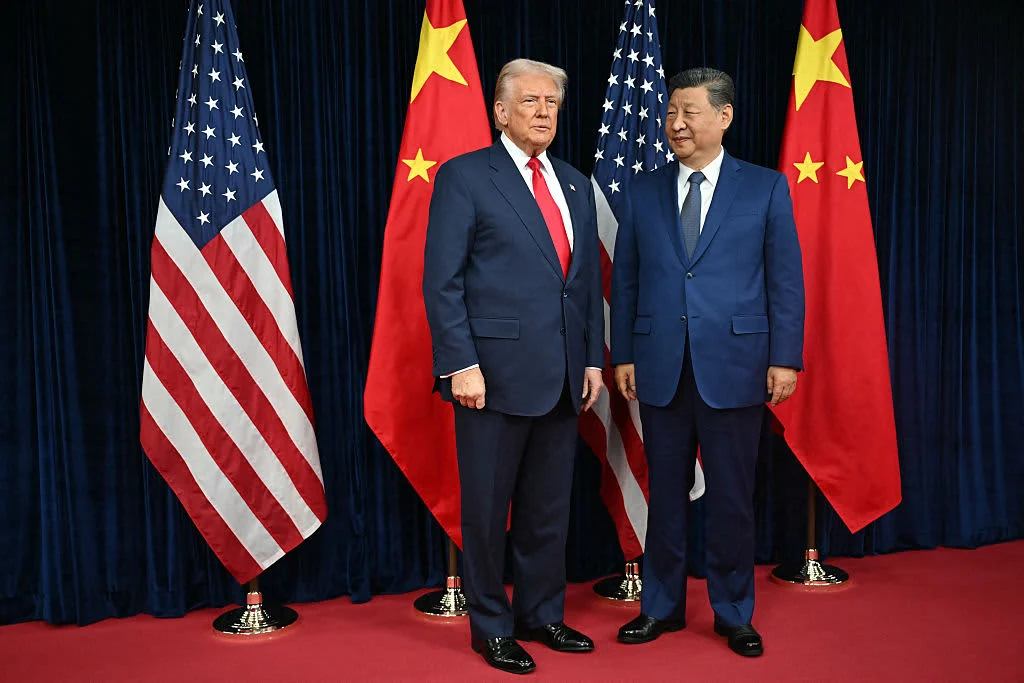
SINGAPORE – U.S. President Donald Trump and China’s President Xi Jinping are set to convene for critical talks in Beijing on Thursday, aiming to de-escalate a bruising trade war that has sent ripples of economic and geopolitical uncertainty across the globe. The agenda for this high-stakes summit is expansive, encompassing a wide array of contentious issues including trade tariffs, technology transfer, China’s control over rare earth mineral exports, the future of Taiwan, the ongoing conflict in Iran, and the burgeoning field of artificial intelligence.
The looming meeting comes at a time of heightened tensions, underscored by recent actions from Beijing. China’s decision to suspend exports of a broad spectrum of rare earth minerals and related magnets, coupled with its ban on semiconductors from Nexperia China, has significantly disrupted global supply chains. These disruptions have had a tangible impact on major industries, particularly global automakers, with far-reaching economic consequences felt across Europe, Japan, and South Korea.
"Virtually everyone has a stake in the outcome of this meeting," remarked Chad Bown, a senior fellow at the Peterson Institute for International Economics, highlighting the pervasive influence of the U.S.-China relationship on the international stage. This sentiment suggests that leaders and stakeholders worldwide will be meticulously observing the proceedings, even from afar, as decisions made in Beijing could reshape the global economic and political landscape for years to come.
The path to this summit has been marked by escalating rhetoric and reciprocal actions. The United States has accused China of engaging in "industrial-scale" campaigns to illicitly acquire American artificial intelligence technology. Conversely, China has retaliated by directing its companies not to comply with U.S. sanctions on Iranian oil and has further solidified its ties with Tehran by hosting Iran’s foreign minister for high-level discussions. The trajectory of the U.S.-China relationship, whether it pivots towards cooperation or further confrontation, carries immense implications for the global economy.
Eswar Prasad, a professor of economics at Cornell University, articulated the global hope for a breakthrough: "The entire world will be hoping that the two leaders can reach agreement on at least a subset of issues…and find ways to prevent any further escalation of tensions on the remaining ones." He further cautioned that the outcome could profoundly impact global trade, geopolitics, and "the very survival of the rules-based order." A contentious summit that exacerbates existing tensions, Prasad warned, could prolong economic and geopolitical volatility, potentially crippling global trade and hindering economic growth worldwide.
The meeting, initially slated for March, experienced a delay due to the escalating conflict involving the United States and Iran, which has precipitated the most severe energy shock in recent history. President Trump has indicated his desire for President Xi to visit Washington later this year, a visit that would mark the Chinese leader’s first trip to the U.S. capital in a decade.
The week leading up to the Beijing summit is expected to be eventful. Top officials, including Chinese Vice Premier He Lifeng and U.S. Treasury Secretary Scott Bessent, are scheduled to meet in South Korea on Wednesday to engage in discussions focused on economic and trade matters. This preliminary meeting aims to ensure that recent escalations, such as U.S. sanctions on Chinese refiners purchasing Iranian crude and Beijing’s unprecedented countermeasures, do not jeopardize the truce that was established in South Korea the previous year. Gabriel Wildau, managing director at political risk advisory firm Teneo, noted the importance of this pre-summit engagement in stabilizing the bilateral economic relationship.
Taiwan: A Flashpoint of Escalating Tensions
Taiwan is poised to be a central and highly sensitive topic on the summit’s agenda, with both the U.S. and China acknowledging its significance. Beijing has reportedly urged the Trump administration to reduce its security commitments to Taiwan and to revise official U.S. policy toward the self-governing island. China considers Taiwan a breakaway province, a claim vehemently rejected by Taiwan’s current ruling Democratic Progressive Party (DPP). For years, China has voiced strong objections to U.S. arms sales to Taipei.
This diplomatic maneuvering follows a high-profile meeting last month where Chinese President Xi Jinping welcomed Cheng Li-wun, the chairwoman of Taiwan’s largest opposition party, the Kuomintang (KMT), to Beijing. During their discussion, Xi reiterated China’s unwavering stance against Taiwanese independence. This engagement subsequently drew criticism from Taiwanese President Lai Ching-te, who warned that "compromising with authoritarian regimes only sacrifices sovereignty and democracy."
Bonnie Glaser, managing director of the Indo-Pacific program at the German Marshall Fund of the United States, stated that any rhetorical softening from President Trump, even if ambiguous, would represent "the most destabilizing outcome" of the summit. Glaser elaborated that a tacit or explicit bargain, wherein Washington appears to concede a sphere of influence to Beijing over Taiwan in exchange for concessions in other areas, could embolden China to adopt more assertive measures to undermine Taiwan’s autonomy.
Reflecting the gravity of the situation, China’s top diplomat, Wang Yi, described Taiwan as "the biggest point of risk" in the bilateral relationship during a call with U.S. Secretary of State Marco Rubio on April 30. Wang urged Washington to "keep its promise and make the right choices to open up new space for China-U.S. cooperation." Secretary Rubio, in turn, acknowledged that "both countries understand that it is in neither one of our interests to see anything destabilizing happen in that part of the world." This exchange underscores the precarious balance surrounding the island’s status.
Southeast Asia’s Precarious Equilibrium
Governments across Southeast Asia will be closely monitoring the summit for any significant shifts in U.S. tariffs on Chinese goods, particularly in relation to tariffs on their own exports. Stephen Olson, a senior visiting fellow at the ISEAS-Yusof Ishak Institute, observed, "If tariff levels on Chinese exports drop, the business rationale for moving production from China to countries like Vietnam will also drop." This indicates that any reduction in trade barriers between the U.S. and China could directly impact the economic competitiveness of Southeast Asian manufacturing hubs.
The Strait of Hormuz also remains a critical concern for the region. Southeast Asian nations, heavily dependent on oil imports from the Persian Gulf, have been disproportionately affected by the energy shock triggered by the ongoing conflict in the Middle East. Officials in Singapore have repeatedly voiced concerns about the economic ramifications and have advocated for unimpeded passage through the Strait. Should Presidents Trump and Xi agree on a joint initiative to ensure the reopening of the Strait, it could provide much-needed near-term relief to the global energy crunch. However, some analysts view such an outcome as a long shot, given the complexities of the regional conflict.
Japan and the EU: Facing Potential Economic Setbacks
The success of the Beijing summit could paradoxically lead to setbacks for Japan and the European Union. Matt Gertken, chief strategist at BCA Research, suggested that a potential energy deal, where Beijing agrees to increase its purchases of U.S. oil and natural gas, could drive up global commodity prices. Furthermore, any progress in trade negotiations, including Chinese commitments to direct investment in the U.S. economy, might result in a displacement of market share currently held by Japanese and European companies. This scenario highlights how U.S.-China trade agreements could inadvertently disadvantage other major economic blocs.
Russia’s Watchful Waiting Game
Moscow will also be keenly observing the outcomes of the Trump-Xi summit, as China’s support has become increasingly vital for Russia. Following the previous in-person meeting between Trump and Xi in October 2025, Russian officials moved swiftly to reaffirm Moscow’s alliance with Beijing, underscoring the geopolitical significance of the U.S.-China dynamic.
Dennis Wilder, a former U.S. intelligence official and professor at Georgetown University, stated, "Russia would be nervous about an overall improvement in U.S.-China relations." He posited that a potential outcome of the summit could be a reduction in China’s support for Russia’s military operations in Ukraine. This observation points to the intricate web of alliances and dependencies that define the current geopolitical landscape. Russian President Vladimir Putin is scheduled to visit Beijing the week after President Trump’s departure, further emphasizing the strategic importance of the Sino-Russian relationship in the context of evolving global power dynamics.
The upcoming summit between President Trump and President Xi Jinping is more than just a bilateral meeting; it is a pivotal moment that could define the future trajectory of the global economy, international relations, and the very fabric of global governance. The world watches with bated breath as these two leaders navigate a complex web of challenges, with the hope that their deliberations will lead to greater stability and cooperation rather than further division and conflict.
