

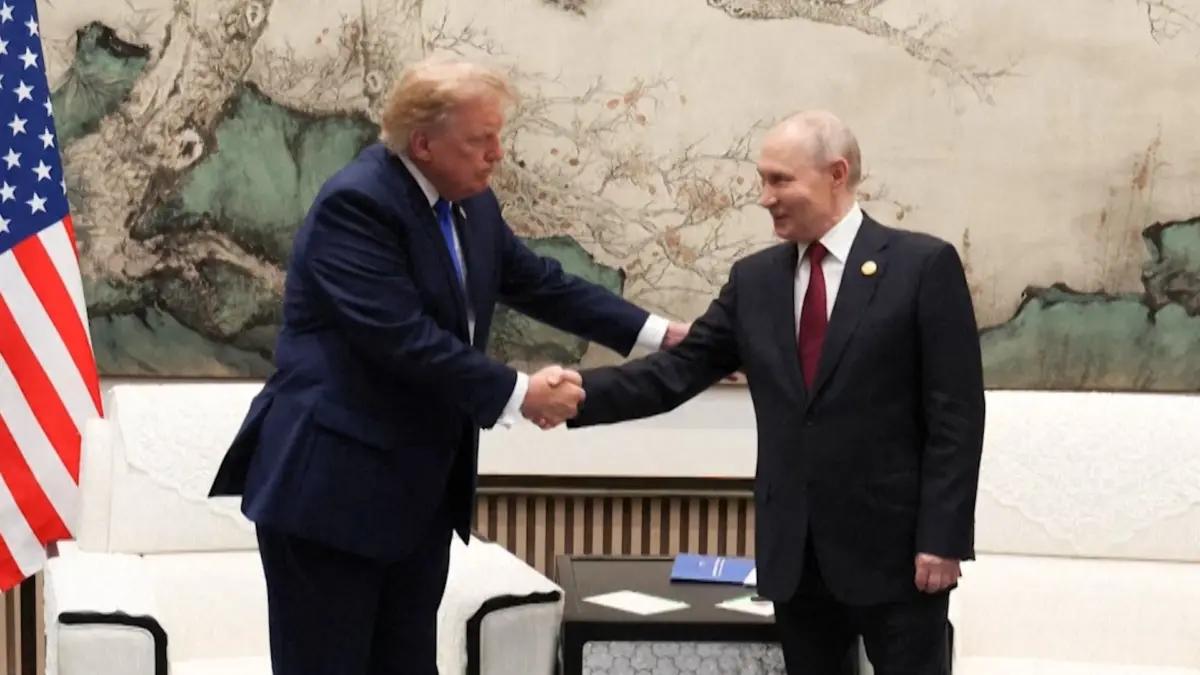
In a moment that immediately captured global attention and ignited a flurry of diplomatic speculation, former U.S. President Donald Trump was observed greeting Russian President Vladimir Putin at the high-profile Belt and Road Forum for International Cooperation in Beijing on November 19, 2026. The brief but potent exchange, punctuated by Trump’s public declaration, "It’s my friend," sent ripples across international media and diplomatic circles, underscoring the enduring complexity of global power dynamics and personal relationships at the highest echelons of influence. The encounter, captured by media outlets covering the extensive Chinese-hosted summit, occurred amidst a backdrop of escalating geopolitical tensions, particularly between the United States, Russia, and China, making the interaction especially resonant.
The Context of the Beijing Encounter
The 2026 Belt and Road Forum for International Cooperation, an ambitious multi-day event hosted by the People’s Republic of China, served as a convergence point for leaders, diplomats, and prominent figures from over 140 nations and 30 international organizations. Held at the state-of-the-art China National Convention Center, the forum’s stated agenda centered on advancing global infrastructure development, trade liberalization, and fostering greater economic interconnectedness under Beijing’s flagship Belt and Road Initiative (BRI). President Xi Jinping opened the forum with a speech emphasizing "shared destiny" and "win-win cooperation," setting a tone of multilateral engagement despite underlying strategic rivalries.
Russian President Vladimir Putin’s attendance was a given, signifying Moscow’s unwavering commitment to its strategic partnership with Beijing, particularly in the face of persistent Western sanctions and diplomatic isolation. Russia has consistently been a key partner in the BRI, leveraging the initiative for energy exports, transit routes, and closer economic integration with Asia. His presence at such a forum is seen as a continuation of efforts to build a multipolar world order less reliant on Western institutions.
The presence of former U.S. President Donald Trump, however, introduced an unexpected and highly scrutinized element into the proceedings. While not representing the current U.S. administration (presumably led by President Joseph Biden or his successor), Trump’s status as a former head of state and a potentially influential figure in future American politics granted him an undeniable platform. Sources indicated that Trump was attending the forum in a private capacity, possibly as an invited guest of a participating delegation or an independent observer with significant global pull, a role that nevertheless carries substantial symbolic weight. His engagement in such a high-stakes diplomatic environment, especially with a leader like Putin, invariably invites intense scrutiny from Washington D.C. and allied capitals.
A History of Personal Diplomacy and its Ramifications
The "It’s my friend" remark immediately drew comparisons to previous interactions between Trump and Putin during Trump’s presidency (2017-2021). Notable among these was their July 2018 summit in Helsinki, Finland, where Trump publicly expressed skepticism about his own intelligence agencies’ findings regarding Russian interference in the 2016 U.S. election, seemingly siding with Putin’s denials. This event, alongside other perceived overtures, frequently fueled accusations from critics that Trump was unduly deferential to the Russian leader and potentially undermined American foreign policy interests.
The history of the U.S.-Russia relationship under various administrations has been a complex tapestry of cooperation and confrontation. Post-Cold War, periods of attempted "reset" under Presidents Clinton and Obama were often followed by increased friction over issues ranging from NATO expansion and human rights to cybersecurity and regional conflicts like Ukraine and Syria. By 2026, the relationship between Washington and Moscow remained profoundly strained, marked by extensive sanctions regimes, diplomatic expulsions, and ideological clashes. The ongoing geopolitical fallout from the prolonged conflict in Eastern Europe, which had by then entered its fourth year, continued to shape the security landscape, with Russia deeply entrenched in its strategic alignment with China.
Trump’s latest public display of camaraderie with Putin, therefore, cannot be viewed in isolation. It feeds into a narrative of personal diplomacy that often diverges from official state-to-state relations, creating potential ambiguities and challenges for the incumbent U.S. administration. Analysts noted that such an interaction, regardless of its official capacity, could be interpreted as sending mixed signals to both allies and adversaries, potentially complicating diplomatic efforts and reinforcing existing perceptions of disunity within the Western alliance.
The Deepening Russia-China Axis: A Strategic Counterweight
The setting for this controversial greeting – a major Chinese-hosted forum – further amplified its significance. By 2026, the strategic partnership between Russia and China had solidified into a robust axis, characterized by deepening economic, military, and geopolitical cooperation. This alliance is increasingly seen as a direct challenge to the U.S.-led liberal international order.
Economically, bilateral trade between Russia and China has witnessed exponential growth in the preceding years. While precise figures for 2026 are still being compiled, projections based on 2025 data suggested trade volumes had exceeded $300 billion annually, largely driven by Russia’s extensive energy exports (oil, natural gas via pipelines like Power of Siberia 1 and 2, and LNG) to China, which in turn supplied Russia with advanced manufacturing goods, electronics, and automotive products. Both nations have also worked assiduously to reduce reliance on the U.S. dollar in bilateral trade, increasingly using their respective national currencies (ruble and yuan) and developing alternative financial messaging systems to circumvent Western sanctions. Data from the Russian Central Bank in late 2025 indicated that over 70% of Russia-China trade was settled in national currencies, a stark contrast to a decade prior.
Militarily, the two powers have engaged in frequent and increasingly sophisticated joint exercises across land, air, and sea. These drills, often conducted in strategic locations such as the Sea of Japan and the South China Sea, aim to enhance interoperability, demonstrate mutual defense capabilities, and project collective strength. Beyond exercises, there has been a notable increase in defense technology sharing, with China reportedly providing advanced surveillance and drone technology, and Russia contributing to China’s aerospace and missile defense programs. This military alignment is underpinned by a shared view of NATO expansion and U.S. Indo-Pacific strategies as existential threats to their respective spheres of influence.
Geopolitically, Moscow and Beijing have consistently aligned their positions on a range of international issues, from challenging Western sanctions and advocating for a reformed United Nations to opposing perceived interference in their domestic affairs. Both countries have championed a vision of a multipolar world where power is distributed among several major poles, rather than concentrated solely in the West. The Belt and Road Forum itself serves as a platform for China to consolidate its influence, offering an alternative development model that bypasses traditional Western financial institutions and regulatory frameworks, an appeal that resonates strongly with Russia and many Global South nations.
Geopolitical Implications and Official Reactions
The encounter in Beijing immediately triggered a cascade of reactions from various stakeholders:
- United States: The U.S. State Department, under the incumbent administration, quickly issued a statement reiterating its official stance on Russia and its commitment to supporting allies against aggression. While carefully avoiding direct criticism of a former president, the statement subtly underscored the importance of unified diplomatic messaging. "The United States’ foreign policy is conducted by the current administration, and our posture towards the Russian Federation remains unchanged: firm in defense of democratic values and international law," a spokesperson stated. Domestically, the reaction was sharply divided. Democratic lawmakers and many foreign policy experts condemned the interaction as undermining current U.S. policy and potentially emboldening adversaries. Senator Maria Rodriguez (D-NY) remarked, "Such displays of personal affection only serve to confuse our allies and play directly into the hands of those who seek to destabilize global peace." Conversely, some Republican factions defended Trump’s right to engage with global leaders, even as a private citizen, and viewed it as a demonstration of his unique diplomatic approach.
- China: As the host nation, China leveraged the optics to its advantage. Chinese state media prominently featured images of the interaction, subtly framing it as an endorsement of China’s diplomatic centrality and its ability to bring together diverse global figures. While Beijing did not issue a direct statement on the greeting itself, Foreign Ministry spokesperson Hua Chunying, in a routine press briefing, emphasized the forum’s role in "fostering dialogue and understanding among nations and influential individuals," indirectly validating Trump’s presence and interaction.
- Russia: For the Kremlin, the encounter was a significant propaganda victory. Russian state television and news agencies widely disseminated clips of the greeting, highlighting Putin’s continued relevance on the global stage despite Western attempts at isolation. The "It’s my friend" remark was particularly emphasized, portraying Putin as a respected figure even among prominent Western politicians. Dmitry Peskov, the Kremlin’s press secretary, commented, "President Putin maintains professional and respectful relations with many global figures. This interaction underscores the importance of direct dialogue, even in challenging times."
- International Observers and Allies: The reaction among U.S. allies, particularly within NATO and the European Union, ranged from concern to cautious observation. Many viewed the incident as further evidence of the internal divisions within the U.S. political landscape regarding its approach to Russia and China. A senior European diplomat, speaking anonymously, expressed apprehension: "Such an event, especially with the former U.S. president, sends a very unsettling message about Western unity and resolve. It makes our collective diplomacy more challenging." Analysts from think tanks across the globe debated whether the interaction signaled a potential shift in U.S. foreign policy should Trump return to office in the future, or if it was merely a characteristic personal gesture.
Economic Undercurrents of the Summit
Beyond the political theater, the Belt and Road Forum itself provided a crucial platform for discussing and shaping global economic trends. The 2026 iteration focused heavily on digital infrastructure, green energy projects, and advanced manufacturing supply chains, alongside traditional infrastructure development. China announced new commitments totaling nearly $100 billion for various BRI projects, with a significant portion earmarked for partners in Southeast Asia, Africa, and Central Asia. The forum also saw discussions around the establishment of new multilateral development banks and investment funds aimed at bypassing Western-dominated financial institutions.
Russia, a major energy supplier and transit country, used the forum to solidify agreements for expanded energy infrastructure, including new gas pipelines and rail links connecting its resource-rich regions to Chinese markets and beyond. Discussions around a "Northern Sea Route" development, jointly promoted by Russia and China, also gained traction, aiming to establish a viable Arctic shipping lane, further diversifying global trade routes. These economic initiatives, while presented as mutually beneficial, are also strategically designed to create a parallel economic order that provides alternatives to the existing global system.
The Road Ahead: Future Scenarios and Enduring Impact
The Beijing greeting between Donald Trump and Vladimir Putin in November 2026 will undoubtedly be remembered as a pivotal moment, symbolizing the complex, multi-layered nature of 21st-century international relations. Its implications could reverberate for years to come.
If Donald Trump were to consider another presidential run, the interaction would inevitably become a point of contention in his campaign, forcing a debate on his approach to foreign policy and his relationships with leaders perceived as adversaries by the current U.S. establishment. It would highlight the enduring influence of personal connections in high-stakes diplomacy, irrespective of official titles.
More broadly, the incident underscores the challenges facing Western alliances in presenting a united front against perceived threats. The perception of internal divisions or contradictory messaging from influential figures can be exploited by rival powers, potentially weakening the efficacy of collective sanctions or diplomatic pressures. The deepening Russia-China axis, exemplified by their joint participation and agenda at the Belt and Road Forum, will continue to be a defining feature of the global landscape, necessitating a careful and coordinated strategic response from democratic nations.
Ultimately, the brief, seemingly casual greeting and the potent phrase "It’s my friend" transcended a simple handshake. It served as a stark reminder of the intricate dance of power, personality, and geopolitics that continues to shape our world, offering a glimpse into a future where traditional alliances and diplomatic norms are constantly being tested and redefined.
