

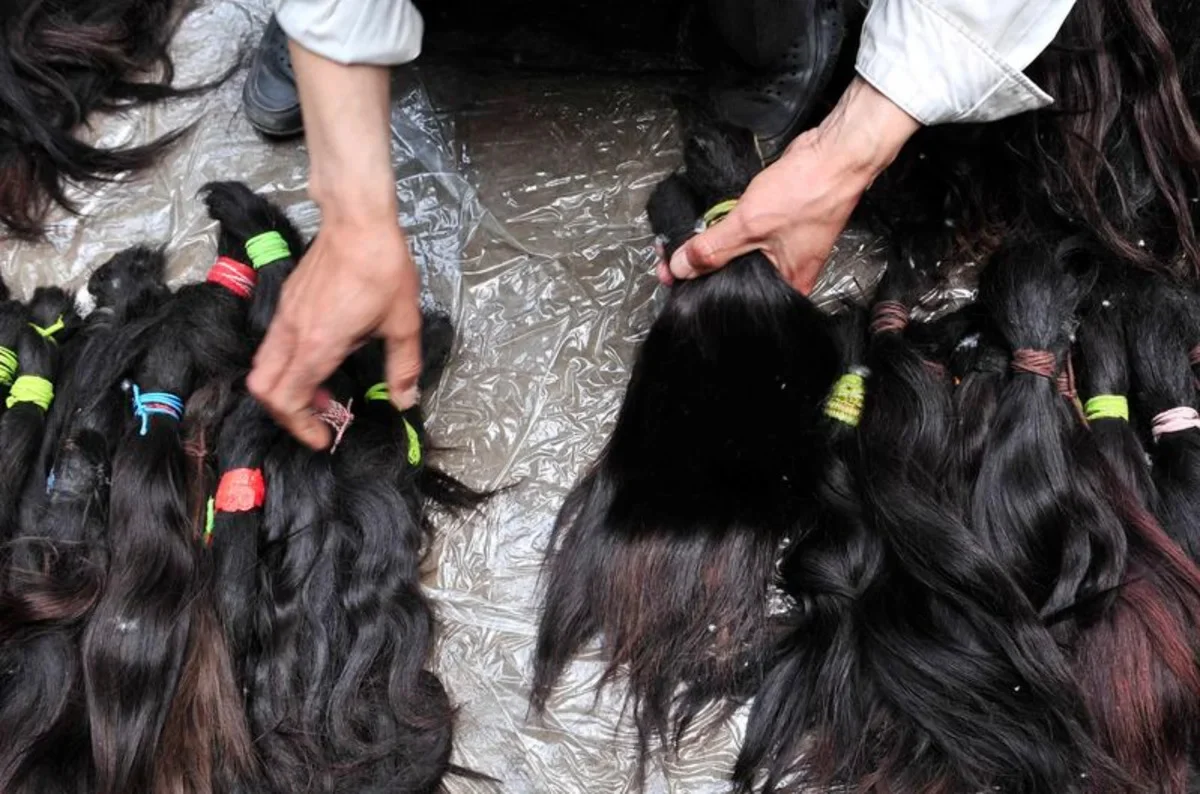
SINGAPORE/LIANYUNGANG, China – In a striking demonstration of China’s enduring manufacturing prowess, sales of Chinese-made beauty accessories, ranging from pre-bleached straight hair wigs to wavy clipped extensions and elaborate coffin-shaped press-on nails, are experiencing an unprecedented surge across the United States. This boom in a seemingly non-strategic sector unfolds against a backdrop of heightened friction over soaring Chinese exports of high-profile items like electric vehicles and advanced batteries, a central theme in ongoing presidential summits and bilateral trade discussions. The flourishing beauty accessory market offers a nuanced lens through which to examine China’s complex role in the global economy, highlighting its capacity to dominate diverse market segments through scale, efficiency, and rapid adaptation to consumer trends.
The phenomenon is not merely an anecdotal observation but a statistically significant trend. Joe Wu, an exporter based in Xuchang, a central Chinese city renowned as the world’s wig capital, anticipates a remarkable 40% growth in his sales this year. This robust expansion is predominantly fueled by American buyers, whose purchasing decisions are increasingly influenced by viral trends and direct marketing through popular social media platforms such as TikTok and Instagram. Customs data corroborates this upward trajectory, revealing that China’s exports of hair products to the US climbed by 12.4% year-on-year in the first half of 2026, reaching a staggering $1.3 billion. If this pace continues, shipments are on track to comfortably surpass the full-year figure of $2.3 billion recorded in 2025, positioning hair products as one of the fastest-growing export categories, alongside more conventional goods like computer parts, scooters, and plastic items.
While specific customs data for artificial nails, which are typically categorized under broader plastic products, remains elusive, industry sentiment unequivocally points to a similar boom. Zhang Da, who owns a 200-worker press-on nail factory in Donghai, an eastern county known for its burgeoning nail industry, reported a dramatic shift in his business model. Exports now account for 70% of his total revenue this year, a significant leap from just 20% in late 2025, with US sales constituting a substantial portion of this growth. These figures underscore not only the surging demand but also China’s unparalleled ability to scale production to meet the capricious whims of global fashion and beauty markets.
The Evolving Landscape of US-China Trade Relations
The current surge in beauty accessory exports provides a fascinating counterpoint to the broader narrative surrounding US-China trade. For several years, economic relations between the two global powers have been characterized by increasing tension, marked by tariffs, sanctions, and intense competition, particularly in strategic sectors deemed critical for national security and technological leadership. Discussions at presidential summits frequently revolve around imbalances in trade, intellectual property theft, and the perceived threat of Chinese state-backed enterprises. Against this backdrop, the robust performance of what might be considered "lower-value-added" goods like wigs and nails offers a different perspective on China’s economic footprint.
Historically, the US has been a significant market for a vast array of Chinese-manufactured goods, a relationship that deepened after China’s accession to the World Trade Organization (WTO) in 2001. This era saw the establishment of complex global supply chains, with China becoming the "world’s factory" due to its competitive labor costs, sophisticated infrastructure, and vast production capacity. While the focus has recently shifted towards reducing dependency on China for critical goods, the beauty accessory market demonstrates the enduring strength and adaptability of Chinese manufacturing, even in sectors not directly targeted by strategic trade policies. The underlying economic principle remains: China possesses a unique capacity to produce quality goods at scale and speed, meeting consumer demand worldwide.
Chronology of a Market Dominance: From Local Craft to Global Trendsetter
The journey of Chinese beauty accessories from local craft to global market dominance is a story of industrial evolution, technological adoption, and market responsiveness.
- Early Foundations (Pre-2000s): The roots of China’s wig industry, particularly in Xuchang, stretch back decades, building on traditional hair processing techniques. Initially, these industries served domestic markets or niche international segments. The focus was often on raw hair material export or basic wig manufacturing.
- Globalization and Mass Production (2000s-Early 2010s): With China’s entry into the WTO and the subsequent liberalization of trade, manufacturers in Xuchang and other hubs began to scale up operations significantly. They leveraged cost advantages and an abundant labor force to become major suppliers to international brands and distributors. The product range expanded to include synthetic wigs, extensions, and hairpieces, catering to a broader, more price-sensitive global audience. This period saw the establishment of efficient supply chains, enabling Chinese factories to quickly process raw materials, manufacture, and export.
- The E-commerce Revolution (Mid-2010s): The proliferation of global e-commerce platforms like Alibaba, eBay, and later Amazon, provided Chinese manufacturers with direct access to international consumers. This disintermediation allowed them to bypass traditional importers and retailers, offering competitive pricing and a wider variety of products. This era also saw the rise of specialized online stores and dropshipping models, further accelerating market penetration.
- The Social Media Catalyst (Late 2010s-Present): The advent and explosive growth of visual social media platforms like Instagram, Pinterest, and especially TikTok, proved to be a game-changer for the beauty accessory market. These platforms democratized fashion and beauty trends, empowering influencers and everyday users to showcase diverse styles. Celebrities and social media personalities frequently change their hairstyles and nail art, creating a rapid cycle of trends that Chinese manufacturers are uniquely positioned to capitalize on. Their ability to quickly design, produce, and ship trendy items at affordable prices has made them indispensable to the "fast beauty" phenomenon, where consumers seek to replicate looks seen online without a significant financial commitment. The direct marketing power of these apps, combined with the efficiency of Chinese logistics, creates a seamless path from trend identification to consumer purchase.
Deep Dive into Data and Market Dynamics
The data on hair product exports is particularly illuminating. The projected $2.3 billion for 2025 and the $1.3 billion in the first half of 2026 represent a consistent and accelerating growth trajectory. To put this in perspective, prior to 2020, annual exports of hair products from China to the US typically hovered around $1.5 billion to $1.8 billion. The significant jump past the $2 billion mark, with continued strong growth, indicates a fundamental shift in consumer behavior and market penetration, largely driven by the social media-fueled demand.
While precise figures for artificial nails are integrated into broader plastic product categories, the anecdotal evidence from manufacturers like Zhang Da provides a strong proxy. His factory’s shift from 20% to 70% export revenue in less than a year, with a large chunk destined for the US, suggests a market potentially even more dynamic than hair products. The sheer volume implied by thousands of businesses dedicated to press-on nails in a single county, like Donghai, points to an industrial ecosystem capable of producing billions of units annually. This segment benefits from low production costs, ease of customization, and the disposable nature of many press-on nail designs, aligning perfectly with fast fashion principles.
The underlying factors driving this demand in the US are multifaceted:
- Affordability: Chinese-made beauty accessories are generally more affordable than their domestically produced or salon-service counterparts, making them accessible to a broader consumer base.
- Variety and Customization: Manufacturers offer an unparalleled range of styles, colors, and designs, often customizable to individual preferences or emerging trends.
- Ease of Access: The widespread availability through online retailers and social media-driven commerce platforms makes purchasing these products incredibly convenient.
- Trend Responsiveness: Chinese factories are adept at rapidly identifying and replicating viral trends, ensuring that consumers can quickly access the latest styles.
- Quality Improvement: While historically some "Made in China" products faced quality concerns, continuous investment in manufacturing processes and materials has significantly improved the quality and durability of many beauty accessories, enhancing their appeal.
The "Problem for the World?" – Analysis and Implications
Dan Wang, the China director of Eurasia Group, succinctly captured the broader implications of China’s manufacturing dominance, even in seemingly niche markets. She posits that Beijing occupies "a unique historical position" where it effectively leverages scale and continuous product upgrades to dominate global markets across both advanced industrial goods and lower value-added commodities. Wang’s observation, "It is not just competing with the industrial products of one or two countries, it is competing with all industrial products globally," presents a profound challenge for other nations rather than for China itself. The conclusion that "It is going to be very difficult to see China’s advantage replaced for many years to come" underscores the formidable nature of this economic reality.
The implications of this pervasive manufacturing strength are far-reaching:
- Economic Impact on Competing Nations: For developing countries striving to build their own manufacturing bases, China’s efficiency and scale create an almost insurmountable barrier to entry in many sectors. Even developed nations with niche beauty industries find it challenging to compete on price or speed of innovation. This can lead to deindustrialization in certain sectors or force other countries to focus on highly specialized, premium segments.
- Labor Force Concentration and Specialization: The sheer concentration of labor in specific industrial clusters is a defining characteristic of China’s manufacturing model. In Xuchang, approximately 300,000 of a 4.4 million population are engaged in the hair industry. Similarly, Donghai, a county of 1 million, hosts nearly 25,000 press-on nail businesses. This hyper-specialization fosters deep expertise, continuous innovation within the sector, and highly efficient supply chains. However, it also creates an economic monoculture that can be vulnerable to shifts in global demand or trade policies. Replicating such an immense, specialized, and cost-effective labor force elsewhere is exceedingly difficult, if not impossible, in the current global economic climate.
- Geopolitical Ramifications: While beauty accessories are not strategic military hardware, the aggregate economic power derived from dominating diverse global markets contributes significantly to China’s overall geopolitical influence. It reinforces its position as an indispensable link in global supply chains, giving it leverage in international relations and economic negotiations. The continued reliance of major consumer markets like the US on Chinese-manufactured goods, even non-strategic ones, complicates efforts to "decouple" or significantly reduce economic ties.
- Sustainability and Ethical Considerations: The rapid, high-volume production inherent in the fast beauty sector raises important questions about sustainability and ethical manufacturing. Concerns often include labor practices in factories, the environmental impact of material sourcing and waste generation (especially for synthetic products and single-use items), and potential intellectual property infringements as designs are rapidly replicated. While not explicitly mentioned in the original article, these are critical considerations for consumers and policymakers in importing countries.
Official Responses and Industry Perspectives
From the perspective of Chinese government and trade bodies, the surge in beauty accessory exports is likely viewed as a validation of their economic development strategies. It demonstrates the resilience and adaptability of Chinese manufacturing, its ability to diversify exports beyond traditional heavy industries, and its successful integration into global consumer markets. Such growth underscores the effectiveness of industrial clusters and the nation’s capacity to meet evolving global demand, thereby contributing to overall economic stability and employment.
For US trade officials and policymakers, the situation presents a nuanced challenge. While the primary focus remains on strategic sectors where competition is perceived as a national security or economic threat, the continued influx of consumer goods from China contributes to the overall trade deficit. However, the affordability and variety of these products also benefit American consumers. The dilemma lies in balancing consumer access to affordable goods with broader economic policy goals of fostering domestic manufacturing and reducing trade imbalances. It is plausible that while the official rhetoric may focus on higher-profile disputes, the underlying reality of widespread consumer reliance on Chinese imports remains a persistent factor in bilateral relations.
US beauty industry and retailers often operate in a complex relationship with Chinese manufacturers. Many major brands source components or finished products from China due to cost efficiencies and production capabilities. Smaller businesses and online retailers directly import and re-brand Chinese products. While domestic manufacturers might face intense competition, the overall beauty market in the US is vast, and Chinese imports fill a specific niche, particularly in the fast-fashion beauty segment, allowing US businesses to focus on premium, niche, or domestically produced alternatives.
Consumer advocacy groups and organizations focused on fair trade and ethical sourcing may raise concerns regarding labor conditions in Chinese factories, the environmental footprint of production, and the authenticity of product claims. As the market grows, scrutiny over the supply chain for these products is likely to intensify, pushing for greater transparency and accountability.
Conclusion
The burgeoning market for Chinese-made beauty accessories in the United States offers a compelling snapshot of China’s indelible mark on the global economy. It underscores not only the nation’s unparalleled manufacturing capacity but also its extraordinary ability to adapt to and capitalize on new market dynamics, particularly those driven by the rapid cycles of social media trends. This success story, unfolding amidst broader geopolitical trade frictions, serves as a powerful reminder of China’s enduring economic leverage. While discussions around strategic industries and trade imbalances will continue to dominate headlines, the everyday reality for millions of consumers and businesses globally is inextricably linked to the efficiency and scale of Chinese production. As Dan Wang observed, China’s advantage in manufacturing, even in the seemingly unassuming realm of wigs and press-on nails, is profoundly difficult to replace, solidifying its position as a central pillar of the global industrial landscape for the foreseeable future. Future trends may see increased automation in Chinese factories, further diversification of product lines, and potentially greater scrutiny over ethical sourcing, but the fundamental dominance of China’s manufacturing sector remains a defining feature of the 21st-century global economy.
