

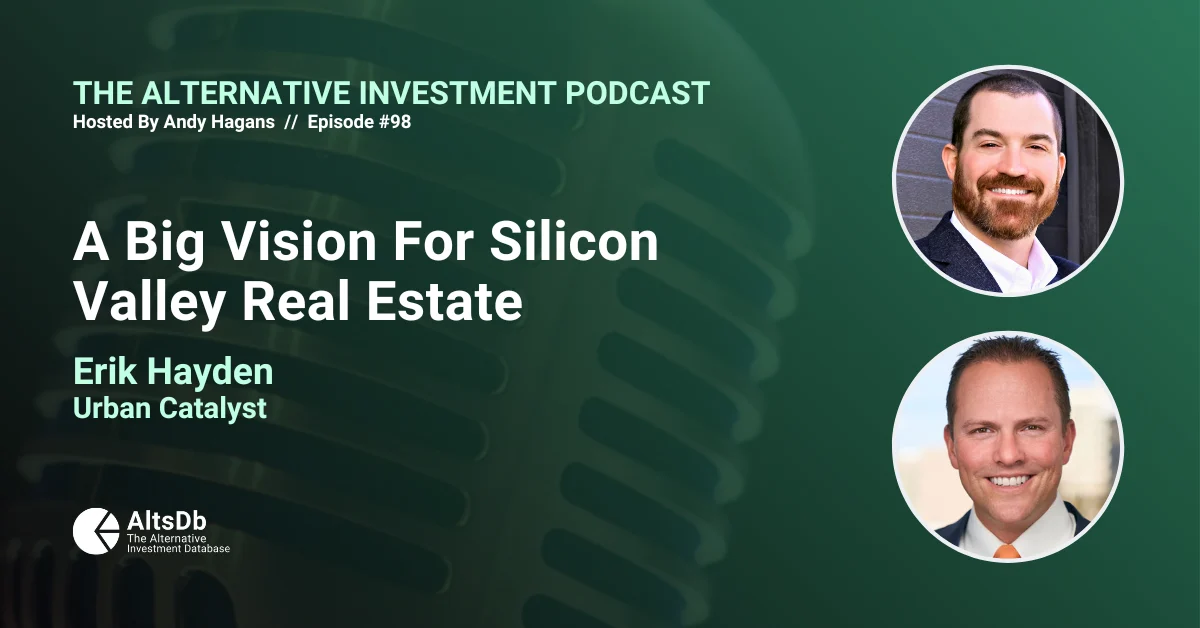
Erik Hayden, founder of Urban Catalyst and a recognized figure among Silicon Valley’s most influential individuals, recently shared his optimistic outlook on the region’s real estate market, asserting its potential for sustained growth over the coming decades. Speaking on "The Alternative Investment Podcast," Hayden detailed how strategic real estate investments in Silicon Valley can generate generational wealth for long-term investors, challenging the prevailing "doom and gloom" narrative that sometimes surrounds California’s property sector.
Urban Catalyst, a real estate equity fund and development firm, has established itself as a prominent player, particularly within the Opportunity Zones initiative. Hayden, a seasoned developer with extensive experience in ground-up construction across the San Francisco Bay Area, founded Urban Catalyst in 2018. The firm specializes in acquiring, owning, managing, and developing existing and new real estate assets.
The Strategic Shift Towards San Jose
Hayden’s vision for Urban Catalyst was deeply rooted in his observation of the evolving tech landscape in Silicon Valley. He noted that while cities like Palo Alto, Menlo Park, and Mountain View serve as the traditional hubs of technological innovation, their limited physical size restricts large-scale expansion. This led to a noticeable migration trend southward, with significant development activity initially concentrating in Sunnyvale. As Sunnyvale neared build-out, Hayden identified downtown San Jose as the next logical frontier for tech company expansion.
"We saw the light switch turning on in downtown San Jose from a ground-up development perspective," Hayden explained. "This was mainly because of the overall tech migration trends throughout Silicon Valley. If Palo Alto, Menlo Park, and Mountain View are kind of the center of the tech universe, they’re not really very big cities. So we’ve seen a lot of expansion."
His foresight proved accurate, as major tech corporations like Google, Apple, and Meta have since acquired land, opened offices, and announced substantial expansion plans in San Jose. While other developers also recognized this potential, Urban Catalyst’s established relationships with property owners allowed them to secure prime locations before the development boom fully materialized.
The Opportunity Zone Advantage: A Strategic Tool, Not a Driver
Crucially, Hayden emphasized that Urban Catalyst’s focus on San Jose was driven by fundamental real estate fundamentals rather than solely by the Opportunity Zone program. "We wanted to be in San Jose, and San Jose was also an Opportunity Zone, and we became an Opportunity Zone fund, and it’s been working out pretty great for us," he stated. The Opportunity Zone initiative, established by the Tax Cuts and Jobs Act of 2017, offers tax incentives for investments in designated low-income communities. By aligning their development projects with these zones, Urban Catalyst provided its investors with additional tax benefits alongside the potential for significant returns.
Navigating the Startup Landscape: Risk and Reward
Launching a company, particularly in a high-cost environment like California, presents inherent risks. Hayden addressed this by highlighting the capital required for initial operations and acquisitions. Urban Catalyst’s sponsor-level funding began with approximately $4.5 million, primarily sourced from friends and family who believed in Hayden’s track record. This initial capital was crucial for covering essential startup costs, including legal fees for creating offering documents, leasing office space, and negotiating contracts.
"We raised around $4.5 million dollars. That was just to start us up, get the lights on and get everything going," Hayden recounted. "And that was mainly friends and family money for me. We didn’t use any, you know, venture money or large equity groups. It was friends and family money. Folks that believed in me, knew my track record, knew I was gonna put everything I had into it."
He contrasted the perceived risk of entrepreneurship with the security of employment, arguing that both carry uncertainties. However, as a business owner, one retains control over decision-making and the direction of the company.
A Bold Vision from the Outset
Hayden’s approach to entrepreneurship at Urban Catalyst was characterized by a grand vision from its inception. Unlike some entrepreneurs who build incrementally through serial ventures, Hayden aimed to establish a significant entity from the start. This philosophy is reflected in the scale of Urban Catalyst’s projects, with Hayden noting that his average building size throughout his career has been around $100 million. He drew a parallel to the growth of major firms like Blackstone, which launched with a substantial fund, suggesting that the effort required to manage a $20 million fund versus a $2 billion fund is conceptually similar, with the primary difference being the scale of capital involved.
Pioneering Digital Marketing in Real Estate Fundraising
Urban Catalyst also distinguished itself by its innovative approach to fundraising. Eschewing the traditional reliance on broker-dealers and registered investment advisors, the firm embraced digital marketing channels such as Google, LinkedIn, and Facebook to reach individual investors directly. This strategy, implemented under the SEC’s 506(c) regulations, proved highly effective, enabling Urban Catalyst to raise $50 million in its first year. This digital-first approach was a significant departure from industry norms and has since been emulated by others.
"We went out with the new 506(c) rules, under SEC regulations. They’re about 10 years old now. And we raised money directly from investors. And raising money directly from investors, in our first year, we raised $50 million, and we did it through a way that a lot of folks had never tried, which, of course, is digital marketing, using Google, LinkedIn, Facebook, all that stuff, to drive investors to our website, investors form fill, and then our investor relations team will call them and talk to them about their situations," Hayden explained.
This direct engagement fostered not only capital but also built a strong brand identity. Hayden recognized that this approach, combining direct marketing with storytelling, created significant brand equity, a value that transcends individual fund offerings. The firm’s consistent media presence, with over 250 mentions in local and national publications over five years, further amplified this brand-building effort, generating what he termed "earned media" – invaluable publicity that cannot be purchased.
Challenging California’s "Doom and Gloom" Narrative
Hayden directly addressed the common perception of California real estate as a declining market. He countered this by presenting data showcasing California’s economic prowess, noting that in 2021, if it were an independent country, it would rank as the world’s fourth-largest economy, surpassing Germany. Silicon Valley, in particular, experienced a historic year in 2021, with more companies going public and receiving venture capital funding than in any previous year, even surpassing the dot-com era.
"If California was its own country, we just became the fourth-largest economy in the world. We just took over Germany. So that’s kind of the type of economic capital that we bring to the world stage," Hayden highlighted.
He also debunked the narrative of mass exodus from California, pointing out that while some residents have relocated, the state’s population growth has historically been robust, driven significantly by international immigration. He noted that in 2021, Menlo Park, a city of 45,000 people, received more venture capital funding than the entire state of Texas.

San Jose: A Booming Metropolis Facing Housing Challenges
San Jose, a focal point of Urban Catalyst’s strategy, was recently ranked as the most expensive big city to live in the United States and the fourth most expensive globally, with median home prices between $1.6 and $1.7 million. This housing crisis, characterized by a severe mismatch between job creation and housing supply—six jobs created for every housing unit built over 30 years—stems from stringent regulatory environments that impede new construction.
"We have six jobs for every housing unit that we’ve built for over 30 years straight," Hayden stated. "Our population grows exactly as fast as we build new housing, and we don’t build new housing fast, because of the regulatory environment here in California."
Despite these challenges, the City of San Jose’s planning and economic development departments have been lauded by Hayden for their proactive approach to facilitating urban development, particularly in the downtown core. This local support is critical in navigating California’s complex development landscape, which can be notoriously anti-development in other municipalities.
Urban Catalyst’s Opportunity Zone Fund II Projects
Urban Catalyst’s current offering, Opportunity Zone Fund II, encompasses four distinct projects designed to diversify risk and capitalize on San Jose’s growth trajectory:
- Echo: A high-rise multi-family development featuring approximately 400 units.
- Icon: A substantial 500,000-square-foot office building.
- Keystone Hotel: A 172-key Marriott Townplace Suites, which is already under construction.
- Gifford Place: A senior living facility offering assisted living and memory care services.
The inclusion of diverse asset classes, from residential and hospitality to office and senior living, provides a strategic hedge against market fluctuations. The office sector, in particular, has faced scrutiny, but Hayden noted that Silicon Valley’s market has remained resilient, with strong demand from major tech firms.
The Google Effect: A Catalyst for Downtown Development
A significant driver for Urban Catalyst’s projects is the proximity to Google’s transformative "Downtown West" campus. This $19 billion, 10-year development project aims to create 7 million square feet of office space and 6,000 residential units, positioning it as Google’s largest campus globally. The integration of this massive undertaking into the urban fabric is expected to generate substantial positive synergy for surrounding developments.
"We have three projects that are literally hundreds of yards away from it. Our office is six blocks away from it, so a lot of real positive synergy with what they’re doing," Hayden remarked, underscoring the strategic advantage of their project locations.
Addressing the Office Market Concerns
While headlines have often painted a bleak picture for office real estate, Hayden offered a nuanced perspective on the Silicon Valley market. He pointed out that the region maintained a strong office market even during the pandemic, with significant transactions and record-high prices for existing spaces. Although a slight decrease in rents and a modest increase in vacancy rates have been observed, the market has not experienced the drastic downturn seen elsewhere.
Hayden also provided data on recent tech layoffs, suggesting they have been significantly smaller relative to the hiring surge during the pandemic. He noted that major tech companies are consolidating their operations within Silicon Valley, with layoffs concentrated elsewhere. For instance, Google, despite laying off 12,000 employees globally, only let go of 1,600 in Silicon Valley, where it holds 18 million square feet of office space. Similarly, Microsoft and Meta’s layoffs in the region were comparatively minor. Apple, notably, has not engaged in layoffs and has recently leased additional office space, indicating continued confidence in the region.
"The labor market is still very tight," Hayden observed. "The unemployment rate in Silicon Valley is now at 2%… we actually have more jobs now than we had six months ago, despite all the layoffs and headlines."
Expansion into Delaware Statutory Trusts (DSTs)
Urban Catalyst is also expanding its offerings with a new Delaware Statutory Trust (DST) product. This move represents a strategic diversification beyond their core Opportunity Zone development projects in San Jose. The inaugural DST focuses on an industrial property in Dallas, Texas, a market known for its robust growth and demand for industrial assets.
"Delaware Statutory Trust, I mean, it fits right in our wheelhouse. Tax-advantaged real estate. That is what we do here at Urban Catalyst," Hayden stated. He explained that DSTs offer investors a tax-advantaged way to invest in real estate, aligning with Urban Catalyst’s expertise in tax-advantaged investment vehicles.
The choice of an industrial property in Dallas was deliberate. Industrial real estate, along with multi-family, is a common asset class for DSTs due to its potential for rent growth. Urban Catalyst’s strategy emphasizes a net lease structure with built-in rent escalations, providing a predictable income stream and a clear exit strategy for investors. The Dallas-Fort Worth metroplex boasts a growing population and is a major hub for industrial activity, with strong historical rent growth.
"We wanted to go into a net lease environment, where we could have built-in rent increases into our leases," Hayden elaborated. "And so that’s what we found here with this property that we have. We have a 10-year lease, 3% built-in rent increases."
The chosen property is strategically located within the city of Dallas, between Dallas and Fort Worth, and is in close proximity to the Dallas-Fort Worth International Airport, a critical factor for industrial logistics. The submarket has experienced a remarkable 14% year-over-year increase in industrial rents, underscoring the strong underlying demand.
Hayden concluded by reinforcing Urban Catalyst’s commitment to strategic, data-driven investment, stating, "We like to say, we like to do business based on a business plan, not on speculation. And that is what we do, but it is nice to have a little speculation in your back pocket that it’s gonna be a strong rental growth in the market itself over time as well."
For investors seeking to learn more about Urban Catalyst’s strategies and investment opportunities, the firm can be found at urbancatalyst.com.
