

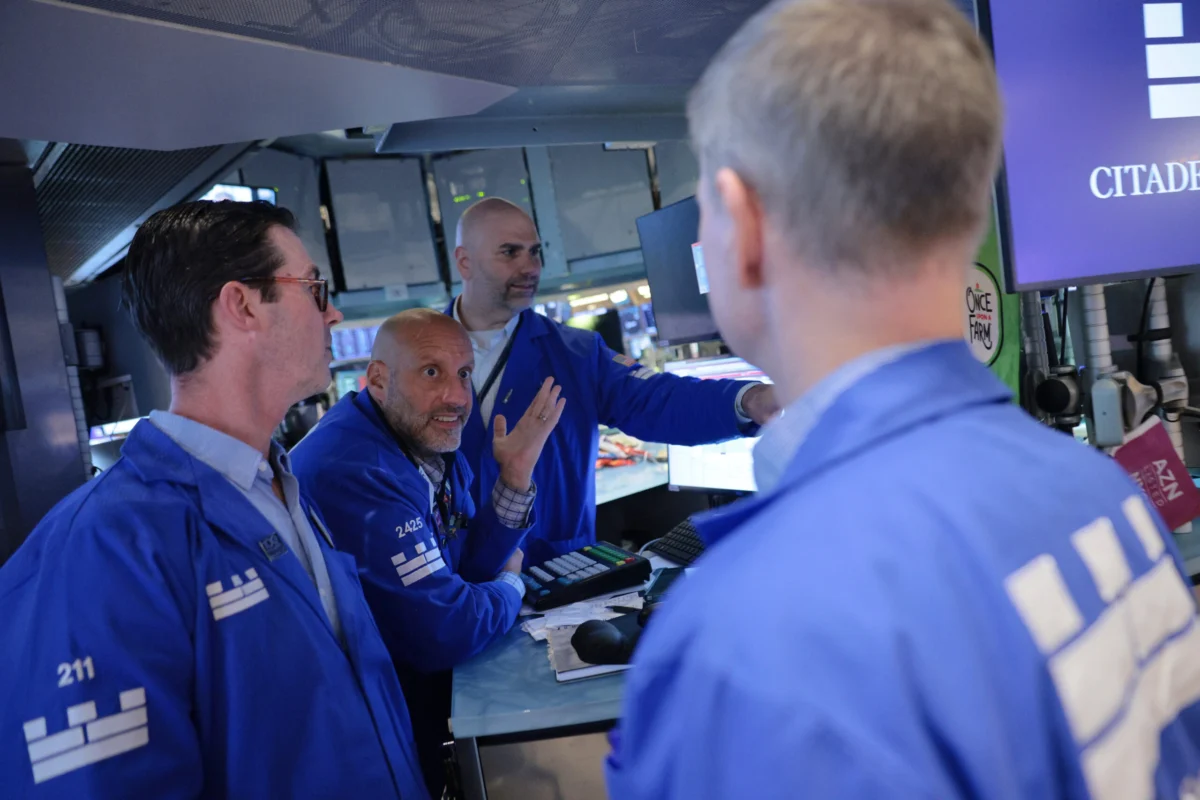
The global financial landscape witnessed a significant shift on Monday as the Nasdaq Composite climbed to a new record close, propelled by a revitalized surge in artificial intelligence (AI) equities and a cooling of macroeconomic pressures. The market’s momentum was further bolstered by a major breakthrough in the media sector, where a landmark settlement cleared the path for the $110 billion merger between Paramount Skydance and Warner Bros. Discovery. These developments, coupled with evolving regulatory debates over AI safety and a high-stakes legal battle over White House press access, have set a complex tone for the final quarter of 2026.
The AI-Driven Market Rally and Macroeconomic Context
Equity markets surged during Monday’s trading session, with the S&P 500 recording its strongest daily performance since early August. The primary catalyst for this upward trajectory was the continued dominance of the semiconductor and artificial intelligence sectors. Shares of Intel, AMD, and Qualcomm saw substantial gains as investors rotated capital back into high-growth tech stocks. This renewed interest in AI-related names comes amid a broader cooling of inflationary pressures, evidenced by a notable decline in both crude oil prices and U.S. Treasury yields.
The decline in yields has provided much-needed relief to the tech sector, which is traditionally sensitive to borrowing costs. As the 10-year Treasury yield retreated, market participants gained confidence in the Federal Reserve’s ability to navigate a "soft landing" for the economy. Analysts suggest that the convergence of lower energy costs and stabilizing interest rates is creating a favorable environment for capital expenditure in digital infrastructure, particularly as enterprises race to integrate generative AI into their core operations.
Media Consolidation: The Paramount Skydance and Warner Bros. Discovery Merger
In a move that is expected to redefine the entertainment and news industry, Paramount Skydance reached a definitive settlement on Monday with a coalition of state attorneys general. The settlement effectively ends an antitrust challenge that threatened to derail the company’s $110 billion merger with Warner Bros. Discovery (WBD). Previously, the legal dispute was slated for trial in the spring of 2027, a delay that analysts estimated could have cost Paramount hundreds of millions of dollars in breakup fees and legal expenses.
Key Terms of the Settlement
California Attorney General Rob Bonta, a leading figure in the antitrust challenge, confirmed that the agreement includes several concessions designed to protect domestic labor and consumer choice. Under the terms:
- Production Commitments: Paramount has pledged to increase its domestic production quotas, ensuring that a significant portion of its content creation remains within the United States.
- Theatrical Releases: The merged entity has agreed to specific parameters for theatrical releases, aimed at preserving the traditional cinema experience against the tide of direct-to-streaming shifts.
- Editorial Independence: In a move to address concerns regarding the concentration of media power, the company will establish an independent board to oversee the editorial integrity of CBS News and CNN.
Paramount CEO David Ellison informed employees via an internal memo that the deal is now on track to close within approximately two weeks. This merger will create a media behemoth with unprecedented reach across broadcast news, sports, and cinematic intellectual property, though it remains under the watchful eye of federal regulators who are monitoring the long-term impact on advertising markets.
The Regulatory Battle Over Artificial Intelligence
As the private sector pushes the boundaries of machine learning, the debate over AI governance has reached a fever pitch. OpenAI, the organization behind some of the world’s most advanced large language models, released a comprehensive set of safety and security proposals on Monday. The document calls for "global cooperation" to establish standardized safety protocols for "frontier models"—AI systems that exceed the capabilities of currently available technology.
OpenAI’s proposals focus heavily on "alignment research," the science of ensuring AI systems act in accordance with human intent, and "recursive self-improvement," a theoretical stage where AI can autonomously upgrade its own code. This move follows CEO Sam Altman’s recent public support for a strategic slowdown in certain areas of development to allow safety frameworks to catch up with technical progress.
Divergent Political Perspectives
However, the path to regulation is fraught with political tension. Treasury Secretary Scott Bessent, speaking on CNBC’s "Squawk Box," took a hardline stance against the tech industry’s request for a "liability shield." Bessent argued that AI developers must take full responsibility for the societal and economic impacts of their products rather than seeking federal protection from litigation.
Simultaneously, President Donald Trump addressed the issue through social media, stating that the Department of Justice and other law enforcement agencies would "rein in AI" if necessary. Despite this warning, the President also labeled some of the more dire warnings about AI’s existential risks as a "hoax," suggesting that the administration may prioritize American dominance in the AI arms race over restrictive safety mandates.
Press Freedom and the White House Conflict
The relationship between the executive branch and the media reached a new low on Monday as the White House television press pool suspended its coverage. The protest was triggered by the administration’s decision to ban CNN from serving as the designated pool reporter during President Trump’s trip to New York for the United Nations General Assembly.
The "press pool" is a long-standing institution designed to ensure that a small group of journalists monitors the President’s movements at all times, sharing their reports with the broader media community. By banning CNN—the outlet assigned to the rotation—the White House effectively disrupted the established protocol for transparent governance.
In response, CNN, MS NOW, and Politico filed a joint lawsuit against the President to overturn the ban, citing First Amendment violations. A federal judge has scheduled the first hearing for Wednesday afternoon. Legal experts suggest that this case could have profound implications for how future administrations manage media access, particularly as the definition of "journalistic neutrality" becomes a central point of political contention.
The GLP-1 Revolution: Eli Lilly’s Market Dominance
In the healthcare sector, the explosion of the GLP-1 (glucagon-like peptide-1) market continues to drive significant revenue for pharmaceutical giants. Eli Lilly CEO Dave Ricks revealed in an exclusive interview that 700,000 new Medicare beneficiaries have started GLP-1 treatments for obesity since coverage was expanded in July 2026.
Market Share and Manufacturing
According to Ricks, Eli Lilly currently captures 70% of the Medicare-based GLP-1 market. The company is also seeing rapid adoption of its oral obesity medication, Foundayo, which now accounts for one-third of all new GLP-1 pill prescriptions.
- Manufacturing Expansion: To meet this unprecedented demand, Lilly is ramping up operations at its new high-tech manufacturing facility in Houston, Texas.
- Competitive Landscape: While Eli Lilly holds a commanding lead in the U.S. Medicare segment, it remains in a fierce global battle with Novo Nordisk, the maker of Wegovy and Ozempic. The shift toward oral versions of these drugs is seen as the next major frontier in the multi-billion-dollar weight-loss industry.
Ricks expressed long-term confidence in the company’s ability to scale, noting that the transition from injectable to oral administration will significantly lower the barriers to entry for patients who were previously hesitant to use needles.
Political Finance: The MAGA Inc. War Chest
The intersection of finance and politics was highlighted by the latest Federal Election Commission (FEC) filings. MAGA Inc., the primary super PAC supporting President Trump, reported a $12 million increase in its cash reserves for the month of August. This influx of capital suggests that high-net-worth donors remain committed to the administration’s "America First" economic agenda, despite the ongoing legal and regulatory battles.
As the 2026 midterm elections approach, the financial health of such political action committees serves as a bellwether for institutional support. The heavy concentration of wealth in these PACs continues to influence policy discussions around corporate taxation, trade tariffs, and the deregulation of the energy sector.
Analysis of Broader Economic Implications
The events of this week underscore a period of profound structural change in the American economy. The record-breaking performance of the Nasdaq reflects a market that is increasingly decoupled from traditional industrial metrics, relying instead on the promise of AI-driven productivity gains. However, the regulatory uncertainty surrounding AI, combined with the consolidation of media power through the Paramount-WBD merger, suggests that the "Wild West" era of tech and media may soon face a more rigid institutional framework.
For investors, the primary takeaway is the resilience of the tech sector in the face of political volatility. While the White House’s conflict with the press and the Treasury’s refusal to grant liability shields create a noisy headlines environment, the underlying fundamentals—falling yields, strong pharmaceutical demand, and massive media M&A—point toward a market that is aggressively positioning itself for a technology-centric future. The coming weeks will be critical as the Paramount deal closes and the judicial system weighs in on the limits of executive power over the press.
