

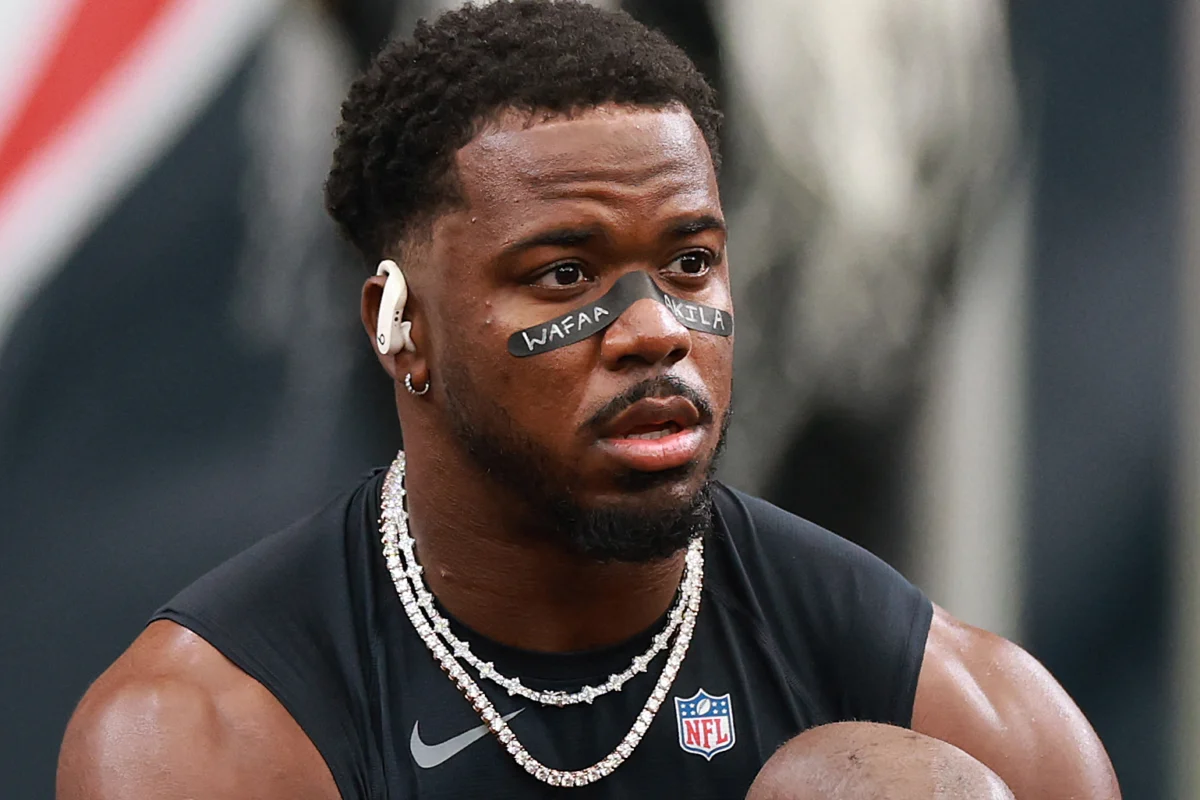
American football player Azeez Al-Shaair has steadfastly continued his public stance on raising awareness about Palestinian children killed in the ongoing conflict, most recently by wearing eye black bearing the name of Wafaa Akila, an eight-year-old girl, during a recent National Football League (NFL) game. This act of protest comes despite having previously incurred a significant fine for similar displays, underscoring a growing tension between athlete activism and league regulations.
The Houston Texans’ linebacker was seen with the black tape across his nose, emblazoned with "Wafaa Akila," during a game against the Cincinnati Bengals on Sunday. This public demonstration followed an earlier incident where Al-Shaair wore the name of five-year-old Hind Rajab on his eye black during a September 13 match against the Buffalo Bills. That initial act led to an $11,941 fine from the NFL, which cited a breach of the league’s code of conduct regarding players’ clothing and equipment. The league’s rules strictly prohibit personal messages, political statements, or commercial branding on uniforms and equipment that are not officially sanctioned.
Chronology of Activism and Repercussions
Azeez Al-Shaair’s journey of advocacy has been building over recent months, establishing a clear pattern of using his prominent platform to highlight the humanitarian crisis in Gaza. His activism began to draw significant attention during the NFL’s previous season. In January, Al-Shaair was fined for displaying the message "Stop The Genocide" on his nose tape. While the message did not explicitly name a conflict, it was widely interpreted as a reference to the escalating situations in Gaza and Sudan, where calls for international intervention against alleged genocidal actions were gaining traction. This early fine served as a precursor to the more recent, specific displays.
The current season saw Al-Shaair escalate his personal protest. On September 13, during a game against the Buffalo Bills, he wore eye black bearing the name "Hind Rajab." This action directly contravened the NFL’s established guidelines, which aim to maintain a neutral and consistent appearance across all players and teams, preventing any individual from using their uniform for unsanctioned messaging. The immediate consequence was the aforementioned $11,941 fine, a penalty designed to deter such breaches.
However, the financial penalty did not deter Al-Shaair. In a notable show of solidarity, nine-time NBA All-Star Kyrie Irving publicly offered to pay the fine for Al-Shaair. Al-Shaair later confirmed that he had been in communication with Irving, signaling a broader network of support among professional athletes for such causes. When speaking to reporters last week about the fine, Al-Shaair dismissed its financial implications, stating, "It’s bigger to me; what’s a life worth? Is a life worth $11,000? No, I think it’s priceless." This statement clearly articulated his belief that the moral imperative of his message far outweighed any monetary cost imposed by the league.
His resolve was further demonstrated in his first match appearance since being fined. Taking the field with "Wafaa Akila" written on his eye black, a common adhesive or paint used by NFL players primarily to reduce glare, Al-Shaair reiterated his commitment to honoring the children affected by the conflict. This consistent and defiant stance has placed him at the center of a burgeoning debate about athlete activism, freedom of expression, and the responsibilities of professional sports leagues.
The Children Behind the Names: Wafaa Akila and Hind Rajab
The names Azeez Al-Shaair has chosen to emblazon on his eye black are not arbitrary; they represent specific, tragic casualties of the conflict in Gaza, giving a human face to the devastating statistics. Wafaa Akila, an eight-year-old girl, was killed on September 6, the very first day of her school year. She was traveling with her father in an Israeli attack in western Gaza when their car was struck by an Israeli drone as they were making their way home. The vehicle was left burned and charred, with only a few pages of Akila’s school books reportedly surviving the horrific incident. Hours before her death, a smiling Akila had posed for a photo, excited for her first day of school, a poignant image that has since circulated widely.
Akila’s death mirrors the tragedy of Hind Rajab, aged five, whose story gained international attention earlier in the year. Hind was killed in Gaza on January 29, 2024, after Israeli soldiers reportedly opened fire on her family’s stranded car. Her final moments were chillingly documented in a phone call with the Palestine Red Crescent Society (PRCS), which captured her desperate pleas for help. This audio recording, along with the circumstances of her death, became the subject of an Oscar-nominated docudrama, bringing her story to a global audience and highlighting the profound human cost of the conflict.
These individual stories are part of a much larger, horrifying reality in Gaza. The Israeli military operations in the region have led to an unprecedented humanitarian catastrophe, with children disproportionately bearing the brunt of the violence. According to the Palestinian Ministry of Health in Gaza, at least 21,500 children have been killed since October 7, 2023. This staggering figure represents a significant portion of the total fatalities, which human rights organizations and international bodies continue to track and report. Beyond direct casualties, the conflict has severely limited access to education for the Strip’s approximately 660,000 children. Reports indicate that over 90 percent of schools have been damaged or completely destroyed, dismantling the educational infrastructure and robbing an entire generation of their right to learn and build a future. The psychological trauma endured by surviving children, many of whom have witnessed unimaginable violence, lost family members, or been displaced multiple times, is a crisis that will impact the region for decades.
Al-Shaair’s decision to name these specific children is a deliberate act to personalize the abstract numbers and bring the plight of Gaza’s children directly onto the highly visible stage of professional sports. On Sunday, he further amplified Wafaa Akila’s story by sharing posts about her and her mother’s reaction to the killing on his Instagram account, leveraging social media to extend the reach of his message beyond the football field.
NFL’s Stance and Code of Conduct
The National Football League maintains a stringent code of conduct regarding player attire and equipment, primarily aimed at upholding uniformity, brand integrity, and avoiding unsanctioned commercial or political messaging. Rule 5, Section 4, Article 1 of the NFL Rulebook, pertaining to "Prohibited Statements," generally restricts players from displaying personal messages or political statements on their uniforms, equipment, or eye black. The league argues that such rules are necessary to prevent distractions, maintain a professional image, and ensure that the focus remains on the game itself, rather than individual political or social commentary.
Historically, the NFL has enforced these rules with varying degrees of consistency, often drawing criticism from players and advocacy groups. While the league permits certain pre-approved campaigns, such as those for breast cancer awareness or military appreciation, individual expressions on sensitive political or social issues are typically met with fines. This policy has been a source of ongoing tension, particularly in an era where athletes are increasingly using their platforms to speak out on matters they deem critical.
The fine levied against Al-Shaair for displaying "Hind Rajab" falls squarely within the established parameters of these rules. The league views such messages, regardless of their intent or the gravity of the issue they highlight, as violations of its uniform policy. This stance puts the NFL in a challenging position, balancing its desire for neutrality and corporate control with the growing expectation for public figures, including athletes, to engage with pressing societal issues. The league’s enforcement, therefore, is not necessarily a judgment on the content of Al-Shaair’s message but rather on the act of unsanctioned display itself.
Freedom of Expression vs. League Policy: A Broader Debate
The situation with Azeez Al-Shaair is not an isolated incident but rather a microcosm of a larger, ongoing debate in professional sports concerning athletes’ freedom of expression versus league policies. This tension has been evident across various sports and countries, highlighting the complex intersection of sports, politics, and social justice.
Historically, athletes have used their platforms to advocate for change, from Jackie Robinson breaking the color barrier in baseball to Tommie Smith and John Carlos’s iconic protest at the 1968 Olympics. In more recent times, figures like Colin Kaepernick, whose kneeling during the national anthem to protest racial injustice sparked a nationwide controversy and effectively ended his NFL career, have brought this issue to the forefront. The NBA, while generally seen as more progressive on player activism, has also faced challenges, particularly in navigating international relations when players speak out on geopolitical issues.
Critics of strict league policies argue that professional athletes, as influential public figures, have a moral right and even a responsibility to use their visibility to draw attention to critical social and humanitarian causes. They contend that stifling such expressions is an attempt to depoliticize sports in an inherently political world, and that it prioritizes corporate branding over fundamental human rights. Supporters of Al-Shaair often point to the immense suffering in Gaza and argue that the gravity of the situation warrants an exception or a re-evaluation of rigid uniform policies. They highlight that the league permits other forms of personal expression or advocacy, suggesting an inconsistency in what is deemed acceptable.
Conversely, sports leagues and their proponents argue that uniform policies are essential for maintaining order, preventing the alienation of fans with differing political views, and ensuring that the focus remains on athletic competition. They emphasize that professional sports are entertainment businesses that rely on broad appeal, and that allowing unrestricted political messaging could lead to a fragmented fan base, sponsor backlash, and a chaotic visual environment on the field. The argument is often made that players have ample opportunities off the field to express their views without violating league rules. However, activists counter that the impact of a message delivered during a live televised game is far greater than one made in a press conference or on social media.
This ongoing tug-of-war reflects a societal shift where consumers and fans increasingly expect organizations and public figures to take stances on social issues. The NFL, like other major leagues, finds itself in a precarious position, attempting to navigate these evolving expectations while maintaining its traditional structures and business interests.
Reactions, Support, and Broader Implications
Azeez Al-Shaair’s actions have garnered significant attention and polarized reactions. His steadfastness has been widely praised by human rights advocates, Palestinian solidarity groups, and many within the Muslim community. Prominent American Muslim scholar Omar Suleiman has repeatedly voiced his strong support for Al-Shaair, highlighting the player’s commitment beyond just wearing eye black. Suleiman wrote in a social media post on Sunday, "My brother, who went to Jordan to be with Palestinian refugees this summer, who spends time with Palestinian children with missing limbs in Houston, who is using every week of his Pro Bowl NFL career to honour a Palestinian child despite the fines." He urged others to emulate such activism, stating, "In the sports and entertainment arenas run by many of the same types of people who run government, choose to be like Azeez Al-Shaair, Kyrie, and Macklemore."
The explicit mention of Kyrie Irving, who offered to pay Al-Shaair’s fine, and rapper Macklemore, who has also been outspoken on Palestinian rights, underscores a growing, albeit sometimes controversial, network of artists and athletes willing to risk professional repercussions for their activism. Indeed, the context of Al-Shaair’s fines aligns with broader pressures observed in the entertainment industry. Robert Kraft, owner of the New England Patriots and a vocal pro-Israel billionaire, recently confirmed that he pressured pop star Ed Sheeran to drop rapper Macklemore from his tour of the United States due to Macklemore’s advocacy for Palestine. This incident illustrates the powerful financial and political forces that can be brought to bear against those who speak out on such sensitive geopolitical issues.
Following the Texans’ match against the Bengals, a social media video circulated showing Al-Shaair interacting with children on the sidelines. Some of these children were seen sporting keffiyehs, traditional Palestinian scarves, while others were amputees holding posters in support of the player. This imagery powerfully conveyed the direct impact of Al-Shaair’s message and the resonance it has with communities deeply affected by the conflict or sympathetic to its victims.
The broader implications of Al-Shaair’s actions are multi-faceted. Firstly, it challenges the NFL to re-examine its policies in an era of heightened social consciousness. The league faces increasing pressure to balance its corporate image with the moral convictions of its players. Secondly, it elevates awareness of the humanitarian crisis in Gaza to a mainstream American audience, leveraging the immense viewership of the NFL. While the league may fine Al-Shaair, the very act of the fine and the subsequent media coverage amplify the message he seeks to convey. Lastly, it reinforces the role of athletes as influential figures capable of shaping public discourse, inspiring others to speak out, and providing a platform for the voiceless, even at personal financial cost. The financial penalty, while significant, is portrayed by Al-Shaair and his supporters as a small price to pay for highlighting what they view as a critical human rights issue.
As the conflict in Gaza continues and the humanitarian crisis deepens, it is likely that athletes like Al-Shaair will continue to use their visibility to advocate for change, pushing the boundaries of what is permissible within the tightly controlled environment of professional sports. His ongoing defiance serves as a potent symbol of principled activism in the face of institutional pressures, ensuring that the stories of children like Wafaa Akila and Hind Rajab do not fade into obscurity.
