

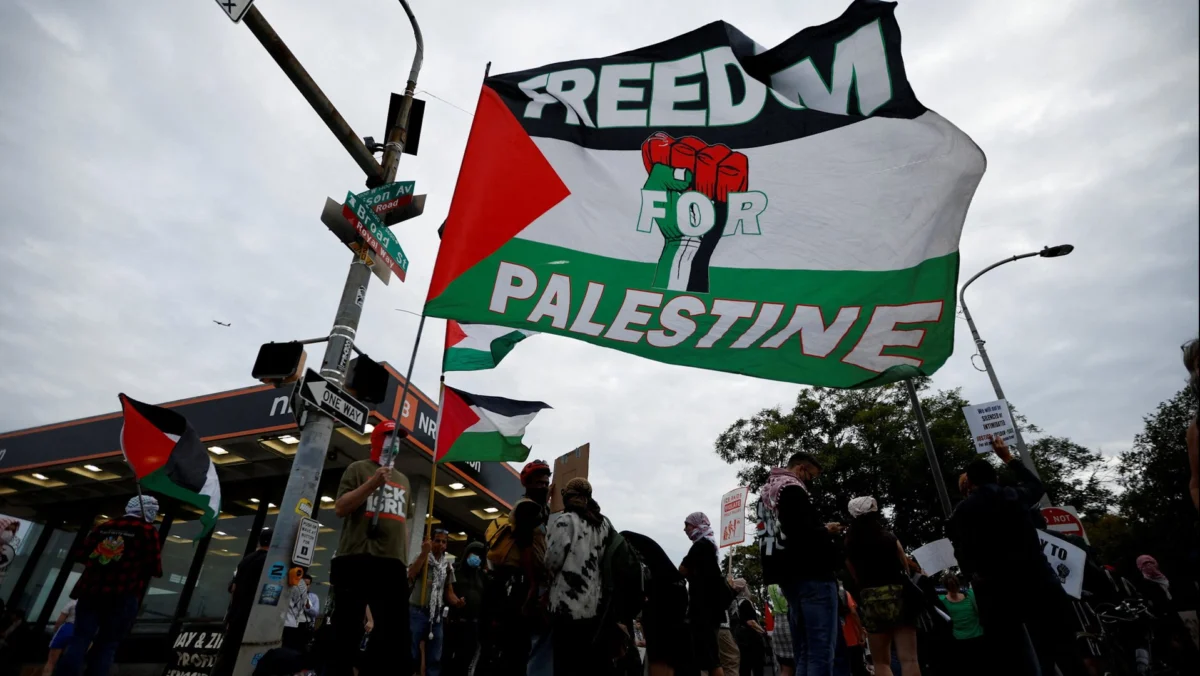
The intersection of global politics and the international music industry reached a boiling point in Philadelphia on Sunday evening as hundreds of pro-Palestine demonstrators gathered outside the venue hosting global pop star Ed Sheeran. The protest, which took place on September 20, 2026, was catalyzed not only by the ongoing geopolitical tensions in the Middle East but specifically by the recent and controversial removal of American rapper Macklemore from Sheeran’s high-profile United States tour. As fans lined up for the sold-out performance, they were met with a sea of flags, chants, and placards demanding accountability from the music industry regarding the perceived silencing of artists who speak out on international human rights issues.
The demonstration in Philadelphia serves as a significant milestone in a summer characterized by increasing pressure on A-list celebrities to leverage their platforms for political advocacy. While Sheeran has traditionally maintained a neutral public persona focused on his musical output, the decision to distance his tour from Macklemore—an artist who has become a vocal figurehead for the Palestinian cause in the arts—has thrust the British singer-songwriter into a polarizing debate over censorship, corporate influence, and the ethics of the entertainment business.
The Philadelphia Demonstration: A Detailed Account
Beginning in the late afternoon, hours before Sheeran was scheduled to take the stage, various activist groups converged on the sidewalk surrounding the arena. The crowd, estimated by local law enforcement to be between 800 and 1,200 participants, was composed of a diverse coalition of local residents, university students, and disillusioned music fans. The atmosphere was described as tense but largely peaceful, with a heavy police presence cordoning off the main entrances to ensure the safety of concertgoers and protesters alike.
Demonstrators utilized megaphones to broadcast messages criticizing Sheeran’s management team and the tour’s promoters. Key slogans included "Art is Political," "No Music on Stolen Land," and "Justice for Macklemore." Many protesters held signs that juxtaposed Sheeran’s lyrics with images of the humanitarian crisis in Gaza, arguing that the "calculated neutrality" of the music industry is a form of complicity.
Security measures at the venue were significantly heightened in anticipation of the event. Reports from inside the stadium suggested that while the concert proceeded as planned, the presence of the protest outside was palpable, with some fans reporting that the chants could be heard during quieter acoustic sets. Despite the disruption, there were no immediate reports of violence or arrests, as the demonstration remained within the designated "First Amendment zones" established by the Philadelphia Police Department.
Chronology of the Controversy: From Collaboration to Conflict
The rift between the two artists began in early 2026 when Ed Sheeran announced his "Global Unity" stadium tour, with Macklemore initially billed as one of the primary opening acts for the North American leg. The pairing was initially seen as a commercial powerhouse, blending Sheeran’s massive pop appeal with Macklemore’s loyal fan base.
However, the professional relationship began to fray in the summer of 2026 following Macklemore’s release of "Hind’s Hall 2," a sequel to his 2024 protest anthem. The track, which directly criticized Western governments and the military-industrial complex for their roles in the Middle East, became a viral sensation and a rallying cry for the Boycott, Divestment, Sanctions (BDS) movement.
- May 2026: Macklemore performs at a major international festival, delivering an impassioned 10-minute speech calling for an immediate ceasefire and the end of the occupation.
- July 2026: Reports surface of "creative differences" and "scheduling conflicts" between Sheeran’s management and Macklemore’s team.
- August 15, 2026: An official statement is released by the tour promoters, AEG Presents, confirming that Macklemore would no longer be appearing on the tour. The statement cited "logistical challenges" but provided no further details.
- August 20, 2026: Macklemore takes to social media, suggesting that his removal was a direct result of his political activism. He stated, "The price of a conscience should not be your career, but I would pay it again a thousand times over."
- September 2026: Protests begin appearing at every stop of Sheeran’s tour, culminating in the large-scale demonstration in Philadelphia.
Industry Data and the Economic Impact of Celebrity Activism
The controversy comes at a time when the music industry is grappling with the financial implications of social and political engagement. According to a 2026 report by the Global Entertainment Analytics (GEA), approximately 62% of Gen Z and Millennial music consumers believe that artists have a moral obligation to speak out on social justice issues. Furthermore, the report found that 45% of these demographics have actively boycotted a brand or artist based on their political stance or lack thereof.
In the case of the Sheeran tour, ticket resale markets have shown a volatile trend. Data from platforms like StubHub and SeatGeek indicated a 15% drop in average resale prices in the week following Macklemore’s removal, as some fans sought to offload their tickets in protest. Conversely, primary ticket sales remained strong, highlighting a divide between the activist-minded segment of the audience and the general public.
Corporate sponsorship also plays a critical role. Major tours of this magnitude are often backed by multinational corporations that prefer to avoid controversial topics to protect their brand image across diverse global markets. Analysts suggest that the pressure to remove Macklemore may have originated from high-level sponsors concerned about potential boycotts or negative associations with the rapper’s outspoken rhetoric.
Statements and Reactions from Involved Parties
While Ed Sheeran has not issued a direct personal statement regarding Macklemore’s removal, a representative for his management team released a brief comment following the Philadelphia protest. "Ed has always believed that music should be a space for everyone to come together," the statement read. "The changes to the tour lineup were made for purely operational reasons to ensure the best possible experience for our fans across the country. We respect the right to peaceful protest and the expression of all viewpoints."
In contrast, the organizers of the Philadelphia protest, including members of the "Artists for Palestine" collective, were far more pointed in their assessment. "By removing Macklemore, Ed Sheeran and his promoters have sent a chilling message to every artist in the industry: stay quiet or stay home," said Sarah Al-Kouri, a spokesperson for the demonstration. "We are here to show that the audience will not accept the sanitization of art. You cannot sing about love and humanity on stage while silencing those who stand up for human rights outside the stage door."
Macklemore himself has remained active on the front lines of the movement. On the night of the Philadelphia concert, he was reportedly attending a separate fundraising event for humanitarian aid in the Middle East. Sources close to the rapper suggest he is considering a solo "Justice Tour" to provide a platform for other artists who have faced similar professional repercussions for their activism.
Broader Implications for the Future of Live Entertainment
The events in Philadelphia are indicative of a broader shift in how live entertainment is consumed and critiqued in the mid-2020s. The "neutral artist" model, which was the industry standard for decades, is increasingly under threat from a more socially conscious and interconnected global audience.
This incident also highlights the "vetting" process that now occurs behind the scenes of major tours. Legal experts in the entertainment sector note that "morality clauses" and "reputational risk" segments in artist contracts are becoming more specific, often granting promoters the right to terminate agreements if an artist’s public statements are deemed detrimental to the commercial interests of the tour. This has led to concerns among civil liberties advocates about the erosion of free speech within the arts.
Furthermore, the Philadelphia protest underscores the power of local activism to disrupt global narratives. Even for an artist as successful as Ed Sheeran—who has broken numerous records for tour attendance and revenue—the persistent presence of protesters creates a narrative that complicates the marketing of the tour as a "unifying" event.
Analysis: The Cost of Neutrality in a Polarized Era
The backlash against Sheeran highlights a difficult reality for modern superstars: in a hyper-polarized world, silence is often interpreted as a statement in itself. For Sheeran, whose brand is built on being relatable, kind, and universally appealing, the Macklemore controversy represents a significant PR challenge. The perception that he—or his team—prioritized corporate comfort over the principle of artistic freedom has alienated a segment of his core audience.
From a strategic perspective, the decision to remove Macklemore may have been intended to minimize controversy, but it has ironically achieved the opposite. By turning the tour into a focal point for the BDS movement and free-speech advocates, the promoters have ensured that every city on the itinerary will now be a site for political debate rather than just a musical performance.
As the tour moves toward its next stops in New York and Boston, industry observers will be watching closely to see if the protests grow in size or if Sheeran eventually addresses the situation directly. For now, the "Global Unity" tour remains a stark example of the friction between the multi-billion-dollar music industry and the grassroots movements demanding that art reflect the struggles of the real world.
The demonstration in Philadelphia was not just about two musicians; it was a testament to the evolving expectations of the public. In 2026, the stage is no longer just a platform for entertainment—it is a battlefield for the soul of the culture, where every chord struck and every voice silenced carries weight far beyond the walls of the arena.
